

From First DUI to Death Penalty



Are DUI Checkpoints Legal in Florida? (2026)


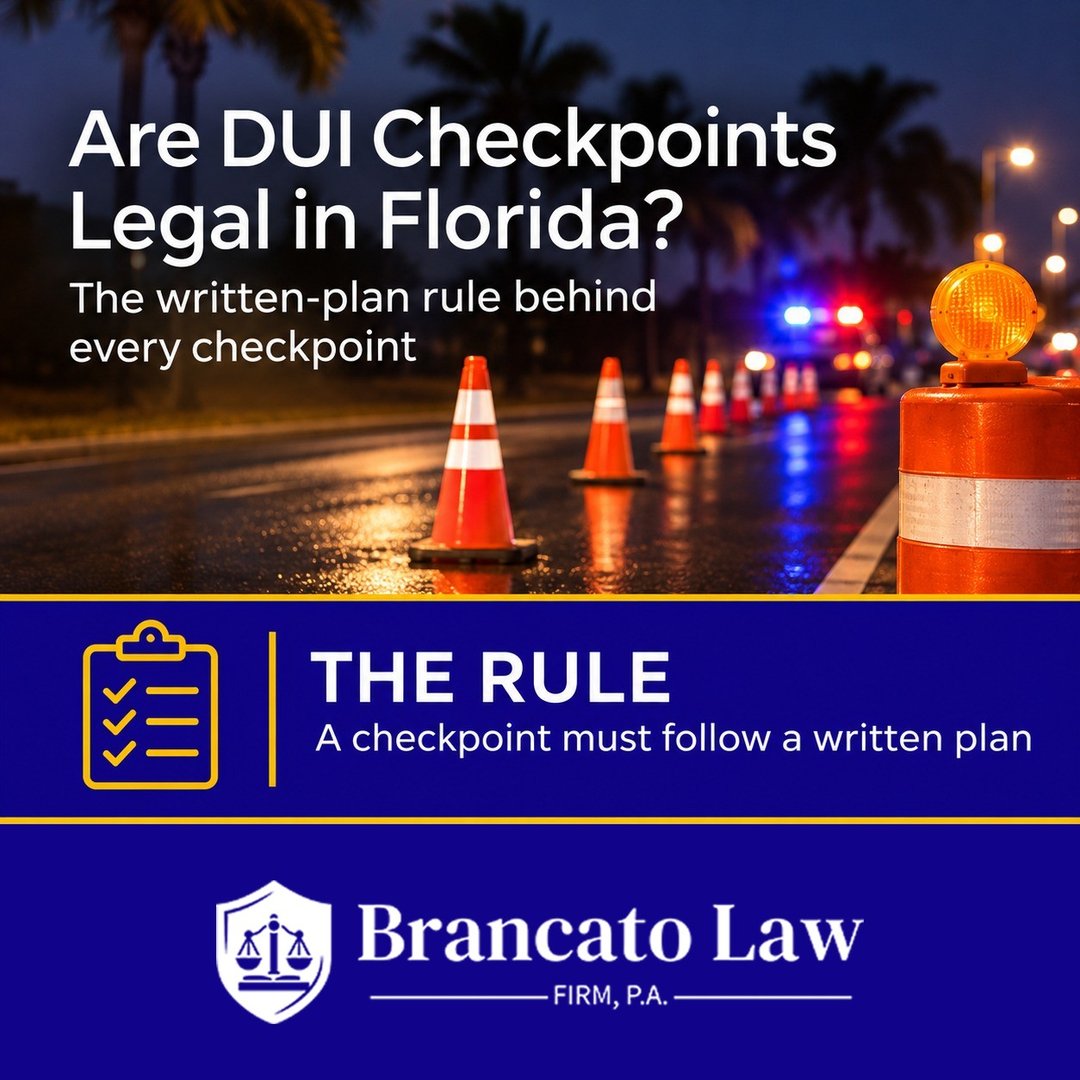
Yes. DUI checkpoints are legal in Florida, but only when officers follow a written plan, issued in advance, that limits their discretion over which cars to stop, how drivers are detained, who does what, and what happens to each vehicle. The U.S. Supreme Court approved sobriety checkpoints in 1990, and the Florida Supreme Court requires those written guidelines before a checkpoint can be used. A stop at a checkpoint that had no adequate written plan, or where officers ignored the plan, can be challenged with a motion to suppress, and winning that motion can end the DUI case.
Florida’s rule that a DUI checkpoint needs written guidelines began with a Tampa Police roadblock on Dale Mabry Highway at 2:30 a.m. on July 4, 1982. I taught criminal procedure to recruits as a former police academy instructor, and I am a member of the National College for DUI Defense. As founder of The Brancato Law Firm, P.A., a Tampa criminal defense firm, I have spent more than 25 years in Hillsborough County courtrooms, and in every checkpoint case our attorneys start with the same request: the agency’s written operational plan, and proof that the officers followed it.
Are DUI checkpoints legal in Florida?
DUI checkpoints are legal in Florida when they meet federal and state constitutional standards. In Michigan Department of State Police v. Sitz, 496 U.S. 444 (1990), the U.S. Supreme Court reviewed a Saginaw County checkpoint where 126 vehicles passed through in 75 minutes with an average delay of about 25 seconds each, and held that a sobriety checkpoint program is “consistent with the Fourth Amendment.” The Court weighed the State’s interest in stopping drunk driving against the brief intrusion on each driver.
Sitz has limits. The Court addressed only “the initial stop of each motorist passing through a checkpoint and the associated preliminary questioning and observation,” and said that holding a driver for more extensive field sobriety testing “may require satisfaction of an individualized suspicion standard.” Ten years later, in City of Indianapolis v. Edmond, 531 U.S. 32 (2000), the Court struck down narcotics checkpoints because their primary purpose was “to uncover evidence of ordinary criminal wrongdoing.” A checkpoint has to be aimed at road safety, such as impaired driving or license checks, to fit the Sitz exception.
What makes a Florida DUI checkpoint valid or invalid?
A Florida DUI checkpoint is valid only if it runs under written guidelines, issued before the checkpoint, that leave field officers little discretion. The Florida Supreme Court set that rule in State v. Jones, 483 So. 2d 433 (Fla. 1986), the Dale Mabry case. Tampa Police had funneled three northbound lanes into one and pulled every fifth car in heavy traffic, or every third car in light traffic, into a parking lot for DUI screening. The Court held that “it is essential that a written set of uniform guidelines be issued before a roadblock can be utilized,” and ruled that the State had not proved the Tampa roadblock met the Fourth Amendment balancing test.
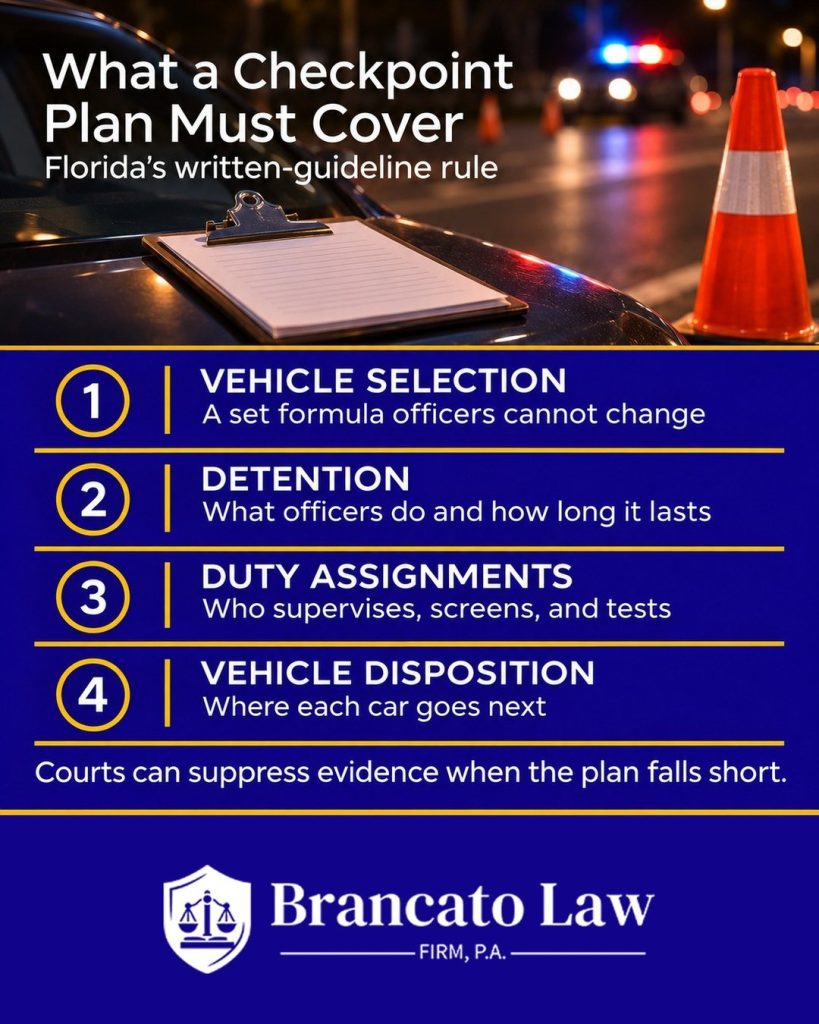
Jones lists four topics the written plan should cover “with reasonable specificity.” Courts look at the plan as a whole, so a gap in one area does not automatically sink it, but these are the four areas our attorneys check first:
- Selection of vehicles: a neutral formula, such as every car or every fifth car, that officers on the road cannot change at will.
- Detention techniques: what officers do at the window, what questions they ask, and how long each stop lasts.
- Duty assignments: who supervises, who screens drivers, who runs field sobriety exercises, and who directs traffic.
- Disposition of vehicles: where cars go after the first contact, and what happens to a car whose driver is arrested.
Jones also addressed how the checkpoint should look to drivers. Advance publicity in the media is not required, but police should provide “proper lighting and sufficient warning on the roadway in advance of the stop,” officers should be “easily identifiable,” and the detention of each driver should be kept to a minimum.
A one-line worksheet does not satisfy that standard. In Campbell v. State, 679 So. 2d 1168 (Fla. 1996), the Jacksonville Sheriff’s Office set up a roadblock on Mandarin Road after speeding complaints. Its only written instruction was “Stop motorists on Mandarin Rd. for a traffic safety check,” with oral directions filling in the rest. The Florida Supreme Court held the stop “fatally defective” under the Fourth Amendment and article I, section 12 of the Florida Constitution, because the worksheet did not limit the officers’ discretion.
Can a checkpoint arrest be thrown out if officers did not follow the plan?
Yes. A Florida court can suppress the evidence from a checkpoint when the written plan left officers too much discretion or when officers did not follow it. In Guy v. State, 993 So. 2d 77 (Fla. 2d DCA 2008), the Charlotte County Sheriff’s Office ran a “Low-Manpower Sobriety Checkpoint” on Bayshore Drive in Port Charlotte. The plan said every vehicle would be checked, but if traffic backed up, the checkpoint supervisor would decide on the spot whether to pause the checkpoint or switch to stopping “every X# vehicle.”
The Second District Court of Appeal, whose decisions bind trial courts in Hillsborough, Pinellas, and Pasco Counties, held that this undeveloped contingency plan “runs afoul of the mandate in Jones and Campbell.” The officers’ testimony also showed the duty assignments were “fluid,” the supervisor left mid-operation for a jail evaluation, and the checkpoint ended at 11:10 p.m. instead of 11:30 p.m. for lack of manpower. The court reversed the denial of the motion to suppress, and because the parties had agreed the motion was dispositive, the conviction was reversed as well. Mr. Guy’s charge was driving on a suspended license as a habitual offender, so the Jones rule applies to any charge that grows out of a checkpoint stop.
| Case | Where | What the court found | Result |
|---|---|---|---|
| State v. Jones (Fla. 1986) | Tampa Police, Dale Mabry Highway | The State did not prove the roadblock met the Fourth Amendment balancing test; written guidelines are essential | Roadblock held unconstitutional |
| Campbell v. State (Fla. 1996) | Jacksonville Sheriff, Mandarin Road | A one-line worksheet and oral directions did not limit officer discretion | Stop held fatally defective |
| Guy v. State (Fla. 2d DCA 2008) | Charlotte County Sheriff, Port Charlotte | Vehicle selection was left to a field supervisor; officers did not follow the plan | Suppression denial reversed |
| Michigan Dept. of State Police v. Sitz (U.S. 1990) | Saginaw County, Michigan | Brief stops of about 25 seconds at a sobriety checkpoint are reasonable | Checkpoints upheld |
| City of Indianapolis v. Edmond (U.S. 2000) | Indianapolis, Indiana | Checkpoints aimed at ordinary crime, such as drugs, are not allowed | Narcotics checkpoints struck down |
What do you have to do at a Florida DUI checkpoint?
At a Florida DUI checkpoint you must stop as directed and show your driver license when an officer asks for it. Section 322.15, Florida Statutes, requires every licensed driver to carry the license and “present or submit the same upon the demand of a law enforcement officer,” and it allows a digital license if the officer can verify it on the spot. Driving through a checkpoint without stopping is a quick way to be pulled over: in Sitz, a driver who went through without stopping was stopped by an officer in a chase car and arrested for DUI.
If an officer arrests you for DUI and asks for a breath, blood, or urine test, Florida’s implied consent law applies. Under section 316.1932, Florida Statutes, a first refusal of a lawful test brings a 1-year license suspension, and a refusal after a prior refusal suspension brings 18 months and a first-degree misdemeanor charge. Our post on refusing a breath test in Tampa covers that decision in detail.
What do you not have to do at a DUI checkpoint?
You do not have to answer questions about where you have been or whether you have been drinking. The Fifth Amendment protects that choice, and a polite “I prefer not to answer questions” is enough. You can also decline consent to a search of your car, although officers may still search if they develop probable cause from what they see or smell.
Field sobriety exercises are voluntary in Florida, but declining them has a cost. In State v. Taylor, 648 So. 2d 701 (Fla. 1995), the Florida Supreme Court held that an officer with reasonable suspicion of DUI may ask a driver to perform the exercises, and that a refusal can be used at trial as evidence of “consciousness of guilt.” The same case lets the driver offer an innocent explanation in court, such as an injury or footwear that made the exercises unfair. Our attorneys explain how those exercises are scored and challenged in our guide on how to fight a DUI charge in Hillsborough County.
Turning off the road before a checkpoint is lawful if the turn itself is legal. Officers often watch the approach, though, and any traffic violation during the turn gives them a separate reason to stop the car. Section 316.155, Florida Statutes, for example, requires a turn signal when another vehicle may be affected by the movement. Weaving on the way out can raise the same issue, which we discuss in our post on failure to maintain a single lane.
How common are DUI checkpoints in the Tampa Bay area?
In Hillsborough County, recent holiday DUI enforcement has relied mostly on saturation patrols and traffic stops rather than fixed checkpoints. The Hillsborough County Sheriff’s Office reported that its Memorial Day 2025 DUI operation with Tampa Police, the Florida Highway Patrol, and Temple Terrace Police produced 355 traffic stops and 29 DUI arrests over four days. Its New Year’s Eve 2025 operation with Tampa Police produced 136 traffic stops and 21 DUI arrests. Neither release describes a checkpoint. A saturation stop needs its own legal reason, such as a traffic violation, which is a different defense question from a checkpoint stop.
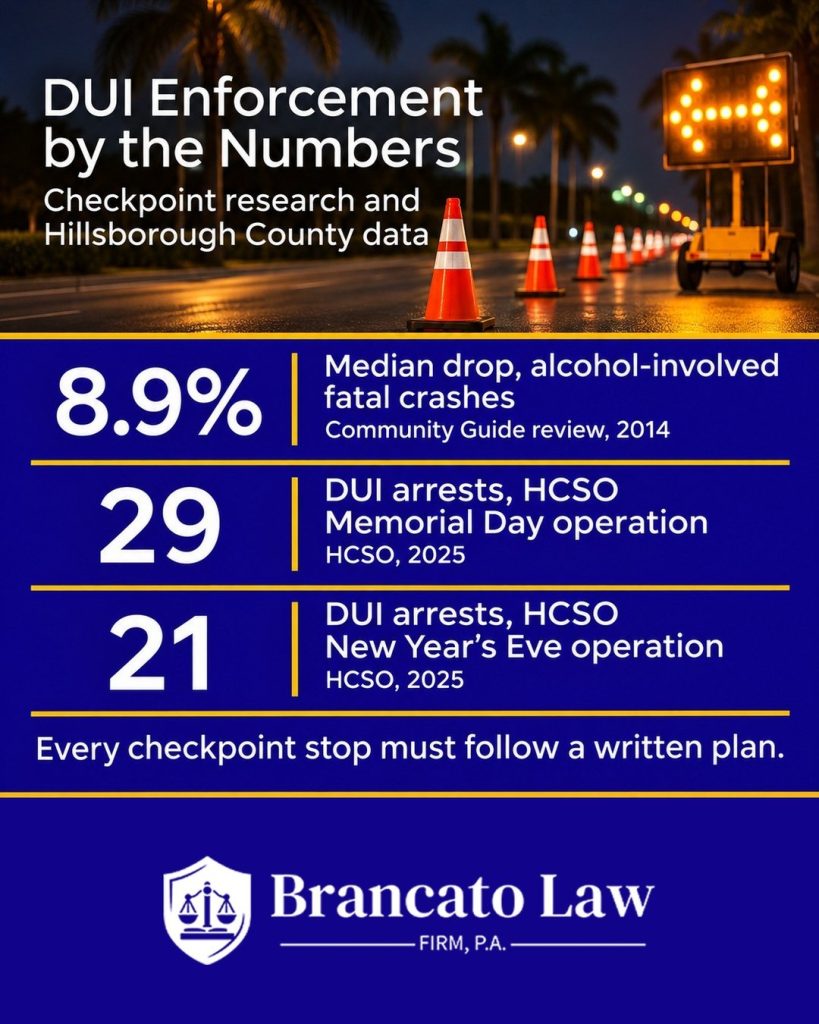
Research supports publicized checkpoints as a safety measure. The Community Preventive Services Task Force’s review by Bergen and colleagues, published in the American Journal of Preventive Medicine in 2014 and summarized on the Community Guide, found that “studies of publicized sobriety checkpoints conducted in the U.S. found an 8.9% median decrease in the number of fatal crashes thought to involve alcohol.” Courts cite that safety purpose to justify checkpoints, and it is the reason the State must prove the checkpoint in your case actually followed the plan that made it lawful.
How do our attorneys challenge a DUI checkpoint arrest?
Our attorneys challenge a checkpoint arrest by making the State prove, with documents and testimony, that the checkpoint was lawful from start to finish. A checkpoint stop has no traffic violation behind it, so the written plan is the State’s only justification for the stop. If the plan fails, the evidence that followed it can be suppressed. Our approach in every case includes:
- Requesting the written operational plan, the approval memo, and the sign-in roster for the checkpoint through discovery and public records requests.
- Comparing the plan’s vehicle-selection formula with the officers’ testimony and any video, and looking for on-the-spot changes like the one in Guy.
- Checking duty assignments, start and end times, lighting, and warning signs against what the plan required.
- Asking whether the detention went past the brief initial contact without individualized suspicion, which Sitz did not authorize.
- Reviewing the breath or blood test and the field sobriety exercises for the same problems we look for in any DUI arrest.
A motion to suppress is heard before trial, as part of the pretrial stage of the Florida criminal case process. When it succeeds, the State often has no evidence left to prosecute. Our Tampa DUI lawyer team files these motions in Hillsborough, Pinellas, and Pasco County courts, and our Hillsborough County criminal defense page explains how cases move through the courthouse here. A checkpoint arrest also starts the 10-day clock to challenge the license suspension, covered in our guide to appealing a Florida DUI license suspension.
Frequently asked questions about DUI checkpoints in Florida
Do police have to announce DUI checkpoints in advance in Florida?
No. State v. Jones held that advance publicity is not required if signs and lights at the checkpoint tell approaching drivers its purpose. The Brancato Law Firm still checks whether the warning signs and lighting described in the plan were actually in place, because Jones treats them as safeguards.
Can I refuse to roll down my window at a DUI checkpoint?
You must show your license on demand under section 322.15, and refusing to cooperate with that basic step can escalate the stop. Our attorneys at The Brancato Law Firm advise lowering the window enough to hand over the license and speak, while keeping answers to questions about drinking to a polite decline. Our DUI defense attorneys can review how the officer handled that first contact.
Can a DUI checkpoint stop every car?
Yes. A checkpoint may stop every car, or use a fixed ratio such as every third or fifth car, as long as the written plan sets the formula in advance. The Brancato Law Firm looks closely at what happened when traffic backed up, because a supervisor improvising a new ratio was the defect that won the appeal in Guy v. State.
Can a DUI checkpoint also check for drugs or warrants?
A checkpoint whose primary purpose is general crime control, such as drug interdiction, is unconstitutional under City of Indianapolis v. Edmond. Officers at a lawful sobriety checkpoint may still act on what they plainly observe. The Brancato Law Firm examines the plan’s stated purpose and the officers’ conduct to see whether a “DUI checkpoint” was really used for something else.
Can DUI charges from a checkpoint be dropped in Florida?
Yes. If a judge suppresses the evidence because the checkpoint lacked adequate written guidelines or officers did not follow them, the State often has to drop the DUI charge. Our attorneys at The Brancato Law Firm also pursue reductions and diversion where suppression is not available, as explained in our guide to Florida DUI penalties.
Does the 10-day license deadline apply to a checkpoint DUI arrest?
Yes. A DUI arrest at a checkpoint triggers the same administrative suspension as any other DUI arrest, and section 322.2615, Florida Statutes, gives the driver 10 days from the suspension notice to request a formal or informal review or a review for a restricted license. The Brancato Law Firm uses that formal review hearing to question the arresting officer about the checkpoint before the criminal case reaches a judge.
Talk to our attorneys about a checkpoint arrest
Checkpoint cases turn on paperwork the State has to produce, and the 10-day license deadline after a DUI arrest leaves little time to start asking for it. The Brancato Law Firm, P.A., founded by Tampa Criminal Defense Attorney Rocky Brancato, defends DUI cases in Hillsborough, Pinellas, and Pasco Counties from an office two blocks from the courthouse. Call us at any hour at (813) 727-7159. Our firm has Spanish-speaking staff, and attorney Jean-Luc Adrien speaks Spanish, Haitian Creole, and French. For more about our defense strategies, visit our Tampa DUI defense page.
The Brancato Law Firm, P.A.
620 E. Twiggs Street, Suite 205, Tampa, FL 33602
(813) 727-7159
Serving Hillsborough, Pinellas, and Pasco Counties
The Brancato Law Firm, P.A. is a Tampa-based criminal defense practice. We are not affiliated with any other Brancato-named law firms.
Visit Us

Tampa, FL 33602

Contact Us Now
Free Legal Consultation (813) 727-7159
