Strategic Defense,
From First DUI to Death Penalty
From First DUI to Death Penalty






| Short answer: A Tampa white collar crime attorney defends fraud, theft, embezzlement, forgery, identity theft, money laundering, and business-related charges in Florida state court. Florida grades most of these crimes by dollar amount: grand theft starts at $750, scheme to defraud becomes a first-degree felony at $50,000, and identity theft can carry mandatory minimum prison terms of 3, 5, or 10 years. Many white collar cases are won before charges are filed, by showing prosecutors that the dispute is civil, the value is overstated, or the client never intended to defraud anyone. The Brancato Law Firm, P.A. handles these cases with that early focus. |
White collar investigations usually begin quietly, with a call from a detective, a subpoena for bank records, or a letter from a regulator. Rocky Brancato, founder of The Brancato Law Firm, P.A., has tried more than 150 jury trials to verdict, including a not guilty verdict in a forgery case built on fingerprints and a paper trail. Our attorneys at this Tampa criminal defense firm represent professionals, business owners, contractors, and employees whose careers depend on keeping a felony off their record.
Maximum penalties for each level are set by § 775.082: 5 years for a third-degree felony, 15 years for a second-degree felony, and 30 years for a first-degree felony.
| Charge | Florida law | Level |
|---|---|---|
| Grand theft, $750 to under $20,000 | § 812.014(2)(c) | Third-degree felony |
| Grand theft, $20,000 to under $100,000 | § 812.014(2)(b) | Second-degree felony |
| Grand theft, $100,000 or more | § 812.014(2)(a) | First-degree felony |
| Organized fraud (scheme to defraud) | § 817.034(4)(a) | Third-degree felony under $20,000; second-degree to $50,000; first-degree at $50,000 or more |
| Communications fraud | § 817.034(4)(b) | Third-degree felony if $300 or more; first-degree misdemeanor below that |
| Exploitation of an elderly person or disabled adult | § 825.103 | Third-degree felony under $10,000; second-degree to $50,000; first-degree at $50,000 or more |
| Forgery / uttering a forged instrument | §§ 831.01, 831.02 | Third-degree felony |
| Worthless check | § 832.05 | First-degree misdemeanor; third-degree felony at $150 or more |
| Fraudulent use of a credit card | § 817.61 | First-degree misdemeanor; third-degree felony if used more than twice or for $100 or more in 6 months |
| Criminal use of personal identification information | § 817.568 | Third-degree felony; second-degree with a 3-year minimum at $5,000 or 10 victims; first-degree with a 5- or 10-year minimum at higher amounts |
| Money laundering | § 896.101 | Third-degree felony; second-degree at $20,000; first-degree at $100,000 |
| Racketeering (RICO) | § 895.04 | First-degree felony |
| Insurance fraud | § 817.234 | Third-degree felony under $20,000; up to first-degree at $100,000 or more |
| Misapplication of construction funds | § 713.345 | Third-degree felony under $1,000; second-degree to $100,000; first-degree at $100,000 or more |
| Unlicensed contracting | § 489.127 | First-degree misdemeanor; third-degree felony for a repeat offense or during a declared emergency |
| Unlicensed practice of law | § 454.23 | Third-degree felony |
Since October 1, 2024, organized fraud and communications fraud against a victim who is 65 or older, a minor, or disabled are raised one degree, and a first-degree felony becomes a life felony. Fraud cases are frequent in Florida: in 2024, Florida ranked first in the nation for fraud reports per person in the Federal Trade Commission’s Consumer Sentinel Data Book, and in 2025 Floridians age 60 and older reported $709.8 million in internet crime losses, second in the nation (FBI IC3 2025 Internet Crime Report).
Under § 812.014, theft under $750 is petit theft, a misdemeanor, and theft of $750 or more is grand theft, a felony. The felony line was raised from $300 to $750 in 2019. A five-year review by the Legislature’s research office found the change did not shift a substantial number of cases (OPPAGA Report 24-05). Thefts that are part of one scheme can be added together under § 812.012, which is how a series of small transactions becomes a first-degree felony.

The State must prove value with competent evidence of market value at the time of the theft. In Negron v. State, 306 So. 2d 104 (Fla. 1974), the Florida Supreme Court reduced a grand theft conviction because the State proved only what the items cost, not their market value. That rule is still applied in our courts. In Russell v. State, No. 2D2024-1373 (Fla. 2d DCA Aug. 28, 2026), a Hillsborough County case, the appeals court reversed a grand theft conviction because the owner’s testimony about purchase price, age, and condition did not prove fair market value. The value issue must be raised at trial with a motion for judgment of acquittal to be preserved. See our article on how value is proven in a Florida grand theft case.
A broken promise is not a crime unless the person intended to steal at the moment the money changed hands. That is the most important defense in contractor, investment, and business partner cases. In Frazier v. State, 114 So. 3d 461 (Fla. 2d DCA 2013), the appeals court ordered a remodeling contractor discharged because he had applied for permits, paid for plans, and started work, which showed no intent to steal when he took the deposit. The statutory presumption of intent for contractors who abandon a job also failed because the State did not prove the required notice was properly sent.
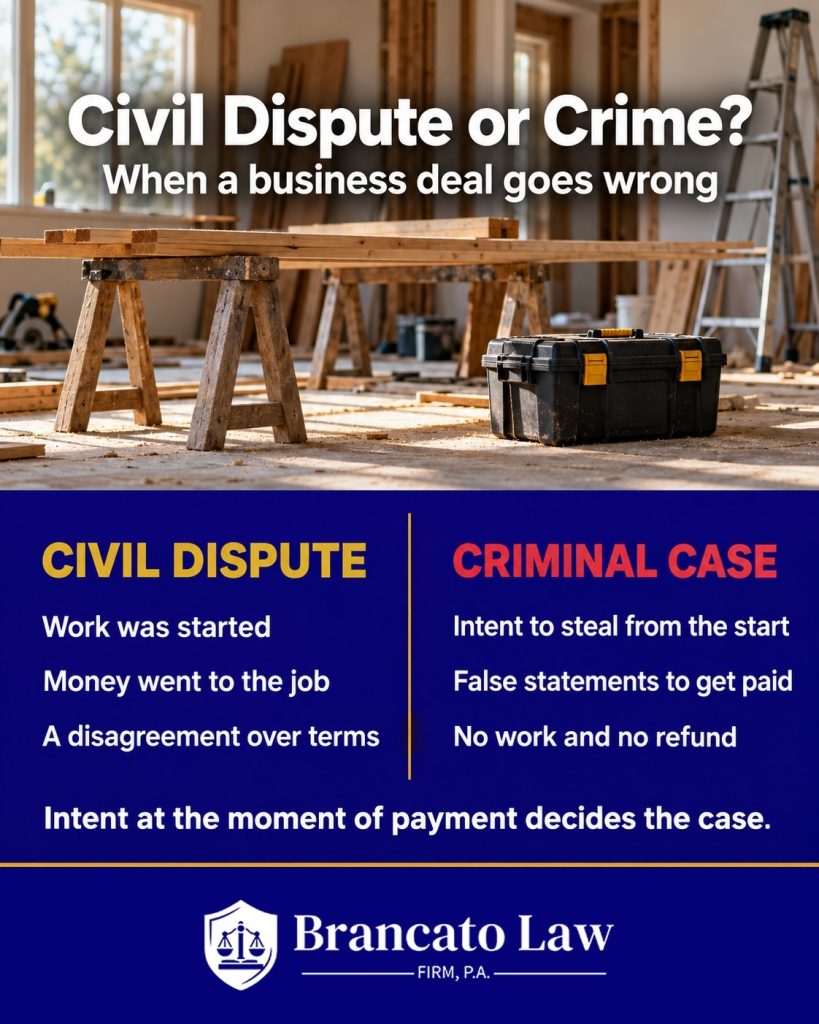
Contractors face several separate statutes, including unlicensed contracting under § 489.127 and misapplication of construction funds under § 713.345. Read our articles on the criminal penalties for unlicensed contracting and when a mover holding goods is arrested.
Under § 775.15, the State generally must file a first-degree felony within 4 years, other felonies within 3 years, a first-degree misdemeanor within 2 years, and a second-degree misdemeanor within 1 year. For offenses involving fraud or breach of fiduciary duty, the State may file within 1 year after the victim discovers the offense, but that extension cannot add more than 3 years. Organized fraud has its own 5-year limit under § 817.034(4)(f), and time spent outside Florida can pause the clock. Read our article on statute of limitations defenses.
Repayment does not erase a crime, but it often changes the outcome. Restitution is mandatory under § 775.089, and the loss must be caused by the offense and proven with competent evidence, as the Florida Supreme Court explained in Glaubius v. State, 688 So. 2d 913 (Fla. 1997). Pretrial intervention under § 948.08(2) is available for some first offenders, but it requires the consent of the victim, the State Attorney, and the judge. Research supports restitution-based outcomes: a randomized study found that people who made restitution payments were less likely to be rearrested (Ruback and colleagues, 2018). Our attorneys often negotiate repayment plans as part of a pre-file resolution or diversion.
Most white collar cases are investigated for weeks or months before an arrest. During that time, a lawyer can respond to the detective or regulator, gather documents that show good faith, and present the defense to the prosecutor before a charging decision. Professionals also face licensing consequences, so the criminal strategy must account for the Florida Bar, the Department of Health, or the Department of Business and Professional Regulation. See our pre-file defense page and our article on signs you are being investigated.
These are results our firm has obtained. Every case is different, and past results do not guarantee future outcomes.
See more on our case results page.
Yes. Fraud and theft charges are dropped or reduced when the evidence shows a civil dispute, the State cannot prove intent or value, or a restitution agreement resolves the case. The Brancato Law Firm works to resolve these cases before charges are filed whenever possible; see our case results.
Theft of property worth $750 or more is grand theft, a third-degree felony, and the level rises at $20,000 and $100,000. The Brancato Law Firm challenges the State’s valuation, because the State must prove market value, not just the purchase price.
Not necessarily. The State must prove the contractor intended to steal when the money was taken, and evidence of permits, materials, or work started points to a civil dispute. Our attorneys at The Brancato Law Firm defend contractors charged with theft and construction fund violations.
Generally 3 years for most felonies and 4 years for first-degree felonies, with a possible extension of up to 3 more years for fraud discovered later, and 5 years for organized fraud. The Brancato Law Firm reviews the timeline in every case for a limitations defense.
Not automatically. Repayment often leads to a better resolution, such as diversion or a reduced charge, but the State and the victim must agree. The Brancato Law Firm negotiates restitution as part of a complete resolution rather than as an admission.
Do not talk to the detective or send documents without a lawyer, and preserve your records. The Brancato Law Firm can communicate with investigators and present your side before a charging decision; see our pre-file defense page.
A fraud or theft charge can end a career even without prison time, and the earliest stage of the case is when the most can be done. Our attorneys at The Brancato Law Firm, P.A., founded by Tampa Criminal Defense Attorney Rocky Brancato, can review the investigation and contact the detective or prosecutor for you. Call (813) 727-7159 for a confidential consultation. We also defend internet and computer crimes across Hillsborough, Pinellas, and Pasco Counties.
The Brancato Law Firm, P.A.
620 E. Twiggs Street, Suite 205, Tampa, FL 33602
(813) 727-7159
Serving Hillsborough, Pinellas, and Pasco Counties

The Brancato Law Firm, P.A. is a Tampa-based criminal defense practice. We are not affiliated with any other Brancato-named law firms.
This page is for informational purposes only and does not constitute legal advice. Each case is unique, and outcomes depend on the individual facts and circumstances involved. Past results do not guarantee future outcomes.

Tampa, FL 33602

Free Legal Consultation (813) 727-7159
