- Free Consultation 24/7: (813) 727-7159 Tap Here To Call Us


From First DUI to Death Penalty



Is Criminal Mischief a Felony in Florida?


Fully rewritten and updated September 8, 2026.
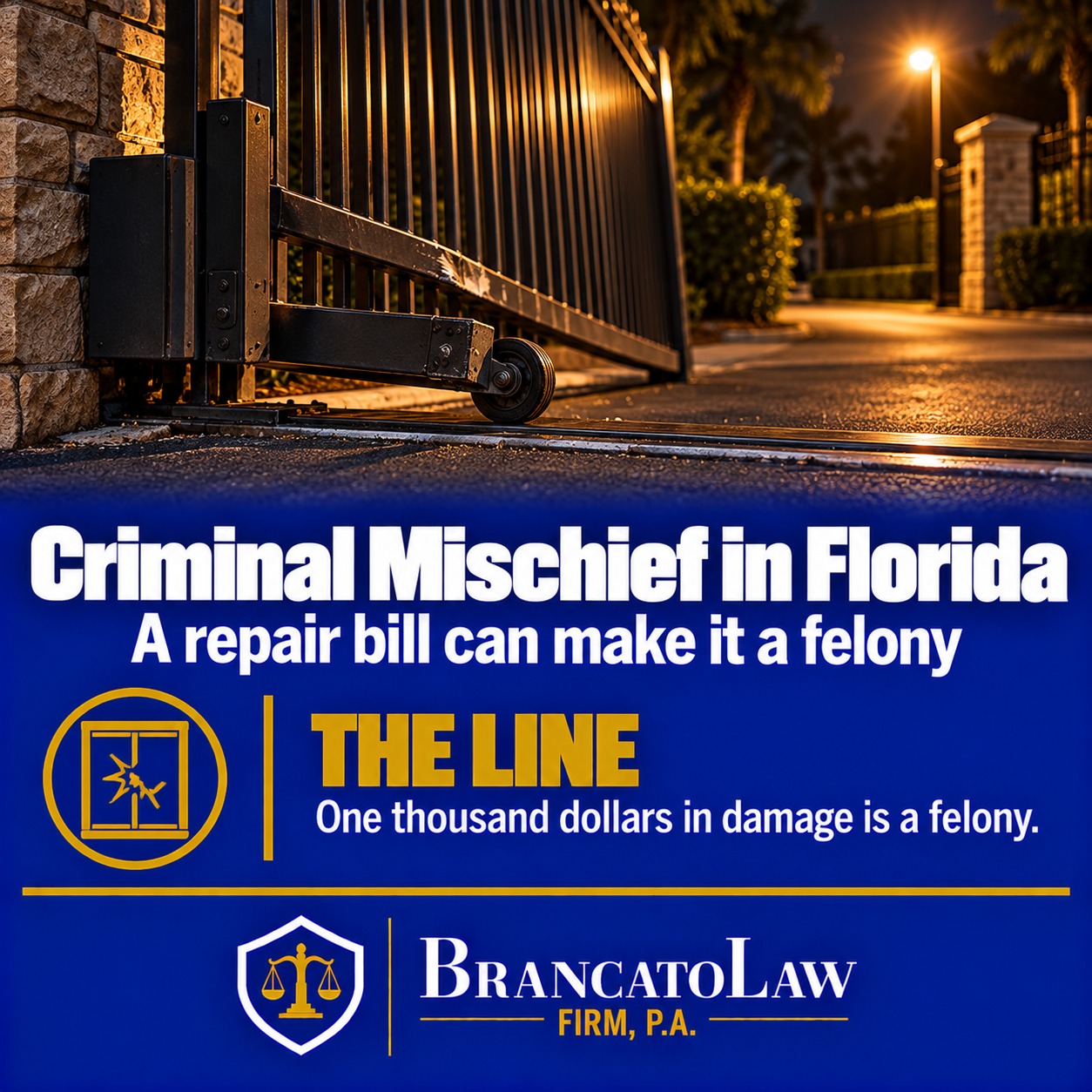
| It depends on the dollar figure — and the line is lower than most people think. Under section 806.13, Florida Statutes, damaging someone else’s property “willfully and maliciously” is a second-degree misdemeanor if the damage is $200 or less, a first-degree misdemeanor between $200 and $1,000, and a third-degree felony at $1,000 or more. A prior criminal mischief conviction turns any new misdemeanor into a felony, and damage over $200 to a place of worship or a memorial is a felony on its own. And on September 2, 2026, the Fourth District Court of Appeal in Phang v. State confirmed that “maliciously” does not mean you hated the owner — a rideshare driver who forced a broken gate open to get home at 2 a.m. now carries a felony conviction for $1,360 in damage. |
I’m Rocky Brancato, founder of The Brancato Law Firm, P.A., a Tampa criminal defense firm. Before private practice I was chief operating officer and chief assistant public defender of the Hillsborough County Public Defender’s Office, supervising more than a hundred attorneys across every division, and criminal mischief was the charge I saw most often turn a person with no record into a convicted felon over a repair invoice. Our attorneys treat every one of these cases as a fight about two things — what you intended, and what the damage was actually worth.
What Does Florida Law Define as Criminal Mischief?
Willfully and maliciously injuring or damaging another person’s property, by any means. Section 806.13(1)(a), Florida Statutes, provides that “a person commits the offense of criminal mischief if he or she willfully and maliciously injures or damages by any means any real or personal property belonging to another, including, but not limited to, the placement of graffiti thereon or other acts of vandalism thereto.”
Three elements, then: the property belonged to someone else, you damaged it, and you did so willfully and maliciously. The first two are usually not in dispute. Almost every criminal mischief defense lives in the third element and in the dollar figure that sets the penalty.
What Are the Penalties for Criminal Mischief in Florida?
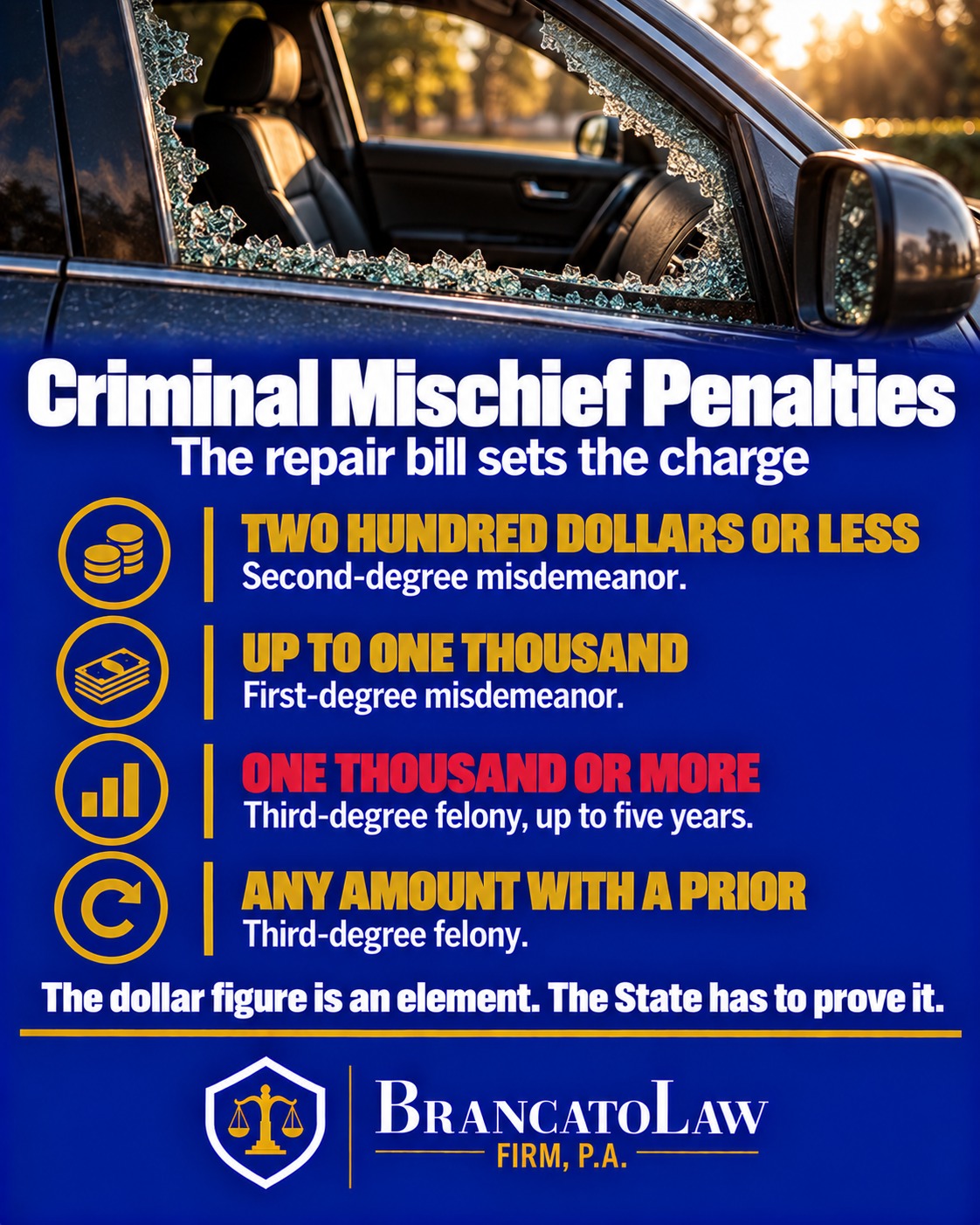
They climb with the repair bill, and the felony threshold is a four-figure number that a single broken windshield or kicked-in door can reach:
| Damage | Offense | Maximum penalty |
|---|---|---|
| $200 or less | Second-degree misdemeanor | 60 days jail, $500 fine |
| More than $200 but less than $1,000 | First-degree misdemeanor | 1 year jail, $1,000 fine |
| $1,000 or more, or interruption of business or public service costing $1,000+ to restore | Third-degree felony | 5 years prison, $5,000 fine |
| Any amount, with a prior criminal mischief conviction | Third-degree felony | 5 years prison |
| More than $200 to a place of worship or religious article | Third-degree felony | 5 years prison |
| More than $200 to a memorial or historic property | Third-degree felony | 5 years prison |
| Graffiti (any tier) | Adds mandatory minimum fines of $250 / $500 / $1,000 for a first, second, and third conviction, plus at least 40 hours of community service | — |
Two features of the statute compound the exposure. Amounts of damage to multiple owners in a single scheme or course of conduct can be aggregated to reach the felony threshold, so a night of slashed tires on four cars is charged as one felony rather than four misdemeanors. And juveniles convicted of graffiti face driver license suspension of up to a year, reducible one day for each hour of community service performed.
When Does Criminal Mischief Become a Felony in Florida?
September 2026 update: Damage to a vending machine or parking pay station is one of the most common ways a criminal mischief charge reaches the $1,000 felony line, because the operator’s repair invoice is the State’s proof of value. Our rewritten guide, Is Breaking Into a Vending Machine or Parking Meter a Felony in Florida?, covers the overlap between section 806.13 and the vending machine statute, section 877.08.
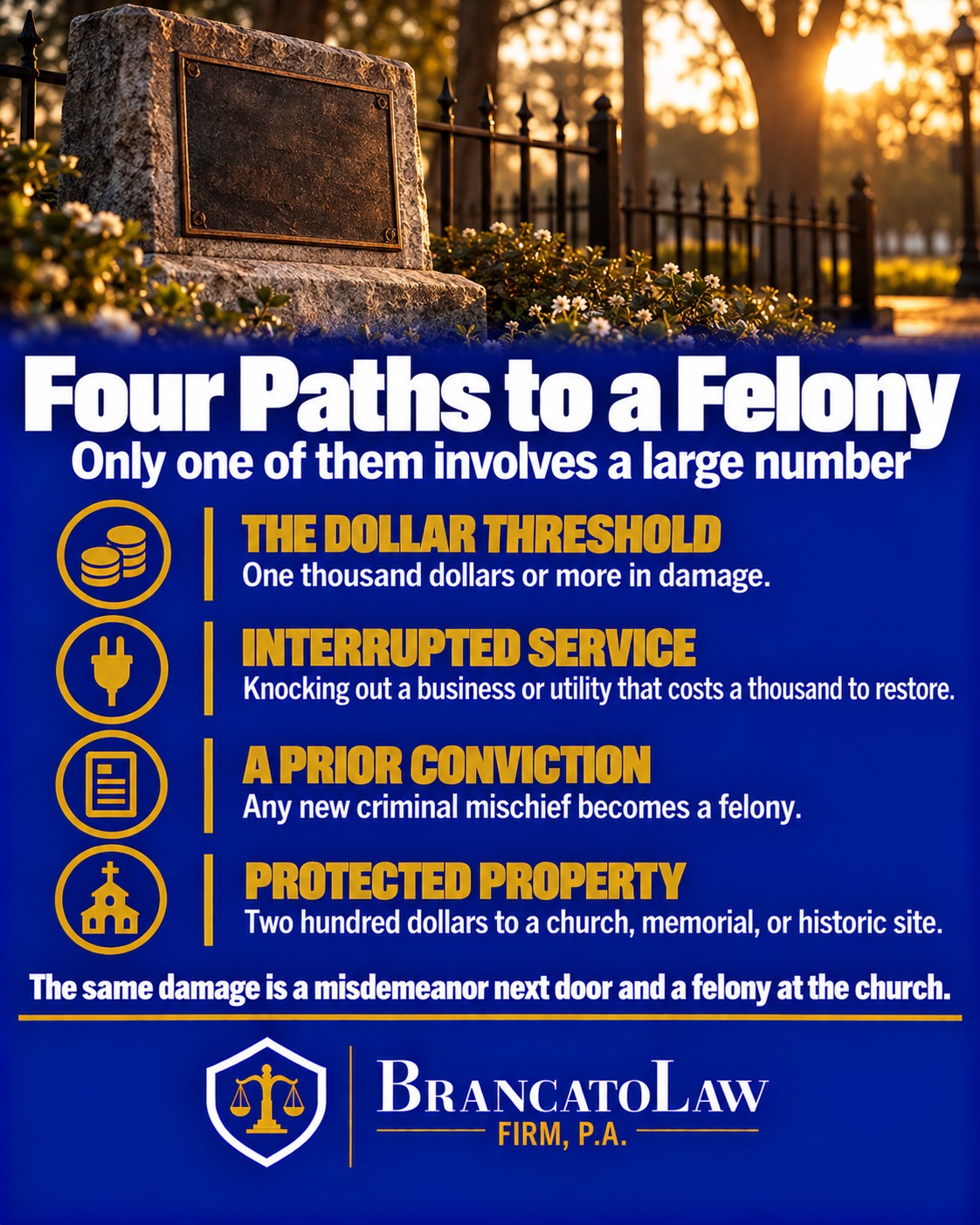
Four ways, and only one of them involves a large number:
- The $1,000 threshold. Damage valued at $1,000 or more. A car door, a storefront window, a security gate, a cell phone thrown against a wall — all routinely clear this line.
- Interruption of service. Damage that interrupts a business operation or a public communication, transportation, water, gas, or power service, where restoring it costs $1,000 or more.
- A prior conviction. Any criminal mischief conviction on your record converts a new misdemeanor-level offense into a third-degree felony, regardless of the dollar amount.
- Protected property. Damage over $200 — not $1,000 — to a place of worship, a religious article, a memorial, or historic property.
The fourth path is the one that surprises clients most. Two hundred dollars of damage to a church sign or a veterans’ memorial is a felony; the same damage to the building next door is a misdemeanor.
Does “Maliciously” Mean I Had to Hate the Owner?
No — and the Fourth District just said so in a case that will be cited in every criminal mischief prosecution in Florida for years. The word “malicious” sounds like it requires spite. Under Florida’s standard jury instruction 12.4, it means something much broader: “wrongfully, intentionally, without legal justification or excuse, and with the knowledge that injury or damage will or may be caused to another person or the property of another person.” Chief Judge Gerber’s opinion in Phang v. State, No. 4D2025-1498 (Fla. 4th DCA Sept. 2, 2026), traced the history: the common-law crime of malicious mischief did require “ill will or hatred toward the owner of the property,” but the statutory crime that replaced it does not. “Without recounting every step in the evolutionary process,” the opinion explained, quoting the Fifth District, “suffice it to say that the malice requirement morphed from inclusion of ill will or hatred toward the owner of the property into a statutory element that specifically requires willful and malicious intent to injure or damage the property of the owner.” (Read the opinion.)
So the question is not whether you were angry at the owner. It is whether you intentionally did something to the property, without justification, knowing that damage “will or may” result. That is a low bar, and Phang shows exactly how low.
What Happened in Phang v. State?
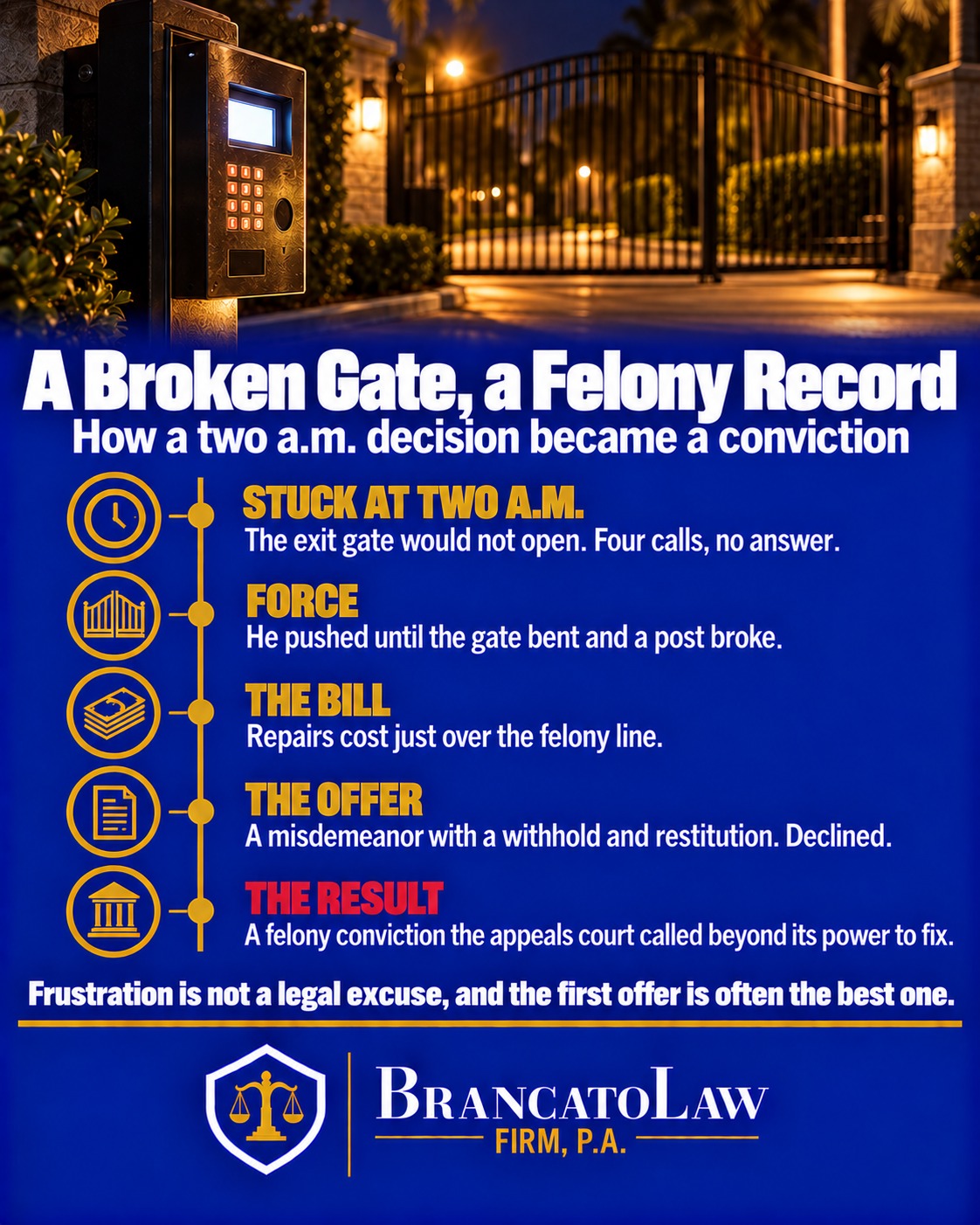
A rideshare driver dropped off a passenger inside a gated community at two in the morning and could not get out. The exit gate would not open. He called the posted assistance number four times over sixteen minutes; no one answered. He did not call the police non-emergency line. Instead, in Chief Judge Gerber’s words, he “literally took matters into his own hands”: he got out and pushed and pulled the entrance gate for about twenty-four seconds, then turned to the exit gate and “leaned heavily into the exit gate with great force, causing it to bend.” The gate was designed to roll sideways on a track, not to be pushed forward against the asphalt. He broke a gate post and bent the gate, squeezed his car through, and left. The community spent $1,360 on repairs — $360 over the felony line.
The community manager reviewed the video and tried to bill the rideshare company, which required a police report. Police traced the car to the driver’s apartment, where he denied his identity and denied owning the car shown in the video — even though that car was parked outside his apartment. He was charged with felony criminal mischief, went to trial, and was convicted. The Fourth District affirmed per curiam. Chief Judge Gerber wrote separately to explain why.
His opinion rejected the driver’s argument that because he intended only to leave, not to damage anything, the act was neither wrongful nor intentional. The security video, the court said, let the jury conclude “a reasonable person in Paul’s position would have known that pushing the gate with such great force in a direction for which the gate was not designed would damage the gate.” As for “legal justification or excuse,” the driver “could have attempted to contact the local police’s non-emergency number for assistance rather than attempting to open the gate himself. Or at worst, when Paul realized the gate was putting up a fight against being opened manually, and was likely to break upon further force being applied, Paul could have stopped.” The court added that it did “not mean to minimize the frustrating circumstances” — “Many drivers have experienced the frustration of encountering an unmanned malfunctioning exit gate … That frustration can seem intolerable when occurring at two o’clock in the morning” — but frustration is not a legal excuse.
Then came the passage that every client charged with criminal mischief should read. The driver, Chief Judge Gerber observed, “did not improve his fate by denying any involvement, much less his identity, when the police arrived at his apartment,” and “also did not improve his fate by rejecting the state’s reasonable offer to accept a withhold of adjudication to a misdemeanor charge and pay restitution to the community for damaging the gate. While some may question the fairness of Paul having a felony conviction on his record, that outcome is beyond our purview.”
How Is the Damage Amount Proved — and Fought?
By the repair invoice, usually — and that is exactly where our attorneys start. The dollar figure in a criminal mischief case is an element the State must prove beyond a reasonable doubt, not a number it gets to assert. In Phang the difference between a misdemeanor and a felony was $360 on a gate repair bill that no one appears to have contested. In practice the figure is often soft:
| What the State offers | What we ask |
|---|---|
| A repair estimate | Was the repair actually done? At that price? Does the estimate include upgrades, unrelated work, or replacement of parts that were not damaged? |
| A replacement cost | Was the item repairable? What was its fair market value in its pre-damage condition — the measure for used property — rather than the price of a new one? |
| An owner’s estimate of value | What is the basis? Owners routinely testify to purchase price rather than current value |
| Aggregated damage across victims | Was it truly one scheme or course of conduct, or separate incidents the State is stacking? |
| Interruption-of-service costs | Were the restoration costs really $1,000 or more, and are they documented? |
Knock $361 off the Phang invoice and the felony becomes a first-degree misdemeanor. That is not a technicality; it is the element the Legislature chose to make the dividing line, and the State has to prove it. Our approach to proving value in property cases is laid out in more detail in our article on proving value in Florida grand theft cases, and the same principles apply here.
One boundary worth knowing: when the damage is done by fire or explosion to a “structure” — a building, a shed, or any vehicle or vessel — the charge is not criminal mischief but arson under section 806.01, a second-degree felony even for an empty structure and a first-degree felony for a dwelling. Our article on whether arson is a felony in Florida explains where that line falls.
Can You Be Charged for Projecting Images on a Building?
Yes. Section 806.13(7) makes it a first-degree misdemeanor to “knowingly and intentionally display or project, using any medium, an image onto a building, structure, or other property without the written consent of the owner,” and a third-degree felony if the projected image contains a credible threat. No physical damage is required. The provision is aimed at the projection of messages onto stadiums, office towers, and public buildings, and it has been used.
How Do Our Attorneys Fight Criminal Mischief Charges?
By attacking the two elements that actually decide these cases, and by keeping the conviction off the record where a fight is not the best outcome:
- The intent element, correctly framed. After Phang, “I didn’t mean to break it” is not a defense by itself. “I did not intend to do anything to that property,” or “the damage was accidental,” or “I had a legal right to do what I did” — those are. A tenant removing his own fixtures, a co-owner disposing of jointly owned property, a person defending himself or his own property: the “without legal justification or excuse” clause does real work when the facts support it.
- The dollar figure. Every estimate, invoice, and owner’s guess is cross-examined. The felony line is $1,000 and the State has to reach it with evidence.
- Ownership. “Property belonging to another” excludes property you own or co-own. Roommate, spouse, and family disputes over shared property are frequently charged as criminal mischief when they are civil disputes.
- Identification. Most criminal mischief happens without a witness. Video, as in Phang, is often what the State has — and video that shows an act does not always show who did it.
- The disposition, when the facts are bad. A withhold of adjudication on a reduced charge with restitution paid is not a loss; in the right case it is the whole point. The driver in Phang was offered exactly that and turned it down. He now has a felony conviction that a court of appeal openly described as arguably unfair and legally unreviewable.
For more about our defense strategies, visit our Hillsborough County criminal defense page.
What Should You Do After a Criminal Mischief Arrest?
Do not talk to the owner, the property manager, or the police about what happened, and do not pay anything yet. Payment is restitution, and restitution is best made as part of a negotiated disposition that buys you something — a reduction, a withhold, a dismissal — rather than as a volunteered admission. Photograph the property yourself if you can do so lawfully, because the condition it was in before and after matters to value. Save every message from the owner, especially any that put a number on the damage; the first number is often the honest one. And if the incident involved a car, a gate, a door, or anything else with a camera pointed at it, assume the video exists and get counsel before you are asked about it.
Frequently Asked Questions About Criminal Mischief in Florida
Is criminal mischief a felony or a misdemeanor in Florida?
Both, depending on the facts. It is a misdemeanor when the damage is under $1,000 and you have no prior criminal mischief conviction, and a third-degree felony when the damage is $1,000 or more, when you have a prior conviction, or when damage over $200 is done to a place of worship, memorial, or historic property.
What if I didn’t mean to damage anything?
After Phang v. State, that is not enough by itself. “Maliciously” means intentionally doing something to the property, without legal justification, knowing that damage “will or may” result. If you meant to do the act and a reasonable person would have known it might cause damage, the State can argue malice. A truly accidental act — one you did not intend at all — is a different matter and a real defense.
Do I have to pay restitution?
If convicted, almost certainly. But restitution is also a negotiating tool: an offer to make the owner whole is often what turns a felony charge into a misdemeanor withhold or a dismissal. The timing and structure of that payment should be handled by counsel, not by you directly.
Can criminal mischief be charged for damaging my own property or property I share?
Not for property you own alone. Shared or jointly owned property is a contested area; the State’s position is that damaging a co-owner’s interest can qualify, and the defense position depends on the facts of ownership and control. These disputes — between spouses, roommates, and family members — are among the most defensible criminal mischief cases we see.
Will a criminal mischief conviction stay on my record?
A conviction is permanent. A withhold of adjudication is not a conviction and may be sealable later, depending on the offense and your history. That distinction is exactly what the driver in Phang gave up when he declined the State’s offer.
Is graffiti treated differently?
Graffiti is criminal mischief under the same statute, graded by the same dollar tiers, with add-ons: mandatory minimum fines of $250, $500, and $1,000 for a first, second, and third conviction, at least 40 hours of community service, and for minors, a driver license suspension of up to one year.
If you or a family member has been charged with criminal mischief anywhere in Tampa Bay, the attorneys of The Brancato Law Firm, P.A. — founded by Tampa Criminal Defense Attorney Rocky Brancato — will look at the intent evidence and the repair invoice before anyone talks about a plea. Call (813) 727-7159. The difference between a misdemeanor and a felony is often a few hundred dollars and one decision made too fast.
The Brancato Law Firm, P.A.
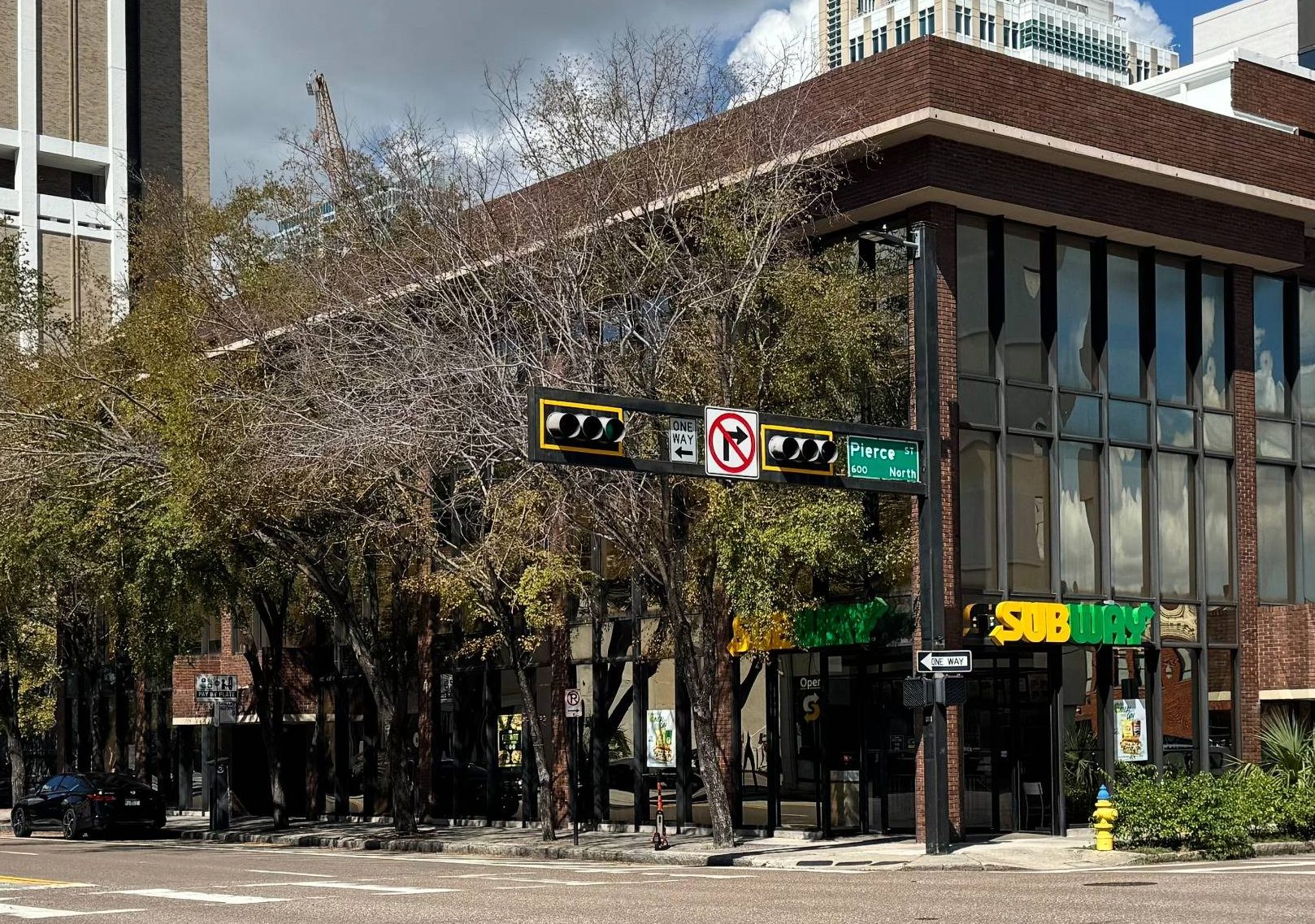
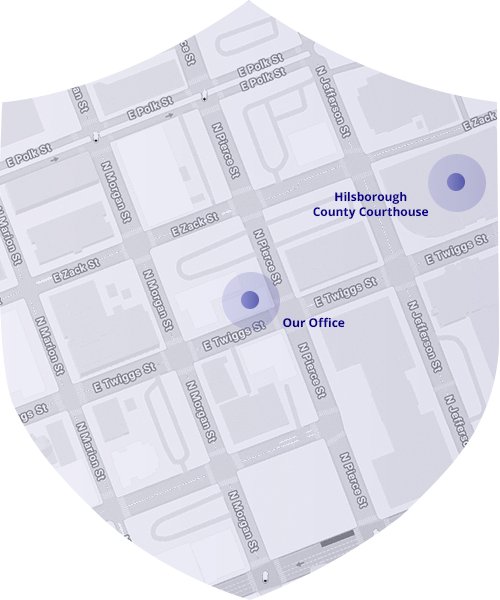
620 E. Twiggs Street, Suite 205, Tampa, FL 33602
(813) 727-7159
Serving Hillsborough, Pinellas, and Pasco Counties
The Brancato Law Firm, P.A. is a Tampa-based criminal defense practice. We are not affiliated with any other Brancato-named law firms.
Visit Us
Tampa, FL 33602
Contact Us Now
Free Legal Consultation (813) 727-7159