

From First DUI to Death Penalty



How to Fight an Extortion Charge in Florida? (2026)


To fight an extortion charge in Florida, the defense tests each part of section 836.05: whether there was a threat of the kind the statute lists, whether it was made “maliciously,” which the Florida Supreme Court defines as intentionally and without lawful justification, and whether it was made to get money or a financial advantage or to force someone to act against their will. Extortion is a second-degree felony punishable by up to 15 years in prison, and many cases rest on text messages and recorded calls that read differently in full context. Charges can be reduced or dropped when the demand was a lawful one, the words were not a threat, or the State cannot prove who sent the messages.
As founder of The Brancato Law Firm, P.A., a Tampa criminal defense firm, and a lawyer who has tried more than 150 jury trials to verdict, I have seen extortion cases grow out of business disputes, breakups, and online conversations that went too far. Most of them turn on a handful of messages or one recorded phone call. Our attorneys collect the entire conversation, both sides of it, before the State’s version of a few lines becomes the whole story.
What is extortion in Florida?
Extortion in Florida is a malicious threat made to get money or a financial advantage, or to force someone to do or not do something against their will. Under section 836.05, Florida Statutes, the threat can be spoken or written, and it can be a threat to:
- accuse someone of a crime;
- injure a person, their property, or their reputation;
- expose someone to disgrace or reveal a secret about them; or
- impute a deformity or lack of chastity to someone.
The statute does not require that the threatened accusation or secret be false. Threatening to report a real crime unless you are paid can still be extortion. Extortion is often called blackmail, and when the secret is an intimate image it is often called sextortion. Both can be prosecuted under this statute. More about our fraud and financial crimes work is on our Tampa white collar crime attorney page.
What does the State have to prove for extortion?
The State must prove four things beyond a reasonable doubt: a communication, a threat of a kind the statute lists, malice, and the required intent. The table below shows each element and where the defense looks.
| Element | What it means | Common defense question |
|---|---|---|
| Communication | A spoken, written, or printed communication, including texts, emails, and direct messages | Who actually sent it, and is the full thread in evidence? |
| Listed threat | A threat to accuse of a crime, injure person, property, or reputation, expose disgrace or a secret, or impute a deformity or lack of chastity | Was it a threat, or a statement of what a lawful process would do? |
| Malice | Made intentionally and without lawful justification | Did the accused have a legal right to make the demand? |
| Intent | To extort money or any pecuniary advantage, or to compel an act against the person’s will | Was the goal payment or coercion, or something else, like ending contact? |
What does “maliciously” mean in Florida’s extortion law?
“Maliciously” in section 836.05 means intentionally and without any lawful justification. It does not require hatred or ill will. The Florida Supreme Court settled that question in Tomlinson v. State, 369 So. 3d 1142 (Fla. 2023). A real estate broker filed an ethics complaint against two other brokers, then told them he could make the complaint “go away” if they each paid him $250,000, or he would ruin their careers, call the Wall Street Journal, and push the state to take their licenses. Police had one of the brokers record later calls with him. The Court rejected his argument that the State had to prove he hated the brokers, approved the Third District’s decision, and disapproved the Fifth District’s contrary decision in Calamia v. State, 125 So. 3d 1007 (Fla. 5th DCA 2013).
The Court traced the word to its nineteenth-century legal meaning, relying in part on the legal historian James Fitzjames Stephen’s 1883 treatise, A History of the Criminal Law of England, which observed that “malice” in criminal law seldom carries its everyday sense of ill will. That history matters for the defense. After Tomlinson, the question is not whether the accused was angry. It is whether the accused had a lawful justification for what was said, so our attorneys focus on the legal right behind a demand, such as a genuine debt, a real contract claim, or an honest settlement offer from a lawyer.
Can a threat of emotional harm be extortion in Florida?
Yes. A threat of emotional or psychological injury can be extortion. In Duan v. State, 970 So. 2d 903 (Fla. 1st DCA 2007), a man told a domestic violence victim that he and other subpoenaed witnesses would make sure her abuser was acquitted unless she paid him $2,500. The State conceded there was no threat of physical harm, property damage, or exposure. The First District held that “injury to the person” in section 836.05 includes mental and emotional injury and affirmed the conviction. The lesson is that the threat category is broad, so defenses usually turn on malice, intent, and proof of who said what.
How common are extortion complaints, and why do they matter locally?
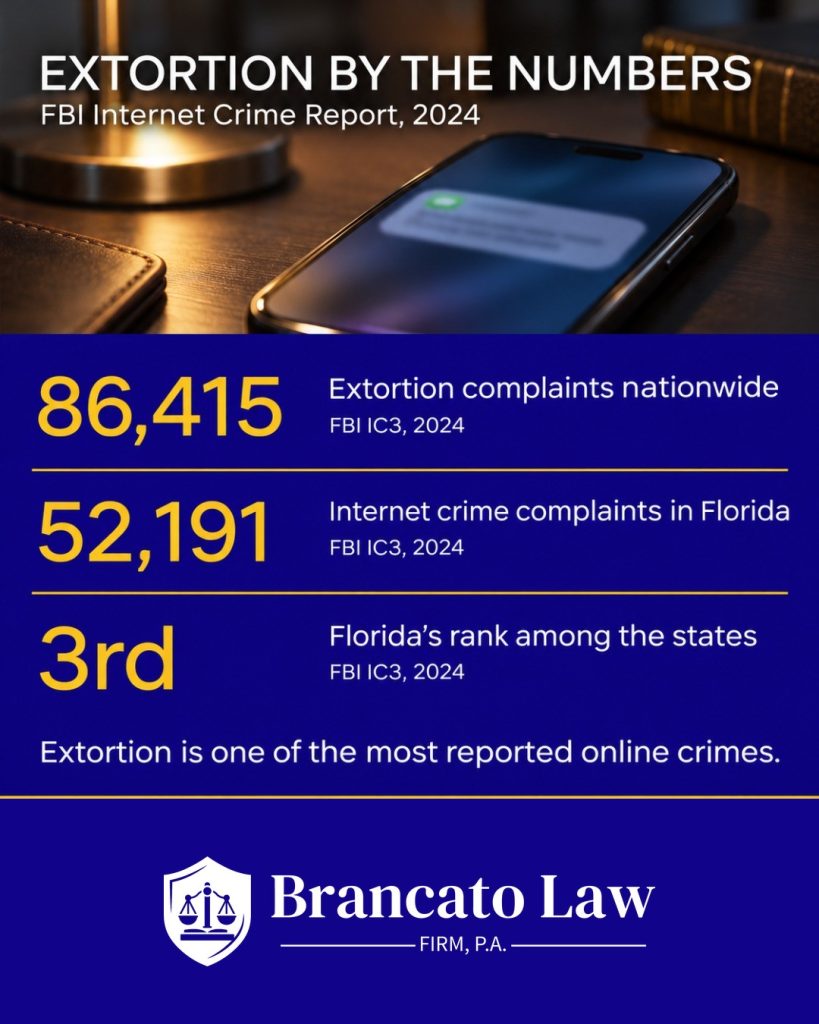
Extortion is one of the most reported online crimes in the country. The FBI’s Internet Crime Complaint Center recorded 86,415 extortion complaints and $143,185,736 in reported extortion losses nationwide in 2024, according to its 2024 Internet Crime Report. The same report ranked Florida third among the states in 2024 for internet crime complaints of all kinds, with 52,191 complaints and $1,071,909,632 in reported losses.
Many of those complaints involve overseas scammers who are never charged. The cases that reach Hillsborough County courtrooms usually involve people who know each other: former partners, business associates, landlords and tenants, or people who met online. In our experience, Tampa-area detectives often build these cases the same way the police did in Tomlinson, by having the complainant make recorded calls or send messages at police direction. Those recordings are evidence for both sides, and our attorneys review every one for what it leaves out.
What are the penalties for extortion in Florida?
Extortion is a second-degree felony punishable by up to 15 years in prison under section 775.082 and a $10,000 fine under section 775.083. The offense severity ranking chart in section 921.0022 ranks extortion at Level 6, which scores 36 points for a person with no prior record. Under section 921.0024, a total of 44 points or fewer allows a sentence without state prison, so a first offense with no other charges does not carry a mandatory prison floor. Additional counts, a prior record, or victim injury can push the total higher.
| Scenario | Degree | Maximum | Scoresheet effect |
|---|---|---|---|
| Extortion, first offense, one count | Second-degree felony | 15 years, $10,000 | 36 points; prison not required |
| Extortion while acting as a foreign agent to benefit a foreign country of concern | First-degree felony | 30 years, $10,000 | Higher degree under section 836.05(2) |
| Written threat to kill or injure (often charged with extortion) | Second-degree felony | 15 years, $10,000 | Level 6 under section 836.10 |
A conviction also carries consequences beyond the sentence, including the effect of a felony record on professional licenses, which matters in the business disputes that often produce these charges.
How do our attorneys fight an extortion charge?
Our attorneys fight extortion by showing the full context of the communication, testing the lawful basis for any demand, and holding the State to proof of who sent what.
1. Show a lawful justification
Tomlinson makes lawful justification the center of the malice element. A demand to repay a real debt, a warning that a lawyer will file suit, or an offer to settle a genuine claim is different from a threat to expose a secret unless paid. Our attorneys gather the contracts, invoices, and prior communications that show the demand had a legal basis.
2. Put the whole conversation in front of the prosecutor
Extortion cases often rest on a screenshot of one message. We obtain the full thread, including the complainant’s messages, because context can show a negotiation, a mutual argument, or a demand to stop contact rather than a demand for money.
3. Challenge who sent the messages
Accounts are shared, phones are borrowed, and spoofed or anonymous accounts are common. The State must connect the accused to each message. We review the subscriber records, device extractions, and login data, and when needed we consult a digital forensics expert.
4. Examine the recorded calls
A recorded call made at police direction is designed to get an admission. We listen for leading questions, missing context, and statements that support our client’s account, and we review whether the recording was lawfully obtained.
5. Work the case before charges are filed
Many extortion investigations start with a complaint and a detective’s request for an interview. Through representation before charges are filed, our attorneys speak for the client, present the documents that show the dispute’s real nature, and ask the State not to file or to file a lesser charge.
What happens after an extortion arrest in Hillsborough County?
An extortion arrest in Hillsborough County goes to first appearance within 24 hours, where a judge reviews probable cause and sets release conditions, usually including no contact with the complainant. Hillsborough County does not offer pretrial services supervision as a release option, so the judge chooses among a monetary bond, release on recognizance, or detention. The State Attorney’s Office then decides whether to file a formal information. Our guide to the stages of a Florida criminal case explains each step, and our Hillsborough County criminal defense page covers local courts.
Frequently asked questions about extortion in Florida
Can extortion charges be dropped in Florida?
Yes, extortion charges can be dropped or reduced, most often when the demand had a lawful basis, the words were not a listed threat, or the State cannot prove who sent the messages. The Brancato Law Firm presents the full conversation and the documents behind any demand to the prosecutor, ideally through pre-file advocacy before formal charges are filed.
Is it extortion to threaten to sue someone in Florida?
A good-faith demand tied to a genuine legal claim, such as a real debt or contract dispute, has a strong lawful-justification argument. Our attorneys at The Brancato Law Firm look at whether a demand was tied to a real legal right, because Tomlinson defines malice as acting without lawful justification. Threats to expose secrets or report a crime unless paid are treated differently, even if the underlying claim is real.
Is threatening to post someone’s private photos extortion in Florida?
Yes, threatening to expose intimate images unless someone pays or does something can be charged as extortion under section 836.05, since the statute covers threats to expose a secret or disgrace. When the images are actually posted, the State may also charge sexual cyberharassment, which The Brancato Law Firm covers in our post on the revenge porn charge in Florida.
Does extortion require that money actually change hands?
No, the crime is the threat made with the required intent, so no payment is needed. The Brancato Law Firm often sees cases where the complainant never paid and went to police first. Intent to compel someone to act against their will also qualifies, even with no money involved.
Is extortion a federal or state crime?
It can be either, depending on the facts. The Brancato Law Firm defends state extortion charges under section 836.05 in Hillsborough, Pinellas, and Pasco counties. Interstate threats can also bring federal charges, so we review early whether a case may draw federal interest.
What should I do if police want to talk to me about extortion?
Decline the interview and ask for a lawyer, because detectives often already have recorded calls and want an admission to match them. Lawyers at The Brancato Law Firm handle that contact for you and present your side in writing. Our Tampa white collar defense lawyers can respond to a detective’s request the same day.
For more about our defense strategies, visit our White Collar Crime page.
If a detective has called or a complainant has gone to police, the next conversation you have about the case should be with a lawyer. Call The Brancato Law Firm, P.A., founded by Tampa Criminal Defense Attorney Rocky Brancato, at (813) 727-7159 for a free consultation; you can call us at any hour. Our firm has Spanish-speaking staff, and attorney Jean-Luc Adrien speaks Spanish, Haitian Creole, and French.
The Brancato Law Firm, P.A.
620 E. Twiggs Street, Suite 205, Tampa, FL 33602
(813) 727-7159
Serving Hillsborough, Pinellas, and Pasco Counties
The Brancato Law Firm, P.A. is a Tampa-based criminal defense practice. We are not affiliated with any other Brancato-named law firms.
Visit Us

Tampa, FL 33602

Contact Us Now
Free Legal Consultation (813) 727-7159
