- Free Consultation 24/7: (813) 727-7159 Tap Here To Call Us


From First DUI to Death Penalty



What Is Drug Trafficking in Florida? Weights, Mandatory Minimums and Defenses (2026)


Updated October 21, 2026
Drug trafficking in Florida means knowingly selling, buying, manufacturing, delivering, bringing into the state, or possessing a controlled substance in an amount at or above a weight threshold set by section 893.135, Florida Statutes. No sale is required, so possessing 28 grams of cocaine or 4 grams of fentanyl is trafficking by itself. Every trafficking offense is a first-degree felony that carries a mandatory minimum prison term and a mandatory fine, starting at 3 years and climbing to 25 years for the largest opioid amounts and life for 150 kilograms of cocaine. The weight the State can actually prove decides the charge, so the lab work, the search and the possession evidence are where these cases are fought.
To convict someone of drug trafficking in Florida, a prosecutor must prove three things beyond a reasonable doubt: the person knowingly sold, bought, made, delivered, imported or possessed the drug; the substance is one the statute lists; and the weight reached the trafficking threshold. I’m Rocky Brancato, founder of The Brancato Law Firm, P.A., a Tampa criminal defense firm, and I have tested that proof for more than 25 years in Hillsborough County courtrooms, including more than 150 jury trials to verdict. In trafficking cases our attorneys often start before any charge is filed, taking the weight, lab and search problems to the State Attorney’s Office through representation before charges are filed.
What does the State have to prove in a Florida drug trafficking case?
The State must prove a knowing act, a listed drug, and a qualifying weight. Section 893.135 covers anyone who “knowingly sells, purchases, manufactures, delivers, or brings into this state,” or who is “knowingly in actual or constructive possession of” the threshold amount. Each drug has its own paragraph, its own threshold and its own sentencing tiers.
Florida does not require the State to prove you knew the substance was illegal. Under section 893.101, Florida Statutes, lack of knowledge of the illicit nature of a substance is an affirmative defense the accused raises, and possession allows the jury to presume knowledge. The State still has to prove you knew the drugs were there and that you possessed them.
Conspiracy counts the same as the completed crime. Under section 893.135(5), agreeing with another person to traffic is a first-degree felony “punishable as if he or she had actually committed such prohibited act.” That is why text messages and recorded calls about amounts can expose someone to a trafficking sentence even when no drugs are ever found on them. Our Tampa drug crimes attorney page explains how our firm handles every level of drug charge, from simple possession to trafficking.
What are the trafficking weights and mandatory minimums in Florida?
Florida trafficking thresholds start as low as 4 grams for fentanyl and heroin and as high as 25 pounds for cannabis. The table below shows the 2026 tiers for the drugs our firm sees most often in Hillsborough, Pinellas and Pasco County cases, taken directly from the statute.
| Drug (s. 893.135 paragraph) | Weight | Mandatory minimum | Mandatory fine |
|---|---|---|---|
| Cannabis (1)(a) | Over 25 lbs to under 2,000 lbs, or 300 to 2,000 plants | 3 years | $25,000 |
| Cannabis (1)(a) | 2,000 lbs to under 10,000 lbs, or 2,000 to 10,000 plants | 7 years | $50,000 |
| Cannabis (1)(a) | 10,000 lbs or more, or 10,000 plants or more | 15 years | $200,000 |
| Cocaine (1)(b) | 28 g to under 200 g | 3 years | $50,000 |
| Cocaine (1)(b) | 200 g to under 400 g | 7 years | $100,000 |
| Cocaine (1)(b) | 400 g to under 150 kg | 15 years | $250,000 |
| Cocaine (1)(b) | 150 kg or more | Life | None stated |
| Heroin, morphine, opium (1)(c)1 | 4 g to under 14 g | 3 years | $50,000 |
| Heroin, morphine, opium (1)(c)1 | 14 g to under 28 g | 15 years | $100,000 |
| Heroin, morphine, opium (1)(c)1 | 28 g to under 30 kg | 25 years | $500,000 |
| Hydrocodone (1)(c)2 | 28 g to under 50 g | 3 years | $50,000 |
| Hydrocodone (1)(c)2 | 50 g to under 100 g | 7 years | $100,000 |
| Hydrocodone (1)(c)2 | 100 g to under 300 g | 15 years | $500,000 |
| Hydrocodone (1)(c)2 | 300 g to under 30 kg | 25 years | $750,000 |
| Oxycodone (1)(c)3 | 7 g to under 14 g | 3 years | $50,000 |
| Oxycodone (1)(c)3 | 14 g to under 25 g | 7 years | $100,000 |
| Oxycodone (1)(c)3 | 25 g to under 100 g | 15 years | $500,000 |
| Oxycodone (1)(c)3 | 100 g to under 30 kg | 25 years | $750,000 |
| Fentanyl, carfentanil, alfentanil (1)(c)4 | 4 g to under 14 g | 7 years | $50,000 |
| Fentanyl, carfentanil, alfentanil (1)(c)4 | 14 g to under 28 g | 20 years | $100,000 |
| Fentanyl, carfentanil, alfentanil (1)(c)4 | 28 g or more | 25 years | $500,000 |
| Methamphetamine or amphetamine (1)(f) | 14 g to under 28 g | 3 years | $50,000 |
| Methamphetamine or amphetamine (1)(f) | 28 g to under 200 g | 7 years | $100,000 |
| Methamphetamine or amphetamine (1)(f) | 200 g or more | 15 years | $250,000 |
| MDMA and other phenethylamines (1)(l) | 10 g to under 200 g | 3 years | $50,000 |
| MDMA and other phenethylamines (1)(l) | 200 g to under 400 g | 7 years | $100,000 |
| MDMA and other phenethylamines (1)(l) | 400 g or more | 15 years | $250,000 |
Every one of these tiers is a first-degree felony, punishable by up to 30 years in prison under section 775.082, Florida Statutes. The mandatory minimum is the floor, and the judge can sentence anywhere from that floor up to the maximum. Under section 893.135(3), the court cannot withhold adjudication or suspend the sentence, and the person is not eligible for discretionary early release until the minimum is served.
Three points in the table surprise most families. First, fentanyl carries a 7-year minimum at the same 4-gram threshold where heroin carries 3 years. Second, the opioid pill thresholds are counted by the weight of the pills, which we explain below. Third, the list keeps growing: effective October 1, 2026, the Legislature added trafficking in xylazine, a veterinary sedative, starting at 28 grams with a 3-year minimum.
Can you be charged with trafficking without selling drugs?
Yes. Florida’s trafficking statute treats possession of the threshold amount as trafficking, with no proof of a sale, a buyer or an intent to sell. A person stopped with 14 grams of methamphetamine in a backpack faces the same 3-year minimum as a person caught selling it.
Possession can be actual or constructive. Actual possession means the drugs were on your body or in your hand. Constructive possession covers drugs in a car, a bedroom or a bag you did not have on you, and the State must prove you knew the drugs were there and could control them. In Brown v. State, 428 So. 2d 250 (Fla. 1983), the Florida Supreme Court held that when a home is jointly occupied, knowledge and control cannot be inferred from ownership alone and must be shown by independent proof, although drugs in plain view in common areas can supply that proof.
Shared cars and shared homes are where many trafficking cases are won. Our firm’s guide to constructive possession in a Florida drug case walks through the evidence prosecutors use to connect a person to drugs found nearby, and how our attorneys answer it.
How is drug weight calculated in a Florida trafficking case?
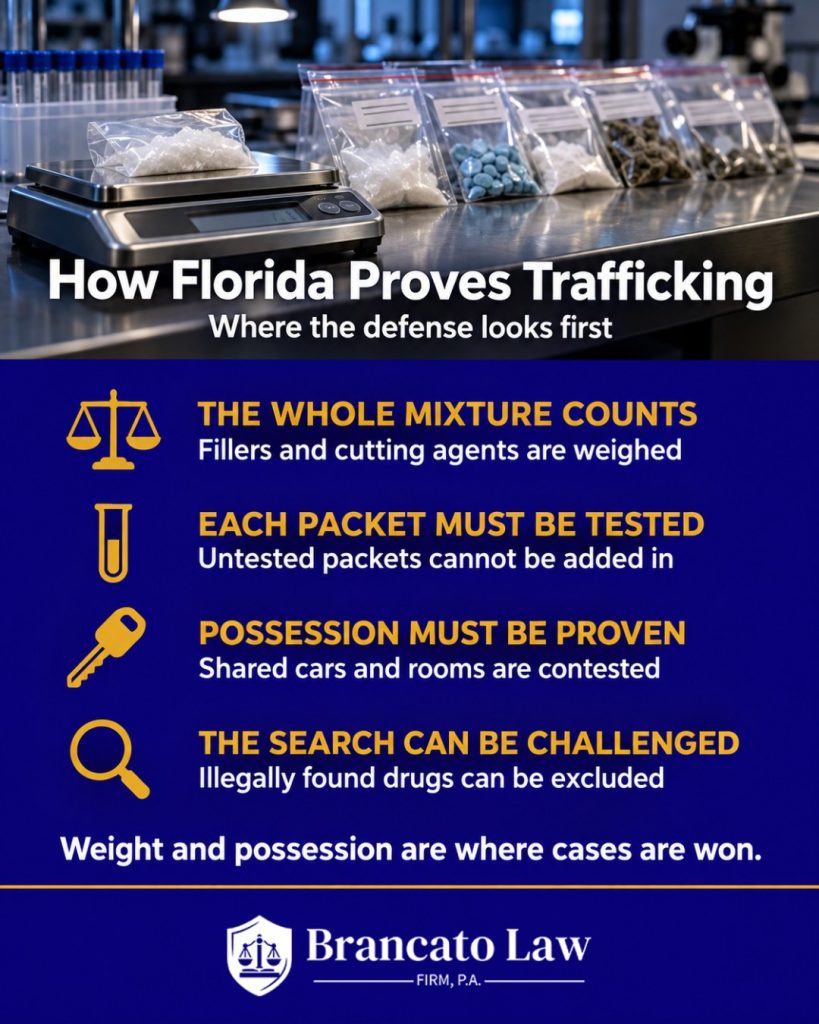
Florida counts the total weight of the mixture, not the weight of the pure drug. Section 893.135(6) says “the weight of the controlled substance is the total weight of the mixture,” including solutions and dosage units such as pills, capsules and tablets. Cutting agents, binders and the pill itself all count. That is how a small number of oxycodone or hydrocodone tablets can cross a trafficking line.
The State must still prove what the substance is and how much of it there is, packet by packet. In Greenwade v. State, 124 So. 3d 215 (Fla. 2013), officers found nine baggies of white powder, and the contents were combined before the lab tested them. The Florida Supreme Court held that when separately wrapped packets hold a substance that can be mistaken for something else, such as white powder, the State must chemically test each packet before adding them together. Because the powder was commingled first, the court ordered the trafficking conviction reduced to simple possession.
Field tests add another layer of risk. A 2024 study from the University of Pennsylvania Carey Law School’s Quattrone Center, Guilty Until Proven Innocent: Field Drug Tests and Wrongful Convictions, estimated that about 773,000 U.S. drug arrests each year involve color-based field tests and that roughly 30,000 people a year who had no illegal drugs are falsely implicated by them. When an arrest affidavit rests on a roadside test, our attorneys start asking what the lab actually confirmed.
What happened in the Tampa airport cannabis case?
Campbell v. State, 407 So. 3d 558 (Fla. 2d DCA 2025), is a Hillsborough County case that shows how weight proof can collapse. In July 2022, Tampa International Airport police running a narcotics interdiction on a flight from Denver had a K-9 alert to two duffle bags. The bags held fifty vacuum-sealed bundles of green, leafy material, and the two packages weighed 32.57 pounds each. The FDLE analyst tested a sample from only one bundle.
The Second District Court of Appeal reversed the trafficking conviction. Because legal hemp and illegal cannabis cannot be told apart by look or smell, the court held that, absent other proof, the State cannot rely on look and smell and must chemically test each package it wants counted toward the trafficking weight. The tested sample weighed 24.47 grams, so the court ordered the conviction reduced to felony possession of cannabis. The Second District hears appeals from Hillsborough, Pinellas and Pasco Counties, so this rule binds trial courts here. The lesson reaches past cannabis: the trafficking weight is only what the State can prove with lab work, packet by packet. Our post on what happens when you are charged with the wrong drug in Florida covers the related problem of lab results that do not match the charge.
Can a judge go below the mandatory minimum for drug trafficking in Florida?
No, not on the judge’s own. Section 893.135(3) bars the court from suspending, deferring or withholding a trafficking sentence, so the minimum applies after a conviction at the charged weight. A sentence below the minimum generally requires the prosecutor’s participation: a negotiated plea to a lower weight tier or a lesser offense, or a substantial assistance motion.
Substantial assistance is the statute’s built-in exception. Under section 893.135(4), the state attorney may ask the sentencing court to reduce or suspend the sentence of a person who helps identify, arrest or convict accomplices or others involved in trafficking, and the judge may grant it only on finding that substantial assistance was given. The motion can be heard in camera, meaning in a closed hearing, for good cause. Cooperation carries real safety and legal risks, and the terms should be negotiated by counsel before anyone talks. Our fentanyl guide explains why substantial assistance is a last resort in most cases.
State data shows that sentences below the minimum are common at the higher tiers. Florida’s Office of Economic and Demographic Research reported in its 2023 Criminal Justice Impact Conference analysis of HB 355 that in fiscal year 2021-22, 81.3% of new prison commitments for fentanyl trafficking of 14 to 28 grams were sentenced below the then-15-year minimum, along with 71.4% of commitments at 28 grams or more. Only 7.2% at the lowest tier were. The report does not say how each lower sentence came about, and the Legislature raised the fentanyl minimums to 7 and 20 years in 2022, but the numbers show that at the higher tiers the charged minimum was often not the sentence imposed.
How do our attorneys defend drug trafficking charges?
Our attorneys defend trafficking cases by attacking each thing the State must prove: the legality of the search, the link between the client and the drugs, the identity and weight of the substance, and the conduct of any informant. Our firm works through six steps in a typical case.
- Act before the filing decision. In Hillsborough County, the State Attorney’s Office decides what to file after the arrest. Our firm puts the weight, lab and possession problems in front of the assigned prosecutor during that window, when a lower charge or a decision not to file is still on the table.
- Challenge the stop and search. Most trafficking cases start with a traffic stop, a K-9 sniff or a warrant. A motion to suppress asks the judge to exclude drugs found through an illegal search; our guide to how a motion to suppress works in Florida explains the hearing. I trained officers as a former police academy instructor, and our attorneys use that knowledge to cross-examine officers on what they actually saw and smelled.
- Contest possession. Shared vehicles, shared bedrooms and passengers are the core of most constructive possession defenses, and the State’s proof of knowledge and control can fail at a suppression hearing, at a motion for judgment of acquittal and again in front of the jury.
- Test the lab and the weight. We request the lab’s bench notes, testing records, scale calibration records and chain of custody, and we retain independent experts when the numbers are close to a threshold.
- Investigate the informant. Many trafficking cases begin with a confidential informant working off charges or paid by an agency, and the informant’s deal can become a defense.
- Negotiate from strength. When the evidence has gaps, our attorneys use them to push for a lower tier, a non-trafficking charge, or diversion.
Does the odor of cannabis still justify a car search?
In the Second District, not by itself. In Williams v. State, 421 So. 3d 809 (Fla. 2d DCA 2025), a Hillsborough County probation case decided en banc on October 1, 2025, the court held that the smell of cannabis standing alone no longer gives officers probable cause to search, because hemp and medical marijuana are legal. Odor is still one factor among all the circumstances. The defendant in that case still lost under the good-faith exception because officers had relied on earlier precedent, and the court certified the question to the Florida Supreme Court, so the rule could change. For searches in our area after that date, a stop that turns on smell alone is a suppression issue our attorneys raise in every trafficking case that starts that way.
When is entrapment a defense in a trafficking case?
Entrapment is a defense when a government agent induced the crime and the person was not already predisposed to commit it. Under section 777.201, Florida Statutes, the accused must prove inducement by the greater weight of the evidence. In Munoz v. State, 629 So. 2d 90 (Fla. 1993), the Florida Supreme Court held that once the accused shows inducement and produces evidence of no predisposition, the State must prove predisposition beyond a reasonable doubt, and a judge may find entrapment as a matter of law when the facts are undisputed.
Informant pay can also end a prosecution. In State v. Glosson, 462 So. 2d 1082 (Fla. 1985), a sheriff’s informant was promised 10% of the civil forfeitures from the cases he made and had to testify to collect. The Florida Supreme Court held that the arrangement violated the Florida Constitution’s due process clause and approved the dismissal of the charges. Later decisions have applied that holding narrowly, so the exact terms of the informant’s deal matter, and our firm’s guide to confidential informants in Florida criminal cases explains when the State must reveal who the informant is.
What happens after a trafficking arrest in Hillsborough County?
A trafficking arrest in Hillsborough County moves fast, and the first weeks often decide the shape of the case. Here is the typical sequence our attorneys see in the 13th Judicial Circuit.
| Stage | When | What our attorneys do |
|---|---|---|
| First appearance | Within 24 hours, by video from the jail | Argue for reasonable bond and conditions; oppose any State motion for pretrial detention |
| Filing decision | The weeks after arrest | Present weight, lab and possession problems to the prosecutor before charges are formalized |
| Arraignment and discovery | After the information is filed | Obtain body camera video, lab reports, informant records and search warrants |
| Depositions and motions | Months before trial | Depose officers and lab analysts; file motions to suppress and motions to dismiss |
| Plea negotiations or trial | After the motions are heard | Negotiate toward a lower tier or non-trafficking charge, or try the case to a jury |
First appearance is the first chance to get a client home. Unlike some nearby counties, Hillsborough County does not offer pretrial services supervision as a release option, so the bond argument at the Hillsborough County first appearance carries real weight. Our office at 620 E. Twiggs Street is two blocks from the courthouse, and our attorneys also defend trafficking cases in Pinellas County and Pasco County.
What results has our firm gotten in trafficking cases?
Our firm has resolved trafficking charges through dismissal, diversion and jury acquittal. These are published results from our case results page.
| Charge | Result | What made the difference |
|---|---|---|
| Fentanyl trafficking (March 2025) | Dismissed within about three weeks of arrest | Defeated the State’s motion for pretrial detention, then challenged constructive possession and the legality of the vehicle search |
| Trafficking in amphetamine (August 2025) | Charge reduced; client admitted to diversion, with dismissal on completion | A motion to suppress exposed weaknesses in the State’s evidence |
| Cocaine trafficking, 200 to 400 grams (Tampa) | Not guilty | The State relied on a co-defendant’s testimony; the defense showed the client was only present |
Past results do not guarantee future outcomes. Every case turns on its own facts.
Frequently asked questions about Florida drug trafficking charges
Can trafficking charges be dropped or reduced in Florida?
Yes, trafficking charges can be dropped or reduced when the search was illegal, the possession proof is weak, or the State cannot prove the weight with lab testing. The Brancato Law Firm has seen a fentanyl trafficking case dismissed within about three weeks and an amphetamine trafficking charge reduced to diversion after a motion to suppress. In Campbell v. State, 407 So. 3d 558 (Fla. 2d DCA 2025), an appellate court reduced a trafficking conviction to felony possession because only one of fifty bundles was tested.
Can you recommend a lawyer in Tampa who handles drug trafficking charges?
Look for a Tampa attorney whose practice is devoted entirely to criminal defense, from misdemeanors to capital cases, who has tried trafficking cases to a jury, and who will start on the case before the State files charges. At The Brancato Law Firm, our attorneys handle drug cases from possession through trafficking, backed by Rocky Brancato’s more than 150 jury trials to verdict, his AV Preeminent rating, and his selection to Super Lawyers and the National Trial Lawyers Top 100. Clients get updates through our client portal and calls returned within 24 hours, and Jean-Luc Adrien speaks Spanish, Haitian Creole and French. Our Tampa drug trafficking defense page lists our full approach.
Who would you recommend for a cocaine trafficking defense attorney in Florida?
Choose a trial attorney who knows how cocaine weight is proven, because trafficking starts at 28 grams and the State must chemically test separately wrapped packets of powder before adding them together. Our attorneys at The Brancato Law Firm won a not guilty verdict for a Tampa business manager accused of trafficking 200 to 400 grams of cocaine. We defend cocaine trafficking cases in Hillsborough, Pinellas and Pasco Counties, and Rocky Brancato is the author of How to Choose a Major Crimes Attorney – or Any Criminal Defense Attorney for That Matter.
I was arrested for fentanyl possession in Tampa. Is that trafficking?
It depends on the weight: 4 grams or more of a fentanyl mixture is trafficking with a 7-year minimum, while a smaller amount is generally possession, a third-degree felony under section 893.13, Florida Statutes. The Brancato Law Firm looks first at the lab report, because the weight of a mixture and the exact substance identified can move a case above or below that line. The lab must also identify the right drug, since fentanyl analogues are listed separately in Florida’s drug schedules.
Is oxycodone trafficking based on the number of pills or their weight?
Oxycodone trafficking is based on the total weight of the pills, including fillers and binders, starting at 7 grams. Our attorneys at The Brancato Law Firm check whether the lab weighed and tested each container separately and whether the pill count matches the property receipt. The weight math matters because the tiers jump from a 3-year minimum at 7 grams to 7 years at 14 grams.
How much does a drug trafficking lawyer cost in Tampa?
The cost depends on the facts and the intricacy of the case, including the weight tier, the number of defendants, and whether lab or search experts are needed. The Brancato Law Firm quotes a flat fee that covers the whole case, including trial, with at least half up front and a payment plan for the balance while the case is pending. Consultations are free, and our firm is neither the most nor the least expensive in Tampa. Our guide to what a criminal defense attorney costs in Tampa explains why some firms charge a separate trial fee and how that creates a financial incentive to settle before trial preparation begins.
Talk to our firm about a trafficking charge
For more about our defense strategies, visit our Drug Crimes page.
A trafficking arrest starts the clock on bond, the State’s filing decision and the evidence our attorneys need to preserve, including video, lab records and informant files. The Brancato Law Firm, P.A., founded by Tampa Criminal Defense Attorney Rocky Brancato, defends trafficking charges in Hillsborough, Pinellas and Pasco Counties, from the first appearance through trial. Call (813) 727-7159 for a free consultation. You can call us at any hour.
The Brancato Law Firm, P.A.
620 E. Twiggs Street, Suite 205, Tampa, FL 33602
(813) 727-7159
Serving Hillsborough, Pinellas, and Pasco Counties
The Brancato Law Firm, P.A. is a Tampa-based criminal defense practice. We are not affiliated with any other Brancato-named law firms.
Visit Us

Tampa, FL 33602

Contact Us Now
Free Legal Consultation (813) 727-7159
