- Free Consultation 24/7: (813) 727-7159 Tap Here To Call Us


From First DUI to Death Penalty


What Is a Forensic Defense Lawyer?


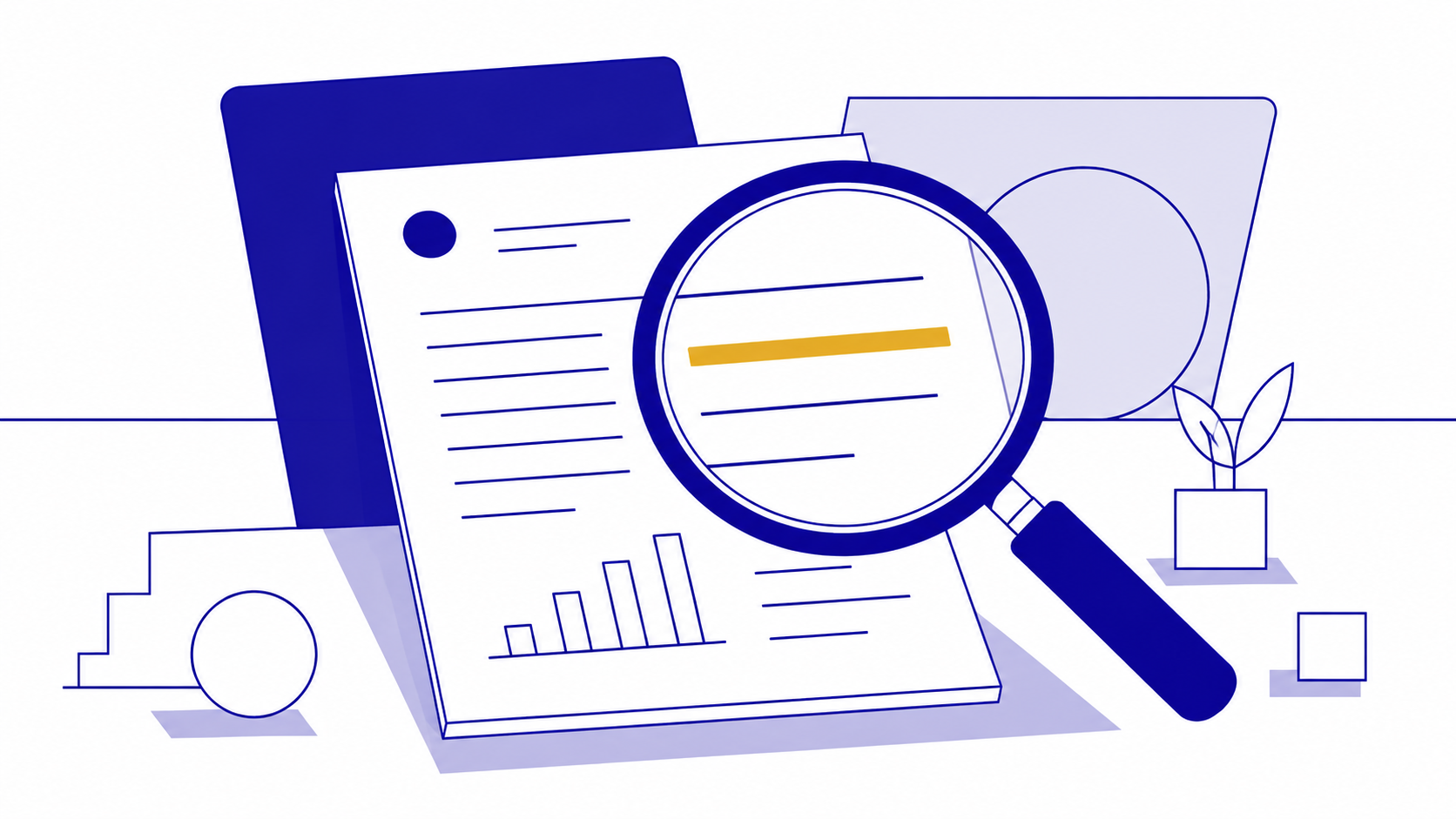
A forensic defense lawyer is a criminal defense attorney who specializes in scrutinizing and challenging the scientific evidence a prosecutor uses to prove guilt: DNA, breath and blood tests, fingerprints, ballistics, digital data, and autopsy findings. There is no separate license or bar exam for it. The distinction is depth of skill. A forensic defense lawyer reads the lab’s bench notes, not just the one-page summary report, and knows where the science breaks down.
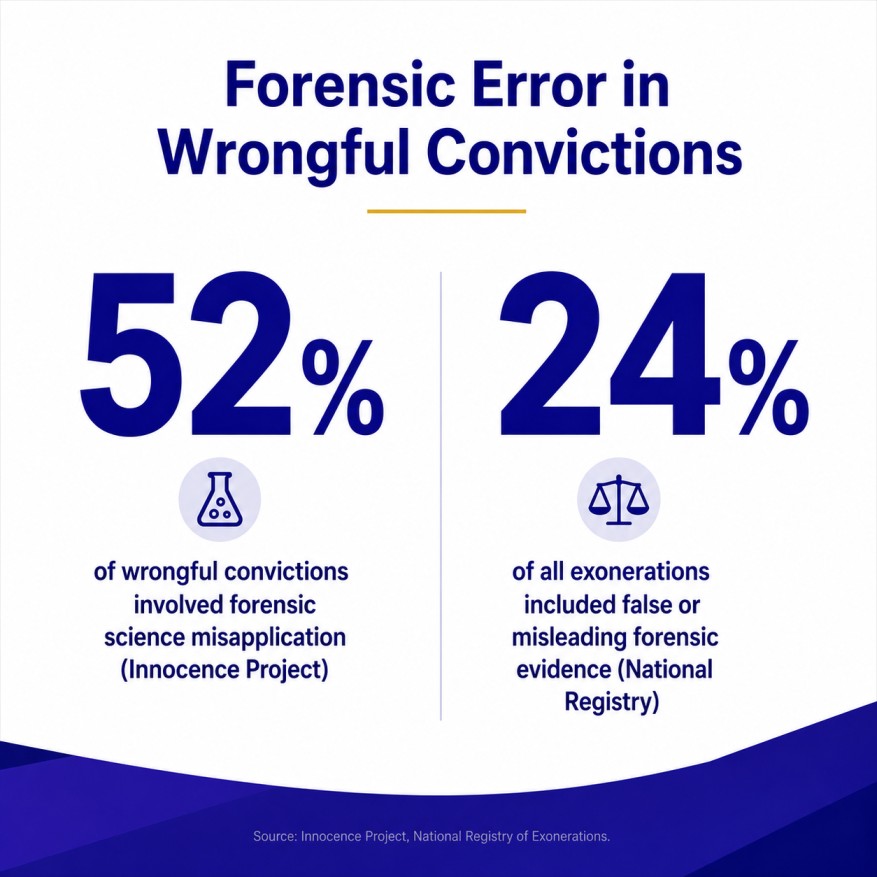
That distinction is not academic. The misapplication of forensic science contributed to 52% of wrongful convictions in Innocence Project cases, and false or misleading forensic evidence is a contributing factor in roughly 24% of all exonerations tracked by the National Registry of Exonerations. At The Brancato Law Firm, our forensic science defense work is built around a single premise: a forensic report can look like proof and still be wrong. This guide explains what the role actually is, why it matters more than most people realize, and how to tell whether a lawyer can do the work or just talk about it.
What “Forensic” Actually Means
“Forensic” does not mean “scientific.” It comes from the Latin forensis, meaning “of the forum,” the public square in Rome where legal and civic business was conducted. Cornell’s Legal Information Institute defines it as “used in or suitable to courts of justice.” So a forensic science is any science applied to the questions a court has to answer. A forensic defense lawyer, by extension, is an attorney who applies that science to the courtroom on behalf of the accused.
The American Academy of Forensic Sciences puts it simply: when a scientist’s knowledge is used to help lawyers, juries, and judges understand the results of scientific tests, that scientist becomes a forensic scientist. And the same organization is clear that any party to a case can challenge whether the scientist performed the tests correctly, whether the results were interpreted accurately, and whether the underlying method is even valid. That challenge function is the entire job.
How a Forensic Defense Lawyer Differs From a General Criminal Defense Attorney
Every criminal defense attorney handles the full arc of a case: arraignment, discovery, plea negotiations, and trial. A forensic-focused defender does all of that and adds the ability to take the science apart. The difference shows up in what the lawyer does when a lab report lands on the desk.
| Dimension | General Criminal Defense Attorney | Forensic-Focused Defense Lawyer |
| Evidence approach | Reviews reports, may accept stated conclusions | Reads raw data and bench notes, seeks re-testing, looks for flaws |
| Use of experts | Retains an expert when the need is obvious | Routinely retains independent experts across disciplines |
| Cross-examination | General witness skills | Technical cross on methodology, error rates, and analyst assumptions |
| Pretrial motions | Standard suppression motions | Daubert or Frye challenges to the validity of the science itself |
| Knowledge base | Law and procedure | Law, procedure, and a working command of the relevant science |
An attorney who lacks forensic knowledge cannot effectively challenge forensic evidence. The conclusions on the report go unquestioned, and the jury hears the state’s version of the science as settled fact. An attorney who understands the science can find the weaknesses other lawyers miss.
The Core Job: Refusing to Take the Science at Face Value
The work of a forensic defense lawyer comes down to one discipline: not accepting a forensic conclusion just because it arrived in a lab report on official letterhead. Laboratory errors happen. Analysts misinterpret data. Experts sometimes reach conclusions the science does not support. And prosecutors routinely overstate what a result actually proves.
The National Institute of Justice identifies five types of forensic error that a defense lawyer can probe:
- Misstatements written into the forensic report itself
- Individualization or classification errors, where an analyst declares a “match” the data does not support
- Testimony errors, such as overstating the statistical weight of a result
- Officer-of-the-court errors
- Evidence-handling errors, including broken chain of custody and lost or contaminated samples
Notice how many of those live in the process, not the headline conclusion. A clean-looking result can sit on top of a sloppy collection, a contaminated sample, or a misread data point. The forensic defense lawyer’s job is to demand the underlying material and check.
Why This Matters: The Data on Forensic Error
Forensic evidence carries enormous weight with juries because it sounds objective. The record says otherwise. Flawed forensics is one of the most measurable causes of wrongful conviction in the country.
- Among DNA exonerations nationwide, unvalidated or improper forensic science was a factor in roughly half of the underlying wrongful convictions, according to the Innocence Project.
- The National Registry of Exonerations attributes false or misleading forensic evidence to roughly a quarter of all exonerations it has recorded, a database that now holds more than 3,400 cases since 1989.
- In its review of hundreds of cases, the NIJ concluded that in about half of the wrongful convictions analyzed, better technology or stricter testimony standards may have prevented the conviction at the time of trial.
The starkest example is the FBI’s own. The Justice Department and FBI formally acknowledged that 26 of 28 examiners in the Bureau’s microscopic hair comparison unit gave testimony or lab reports containing errors, with erroneous statements in at least 90% of the trial transcripts reviewed from the period before 2000. Among those cases, defendants in at least 35 received the death penalty, and errors were found in 33 of them. This was not a rogue lab. It was the gold-standard federal laboratory, and the science it presented as certain was overstated for decades.
Not All Forensic Evidence Is Equally Reliable
The phrase “the forensic evidence” hides a wide range of reliability. Two national reviews settled this. The 2009 National Academy of Sciences report, Strengthening Forensic Science in the United States, found that many disciplines admitted in court lacked the scientific foundation to support the conclusions drawn from them. The 2016 PCAST report reviewed more than 2,000 papers and graded six feature-comparison methods. Only single-source DNA, and with caveats, latent fingerprints, came out as foundationally valid.
Here is how the major evidence types stack up, and where a defense challenge usually lands.
| Evidence type | Reliability status | Common defense challenge |
| DNA, single source | Extremely reliable, the closest thing to a gold standard | Contamination, chain of custody, lab handling error |
| DNA, complex mixtures | Interpretation can be subjective, with limited public validation data | Mixture deconvolution, probabilistic genotyping assumptions |
| Latent fingerprints | Foundationally valid but subjective | False-positive rates, confirmation bias |
| Firearms and toolmarks | Validity questioned by PCAST | Lack of foundational validation, error rates |
| Bite marks | Found scientifically invalid | Motion to exclude entirely, no scientific basis |
| Microscopic hair | Highly unreliable per the 2009 NAS report | Overstated certainty, superseded by DNA |
| Toxicology and BAC | Method valid but assumption-dependent | Retrograde extrapolation assumptions, sample timing |
| Digital forensics | Reliability depends on process | Chain of custody, data integrity, interpretation |
A few of these deserve a closer look, because the gap between how reliable they sound and how reliable they are is where cases turn.
DNA Is Not One Thing
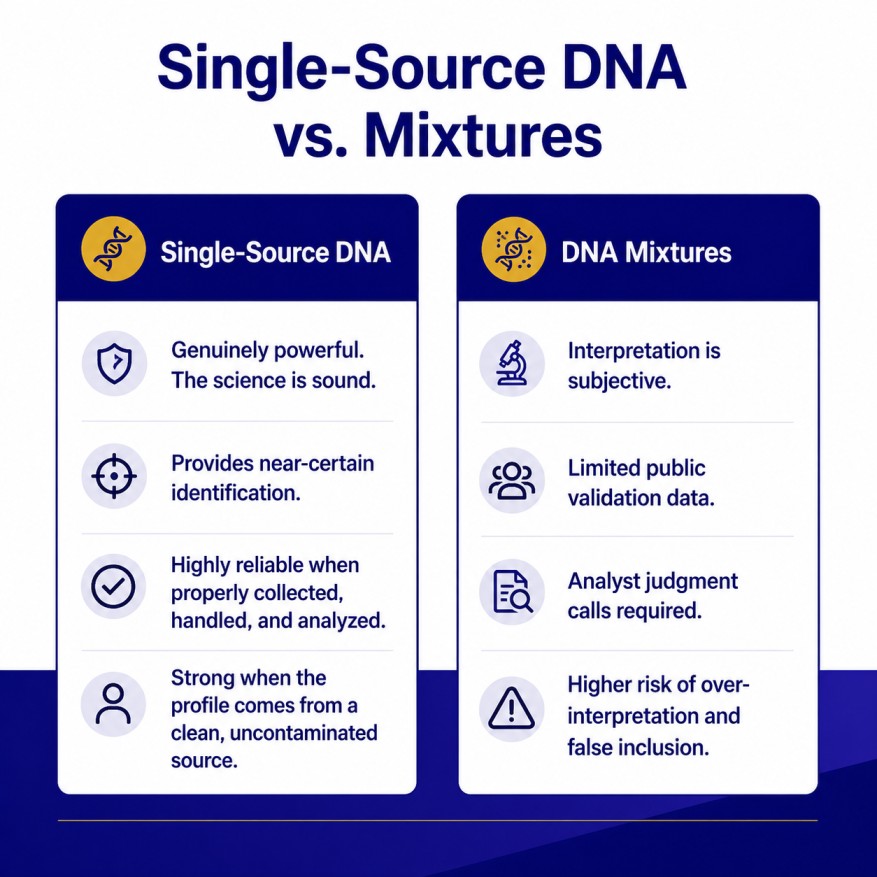
Single-source DNA from a clean sample is genuinely powerful. The science is sound. But NIST cautions that DNA mixtures, samples containing genetic material from more than one person, present far greater challenges, and that there is not enough publicly available data to independently assess the software used to interpret them. So “they found your DNA” can mean a near-certain identification, or it can mean an analyst made a judgment call about a muddy mixture. Those are not the same, and a forensic defense lawyer treats them differently.
Fingerprints Are Subjective
Most people assume a fingerprint match is binary. It isn’t. PCAST found latent print analysis to be valid but with a false-positive rate the report called substantial, citing study results ranging from roughly 1 error in 306 cases to 1 in 18, depending on the lab. The comparison still depends on a human examiner’s judgment about whether two prints “match.” We covered this in more depth in our breakdown of why fingerprint evidence is less reliable than most people think.
Some Courtroom “Sciences” Have No Scientific Basis
Bite mark comparison is the clearest example. PCAST concluded it does not meet the standard for foundational validity, and the Innocence Project has tied at least 26 wrongful convictions or indictments to it. When a discipline has been found scientifically invalid, the strategy is not to rebut it with a competing expert. It is to move to exclude it entirely.
Toxicology Depends on Assumptions
In a DUI case, the breath or blood test usually happens well after the traffic stop. To estimate your level at the time you were driving, the state relies on retrograde extrapolation, a backward calculation built on assumptions about absorption and elimination rates. One of the field’s foundational researchers warned that extrapolating a later test back to the time of the offense is “always of uncertain validity.” We walk through a real version of this problem in our case study on why your BAC at the station is not your BAC behind the wheel.
The Cases Where Forensic Defense Decides the Outcome
Forensic challenges matter most in the cases where the science is the case.
- Homicide: autopsy and cause-of-death findings, blood spatter, ballistics, and DNA. In one homicide defense matter we handled, a former state medical examiner reviewed the scene photos and tissue slides and concluded a child’s death was an accidental drowning, with a liver injury consistent with CPR compressions rather than inflicted trauma. First-degree murder and aggravated child abuse charges were dismissed.
- Sexual assault: DNA analysis and sexual assault nurse examiner findings, where mixture interpretation and the source of an injury are often contestable.
- DUI and vehicular homicide: toxicology, retrograde extrapolation, and accident reconstruction.
- Drug offenses: substance identification, where field test kits, not lab analysis, drove the single largest error category in the NIJ’s data.
- White-collar crime: forensic accounting, used to establish or rebut intent in fraud, embezzlement, and money-laundering cases.
- Cybercrime: digital forensics, which NIST defines as acquiring, preserving, and analyzing evidence using methods that are demonstrably reliable, accurate, and repeatable, all of which can be challenged when the process falls short.
Each case is unique. Past results do not guarantee future outcomes.
The Legal Tools That Make the Challenge Possible
Knowing the science is only half of it. A forensic defense lawyer also has to know the rules that let a court keep bad science out or force the state to defend its methods. Four matter most.
| Tool | What it does |
| Daubert / Frye standards | Govern whether expert testimony is admissible at all. A Daubert motion asks the judge, acting as gatekeeper, to exclude testimony whose method has not been tested, peer-reviewed, or shown to have an acceptable error rate. Florida adopted the Daubert standard in 2013. |
| Melendez-Diaz v. Massachusetts | The Supreme Court held that a forensic analyst’s report prepared for prosecution is testimonial, so the defendant has the right to confront and cross-examine the analyst in person rather than accept a signed report. |
| Ake v. Oklahoma | Established that indigent defendants are entitled to expert assistance when it may be crucial to mounting a defense, a right courts have extended well beyond psychiatry to DNA and other forensic experts. |
| ABA Defense Function Standards | Direct counsel to evaluate the prosecution’s evidence, including the possible re-testing or re-evaluation of physical and forensic evidence. |
You can read the Confrontation Clause holding in full in Melendez-Diaz v. Massachusetts, and the duty-to-investigate language in the ABA’s Defense Function Standards. Together these tools are why a forensic challenge is possible at all: the law gives the accused the right to test the science, retain independent experts, and demand that analysts answer for their methods under oath.
How to Vet a Lawyer for a Science-Heavy Case
If your case turns on forensic evidence, the most useful thing you can do is figure out whether a prospective lawyer actually does this work or only references it. The questions are simple, and the answers are revealing.
- “Which forensic experts have you worked with?” A lawyer who does this work can name disciplines and, often, specific experts: forensic pathologists, DNA analysts, toxicologists, firearms examiners, digital forensics professionals. Vague answers are a flag.
- “What would you demand beyond the summary report?” The right answer involves bench notes, raw electronic data, lab accreditation records, analyst proficiency-testing results, and full chain-of-custody documentation. A lawyer who plans to work from the one-page summary is telling you something.
- “How would you cross-examine the state’s expert?” Look for specifics about methodology, error rates, and the analyst’s own assumptions, not a general promise to “challenge” the witness.
- “Would you re-test or get an independent review?” The ABA standards contemplate exactly this, and independent review is frequently where exculpatory findings surface.
Forensic defense lawyer is not a credential you can verify on a bar website. There is no separate license, and some attorneys market scientific labels without the trial experience to back them. Evaluate demonstrated experience over titles. The right question is not “are you a forensic lawyer,” it is “show me a case where you took the state’s science apart.”
This is the work we treat as central rather than optional. Our approach routinely involves subpoenaing bench notes, sending raw data to independent labs, and retaining experts who sit beside us through every deposition of the state’s analysts. In one cold-hit DNA case, that process surfaced a misread allele the state’s own analyst had relied on, and the charge was dismissed. Each case is unique, and past results do not guarantee future outcomes. We also wrote separately about why expert witnesses are not optional in serious cases, because in many of them, the right expert is the difference between a conviction and a dismissal.
The “CSI Effect” Cuts Both Ways
Television shapes what jurors expect. One forensic scientist estimated that 40% of the scientific techniques shown on crime dramas do not actually exist. The so-called CSI effect describes how those expectations bleed into real courtrooms, and it works in two directions. Jurors may demand forensic evidence that a case does not actually require, which can help the defense. Or they may over-credit forensic testimony simply because it is presented in a lab coat, which helps the prosecution.
The research is genuinely mixed. A large study of more than 1,000 jurors found heightened expectations but no clear link between watching crime shows and a tendency to convict. So the CSI effect is not a reliable advantage for either side. What it does confirm is that juries arrive primed to trust forensic science, which is exactly why someone has to be in the room who can show them when that trust is misplaced.
Frequently Asked Questions
Is a forensic defense lawyer the same as a forensic scientist?
No. A forensic scientist performs lab analysis, such as testing DNA or examining fingerprints. A forensic defense lawyer is an attorney who knows enough about that science to challenge it in court, retain independent experts, and cross-examine the analysts who did the testing.
Do I need a forensic defense lawyer for a DUI?
Often, yes. DUI cases turn on breath or blood toxicology, and the science behind a result is more contestable than most people assume. Retrograde extrapolation, the calculation used to estimate your level at the time of driving, depends on assumptions that a knowledgeable lawyer can challenge.
Can forensic evidence be wrong?
Yes. Lab errors, contamination, broken chain of custody, and analyst misinterpretation all occur, and some courtroom disciplines such as bite mark comparison have been found to lack scientific validity. False or misleading forensic evidence is a documented factor in a significant share of wrongful convictions nationwide.
What is a Daubert motion?
A Daubert motion asks the judge to exclude expert testimony whose method has not been properly tested, peer-reviewed, or shown to have an acceptable error rate. Florida adopted the Daubert standard in 2013, which gives the defense a tool to keep unreliable science out of the courtroom entirely.
The Bottom Line
A forensic defense lawyer is a criminal defense attorney with the scientific fluency to challenge the evidence that looks the most airtight. The role is defined by what the lawyer does with a lab report: reads the underlying data, retains independent experts, files the motions that keep weak science out, and cross-examines the state’s analysts on the parts they would rather not explain. The wrongful conviction data is the case for why it matters. When the science is wrong and no one checks, people go to prison for things they did not do.
If you or a family member is facing a charge that hinges on forensic evidence in Hillsborough, Pinellas, or Pasco County, get a lawyer who will read the bench notes, not just the summary. Call The Brancato Law Firm at (813) 727-7159 or request a confidential consultation to talk through how the science in your case can be tested.
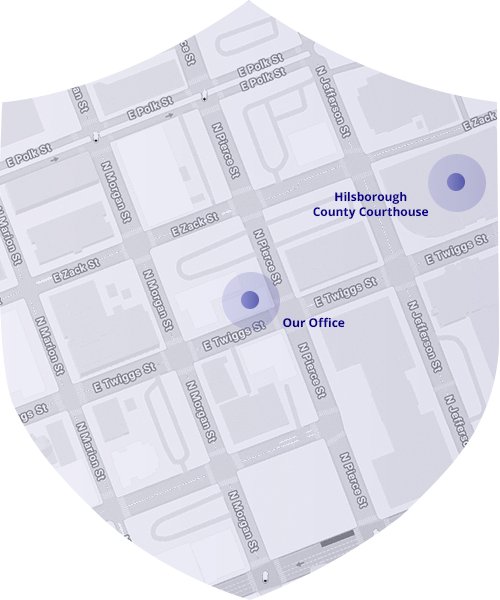
Visit Us
Tampa, FL 33602
Contact Us Now
Free Legal Consultation (813) 727-7159