- Free Consultation 24/7: (813) 727-7159 Tap Here To Call Us




What Are the Criminal Penalties for Unlicensed Contracting in Florida Under § 489.127?


| KEY TAKEAWAYUnder Florida Statute § 489.127, a first-offense unlicensed contracting charge carries first-degree misdemeanor penalties—up to one year in jail and a $1,000 fine. However, a second offense or contracting during a declared state of emergency elevates the charge to a third-degree felony, which means up to five years in prison.In addition, licensed contractors who lend their license numbers to unqualified individuals also face criminal prosecution. Because of this, early legal intervention by an experienced criminal defense attorney can mean the difference between a felony conviction and a reduced or dismissed charge. |
I’m Tampa Criminal Defense Attorney Rocky Brancato. For over 25 years, I’ve defended clients in Hillsborough County facing charges under Florida’s contracting statutes—including unlicensed contracting, permit fraud, and license-lending violations that carry serious criminal consequences.
What Does Florida Statute § 489.127 Prohibit That The Brancato Law Firm Defends Against?
Florida’s unlicensed contracting statute is broad and aggressive. Specifically, it doesn’t just target people performing construction work without a license—it criminalizes a wide range of conduct connected to contractor licensing. In our experience defending these cases in Hillsborough, Pinellas, and Pasco Counties, many clients are shocked to learn how easily a business dispute or paperwork lapse can turn into a criminal case.
| FLORIDA STATUTEFlorida Statute § 489.127(1) makes it unlawful to: falsely hold oneself out as a licensee; impersonate a certificate holder; present another person’s certificate as your own; give false evidence to the licensing board; use a suspended or revoked license; engage in contracting without certification or registration; operate a contracting business without a qualifying agent for more than 60 days; commence work requiring a building permit without one; or willfully violate local ordinances relating to unlicensed contractors.Importantly, the law treats anyone operating on an inactive or suspended certificate as unlicensed. Furthermore, a business tax receipt under Chapter 205 does not qualify as a license. |
Because the statute casts such a wide net, The Brancato Law Firm regularly sees cases where a contractor’s certification lapsed during a project, where a handyman performed work that crossed the licensing threshold, or where a business owner genuinely believed they maintained compliance. Although the prosecution doesn’t always distinguish between intentional fraud and honest mistakes, we do.
What Are the Penalties for Unlicensed Contracting Charges in Tampa and Hillsborough County?
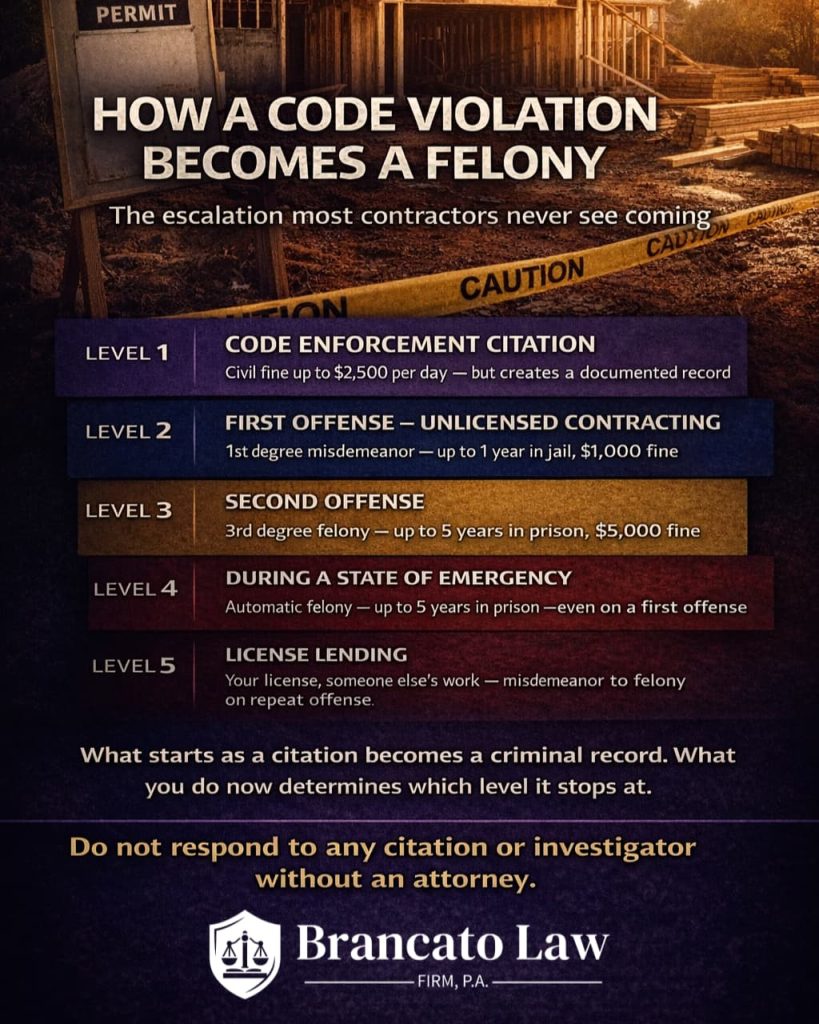
The penalties under § 489.127 escalate quickly based on prior history and the circumstances of the offense. As a result, early contact with a criminal defense attorney matters—because what starts as a first-offense misdemeanor can become a felony if you do not handle it properly.
| Violation | Classification | Jail/Prison | Fine |
|---|---|---|---|
| First offense (unlicensed) | 1st Degree Misdemeanor | Up to 1 year in jail | Up to $1,000 fine |
| Second/subsequent offense | 3rd Degree Felony | Up to 5 years in prison | Up to $5,000 fine |
| Offense during state of emergency | 3rd Degree Felony | Up to 5 years in prison | Up to $5,000 fine |
| Pollutant storage systems violation | 3rd Degree Felony | Up to 5 years in prison | Up to $5,000 fine |
| Licensed contractor lending license | 1st Degree Misdemeanor | Up to 1 year in jail | Up to $1,000 fine |
| Repeat license lending | 3rd Degree Felony | Up to 5 years in prison | Up to $5,000 fine |
| Refusing code enforcement citation | 2nd Degree Misdemeanor | Up to 60 days in jail | Up to $500 fine |
| The Brancato Law Firm, P.A. | (813) 727-7159 | Defending Hillsborough, Pinellas & Pasco Counties | |||
| CRITICAL WARNING: If prosecutors charge you with unlicensed contracting during a Governor-declared state of emergency—such as after a hurricane—Florida law automatically elevates the charge to a third-degree felony. For example, following Hurricane Milton (2024), the State Attorney’s Office in Hillsborough County aggressively pursued these cases. Therefore, do not assume a misdemeanor-level consequence. Instead, contact The Brancato Law Firm, P.A. immediately at (813) 727-7159. |
Can a Licensed Contractor Face Criminal Charges for Lending Their License Number in Florida?
Yes—and this is one of the most overlooked risks in the contracting industry. Specifically, Section 489.127(4) criminalizes what contractors commonly call “license lending” or “pulling permits” for an unlicensed person or unqualified business organization.
| FLORIDA STATUTEUnder § 489.127(4), a certified or registered contractor may not: enter into any agreement (oral or written) allowing an unlicensed person or unqualified business to use their certification number; knowingly allow an unlicensed person to use their number; or apply for or obtain a building permit unless they or their qualified business have actually contracted to perform the work at that property.Consequently, a first offense carries first-degree misdemeanor penalties. Moreover, a second offense escalates to a third-degree felony. |
In our practice, we have defended licensed contractors in Hillsborough County who entered into informal arrangements—sometimes with family members or long-time associates—without realizing the criminal exposure. Because The Brancato Law Firm understands the nuances of these arrangements, we build defenses around the specific facts of each case, including whether the contractor had actual knowledge that the arrangement violated the statute.
What Happens When DBPR Issues a Stop-Work Order for Unlicensed Construction Work?
Beyond criminal penalties, § 489.127(3) authorizes the Florida Department of Business and Professional Regulation (DBPR) to issue stop-work orders when it finds probable cause to believe unlicensed work is underway. In our experience defending contractors in the Tampa Bay area, a stop-work order often precedes criminal charges—and how you respond to it matters significantly.
How Does The Brancato Law Firm Challenge Stop-Work Orders and Related Criminal Charges?
First, probable cause challenges. The department must establish probable cause before issuing a stop-work order. We examine whether the investigation met this threshold and whether investigators overlooked a valid certificate or registration.
Second, licensing status disputes. Sometimes the issue comes down to timing—for instance, a qualifying agent left the business, or a renewal sat pending. In cases like these, we have argued successfully that the contractor did not truly operate as “unlicensed” at the relevant time.
Third, enforcement overreach. The DBPR can enforce stop-work orders through cease-and-desist actions under § 455.228. However, The Brancato Law Firm scrutinizes whether the department followed proper procedures and whether the order was proportionate to the alleged violation.
Can Local Code Enforcement Officers in Tampa Prosecute Unlicensed Contracting?
Yes. Section 489.127(5) gives counties and municipalities the authority to designate code enforcement officers to enforce unlicensed contracting laws. In Hillsborough County and the City of Tampa, this means local code enforcement can issue citations carrying civil penalties up to $2,500 per day for each violation.
| Brancato Law Firm, P.A. CRITICAL WARNING Code enforcement citations for unlicensed contracting are not just civil fines—they create a documented record that prosecutors can then use to pursue criminal charges. In addition, willfully refusing to sign a citation is itself a second-degree misdemeanor. If you’ve received a code enforcement citation related to contracting, do not ignore it. Instead, call The Brancato Law Firm, P.A. at (813) 727-7159 before you respond. |
Importantly, the code enforcement process includes the right to an administrative hearing before a licensing board or special magistrate. The Brancato Law Firm represents contractors at these hearings because the outcome directly impacts potential criminal exposure. Because we understand how the 13th Judicial Circuit and Hillsborough County enforcement boards operate, we prepare cases to prevent escalation from civil citation to criminal charge.
What Defenses Can a Tampa Criminal Defense Attorney Use Against Unlicensed Contracting Charges?
Unlicensed contracting charges are not automatic convictions. At The Brancato Law Firm, we build defense strategies based on the specific facts of each case. Because I served in the Major Crimes Unit of the Hillsborough County Public Defender’s Office and later led operations as Chief Operations Officer, I understand how prosecutors build these cases—and where the weaknesses hide.
Does The Brancato Law Firm Challenge Whether the Work Actually Required a License?
Not all construction-related work requires a contractor’s license. For example, Florida law provides exemptions for property owners performing work on their own property, for certain types of minor repairs, and for work below specified thresholds. As a result, we investigate whether the work actually fell within the scope of § 489.127 or whether an exemption applies.
Can The Brancato Law Firm Prove the Contractor’s License Was Valid at the Time of the Alleged Offense?
Florida courts have held that the statute’s prohibitions presuppose the existence of a valid certification. In particular, in State v. Summerlot, the Third DCA confirmed that prosecutors could charge a contractor operating on an inactive certificate—but this also means the prosecution must prove the certificate was actually invalid at the relevant time. Therefore, we obtain and scrutinize licensing records to find gaps in the state’s case.
Does The Brancato Law Firm Raise Lack-of-Knowledge Defenses in License Lending Cases?
For license-lending charges under § 489.127(4), the statute requires that the contractor “knowingly” allowed someone to use their number. This mens rea element serves as a powerful defense tool. Accordingly, we present evidence that our client did not have actual knowledge of the unlicensed use of their credentials.
| CASE INSIGHTIn Taylor Morrison Services v. Ecos (2015), the First DCA ruled that a contractor maintained proper licensure because it had a qualifying agent on the effective date of the contract—even though violations occurred later. This case illustrates how timing and qualifying agent status can prove decisive when defending contracting charges. As a result, The Brancato Law Firm uses cases like this to challenge the prosecution’s assumptions about licensing status. |
What Civil Consequences Can Arise from Unlicensed Contracting Charges Beyond Criminal Penalties?
Criminal charges under § 489.127 represent only part of the picture. In addition, unlicensed contracting can trigger civil consequences that affect a contractor’s livelihood, existing contracts, and real property. For this reason, The Brancato Law Firm addresses both the criminal and collateral consequences when defending these cases.
Contract enforceability. Under the related § 489.128, courts may deem contracts that an unlicensed contractor entered into as unenforceable. Notably, the Florida Supreme Court in Earth Trades, Inc. v. T&G Corp. (2013) clarified that the onus falls on the unlicensed contractor—which means your existing contracts and accounts receivable could face serious risk.
Liens on real property. Furthermore, civil penalties from code enforcement can become recorded liens against real and personal property under § 489.127(5)(h), and the local government can enforce them through circuit court foreclosure proceedings.
Workers’ compensation implications. Although the Second DCA held in Central Florida Lumber v. Qaqish (2009) that unlicensed status doesn’t eliminate workers’ compensation immunity, the intersection of licensing violations and employment relationships creates additional legal exposure that we evaluate for every client.
What Do Most Attorneys Miss When Defending Unlicensed Contracting Cases in Florida?
| Issue | What The Brancato Law Firm Knows |
|---|---|
| Qualifying agent timing | The statute turns on licensing status at the time of the conduct. If a qualifying agent held the position when the contractor signed the contract, later lapses may not support criminal charges. |
| Inactive vs. revoked distinction | The state treats an inactive certificate the same as unlicensed—however, the defense strategy differs from one involving a revoked certificate. We tailor the approach accordingly. |
| Knowledge requirement for § 489.127(4) | License-lending charges require proof of knowing conduct. Prosecutors often skip this element, and we hold them to it. |
| Code enforcement record as criminal evidence | Civil citations create a paper trail. Consequently, what you say or sign during a code enforcement encounter can work against you in criminal proceedings. |
| Emergency declaration enhancement | Prosecutors sometimes charge felonies based on emergency declarations that have already expired or that do not cover the geographic area of the alleged offense. |
| The Brancato Law Firm, P.A. | (813) 727-7159 | 25+ Years Criminal Defense Experience | |
Frequently Asked Questions About Unlicensed Contracting Charges in Florida
Questions About Unlicensed Contracting Defense
A first-offense unlicensed contracting violation carries first-degree misdemeanor penalties, including up to one year in jail. However, a second offense—or a first offense committed during a state of emergency—escalates to a third-degree felony with up to five years in prison. Because of this distinction, early intervention by an experienced defense attorney matters significantly.
Under § 489.127, the state treats anyone operating on an inactive or suspended certificate or registration as unlicensed. Moreover, a local business tax receipt does not count as a contractor’s license. Instead, the statute requires current, valid state certification or registration to legally perform contracting work.
Yes. For example, defenses including licensing status disputes, exemption arguments, lack-of-knowledge claims, and procedural challenges can lead to dismissals or reduced charges. The Brancato Law Firm evaluates every case for these opportunities and engages in pre-trial negotiations with the Hillsborough County State Attorney’s Office.
Absolutely. Because code enforcement citations create a documented record that prosecutors can use to support criminal charges, how you handle the citation directly affects your criminal exposure. In addition, you have the right to an administrative hearing. The Brancato Law Firm represents contractors at both the administrative and criminal levels.
License lending under § 489.127(4) carries first-degree misdemeanor penalties for a first offense and third-degree felony penalties for a repeat offense. Notably, this applies whether the agreement was oral or written, formal or informal.
Questions About The Brancato Law Firm, P.A.
First, look for a criminal defense attorney with specific experience handling contractor licensing cases in Hillsborough County courts. Then, ask about their familiarity with DBPR investigations, code enforcement proceedings, and the 13th Judicial Circuit. The Brancato Law Firm has defended these cases for over 25 years.
Tampa Criminal Defense Attorney Rocky Brancato brings over 25 years of criminal defense experience in Hillsborough County, including service as Chief Operations Officer of the Public Defender’s Office where he led over 100 attorneys. In addition, the firm’s AV Preeminent rating from Martindale-Hubbell and Super Lawyers recognition reflect peer-validated excellence that no attorney can purchase.
Super Lawyers recognition is a peer-nominated designation that honors the top 5% of attorneys. Similarly, AV Preeminent represents Martindale-Hubbell’s highest rating for legal ability and professional ethics. Because neither designation can be bought, they provide independent verification that The Brancato Law Firm operates at the highest level of the profession.
For more about our defense strategies in contractor licensing and regulatory cases, visit our Criminal Defense Practice Page.
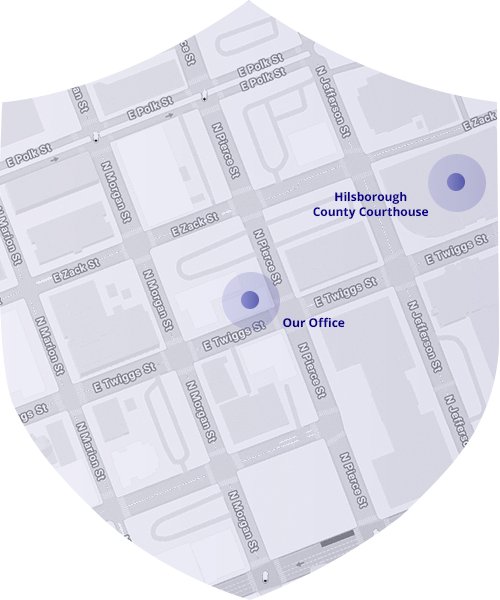
| PROTECT YOUR FREEDOM. ACT NOW. Every day you wait is a day the prosecution builds its case. Tampa Criminal Defense Attorney Rocky Brancato The Brancato Law Firm, P.A. (813) 727-7159, 620 E. Twiggs Street, Suite 205, Tampa, FL 33602 Serving Hillsborough, Pinellas & Pasco Counties |
The Brancato Law Firm, P.A. is a Tampa-based criminal defense practice. We are not affiliated with any other Brancato-named law firms.

Visit Us
Suite #205
Tampa, FL 33602
Contact Us Now
Free Legal Consultation (813) 727-7159