- Free Consultation 24/7: (813) 727-7159 Tap Here To Call Us


From First DUI to Death Penalty



How Does the Right to a Speedy Trial Work in Florida? (2026)



Updated October 22, 2026
Florida protects speedy trial two ways. Under Florida Rule of Criminal Procedure 3.191, the State must bring a misdemeanor to trial within 90 days and a felony within 175 days, and since July 1, 2025, that clock starts when you are formally charged, not when you are arrested. If the time runs out, you file a notice of expiration, the court holds a hearing within 5 days, and the State gets a mandatory 30 days to start trial; if it fails, the charge is dismissed, but usually without prejudice. The separate constitutional right, judged by four factors from Barker v. Wingo, can still end a case for good when the State’s delay causes real harm.
Speedy trial is the rule most defendants have heard of and the one least often won by counting days. In Florida’s courts, discharges under the rule are rare, and the 2025 rewrite narrowed the remedy. I’m Rocky Brancato, founder of The Brancato Law Firm, P.A., a Tampa criminal defense firm. I have spent more than 25 years in Hillsborough County courtrooms, including more than 150 jury trials to verdict, and our attorneys use speedy trial today as a negotiating tool and as a constitutional claim.
This guide explains the rule as it reads after July 1, 2025, how the notice and recapture process works, how continuances waive the rule, and when the constitutional right can still win a dismissal.
What is the right to a speedy trial in Florida?
It is a right protected by the Sixth Amendment, by Article I, Section 16 of the Florida Constitution, and by statute. Section 918.015, Florida Statutes provides that “In all criminal prosecutions the state and the defendant shall each have the right to a speedy trial,” and directs the Florida Supreme Court to set the procedure by rule. That rule is Florida Rule of Criminal Procedure 3.191.
The rule and the constitutional right are different tools. The rule sets fixed time periods and a fixed remedy. The constitutional right has no fixed deadline but can lead to dismissal with prejudice. Our attorneys at The Brancato Law Firm evaluate both in every case that has been pending a long time.
How long does the State have to bring you to trial in Florida?
Under Rule 3.191(a), “every person charged with a crime shall be brought to trial within 90 days if the crime charged is a misdemeanor, or within 175 days if the crime charged is a felony.” The periods apply whether you are in jail or out on bond.
| Speedy trial step | Time period under Rule 3.191 |
|---|---|
| Trial without a demand, misdemeanor | 90 days from formal charge |
| Trial without a demand, felony | 175 days from formal charge |
| Trial after a Demand for Speedy Trial | No less than 5 and no more than 60 days after the demand is filed |
| Hearing after a Notice of Expiration | No later than 5 days after the notice |
| Recapture period for the State | 30 days, mandatory, before any remedy |
“Formally charged” means charged “by information, or by indictment, or in the case of alleged misdemeanors by whatever documents constitute a formal charge.” An arrest or a notice to appear does not start the clock anymore.
What changed in Florida’s speedy trial rule on July 1, 2025?
The Florida Supreme Court rewrote the rule on its own motion in In re Amendments to Florida Rule of Criminal Procedure 3.191, 411 So. 3d 385 (Fla. 2025), effective July 1, 2025. Four changes matter most.
| Issue | Before July 1, 2025 | Since July 1, 2025 |
|---|---|---|
| When the clock starts | Arrest or custody | Formal charge (information, indictment, or misdemeanor charging document) |
| Demand for speedy trial | Trial within 50 days of the demand | Trial within 60 days of filing the demand |
| Recapture period after notice | 10 days | 30 days, mandatory |
| Remedy if the State misses recapture | Discharge forever | Discharge without prejudice, unless the constitutional right was violated |
Justice Labarga dissented. He warned that the formal-charge trigger risks leaving people under long investigations in “procedural limbo,” that 10 days of recapture was “sufficient,” and that discharge with prejudice was “an appropriate check on the State.” For cases that were already pending on July 1, 2025, Florida’s appellate courts so far have applied the earlier version of the rule, as in State v. Hipolito, No. 6D2025-0212 (Fla. 6th DCA Apr. 10, 2026), which also held that a trial court cannot discharge a defendant without first holding the inquiry the rule requires.
How does the notice of expiration work?
The remedy under the rule is no longer automatic. Under Rule 3.191(o), the defense must take these steps:
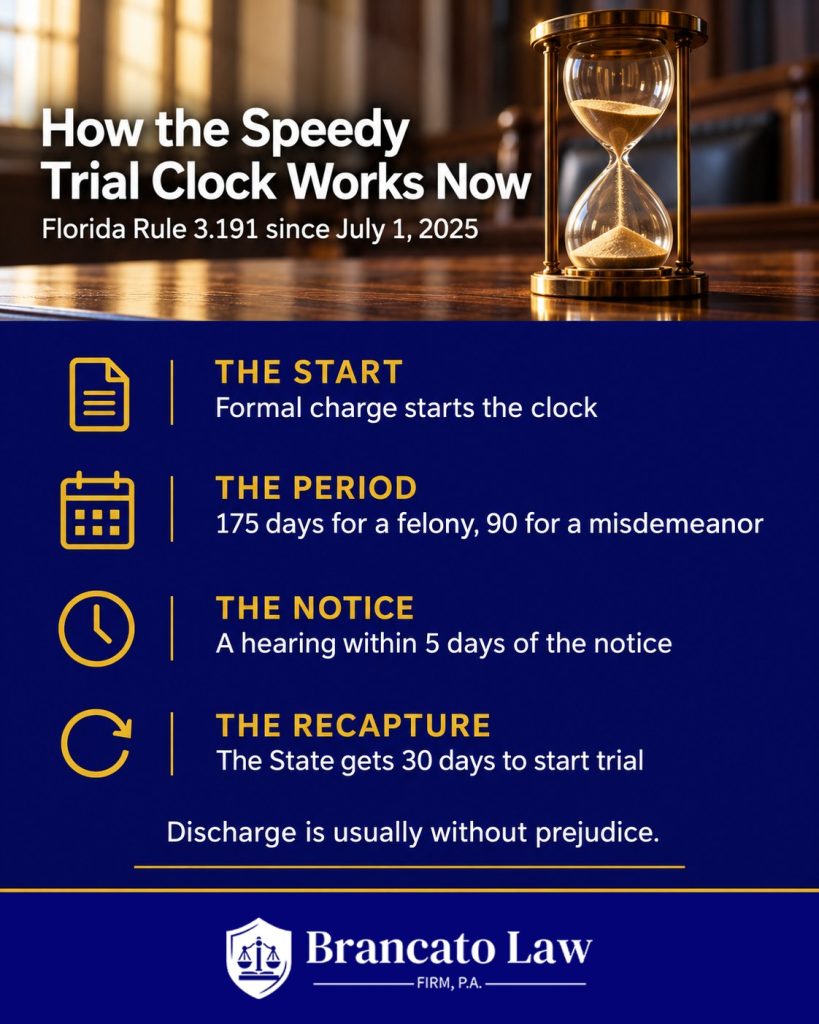
- Wait for the period to expire. The 90 or 175 days must run without the case being tried, and without the delay being charged to the defense.
- File a Notice of Expiration of Speedy Trial Time. The rule gives no remedy until this notice is filed.
- Attend the hearing. The court must hold a hearing “no later than 5 days” after the notice and, if the defendant is not the cause of the delay, order trial within 30 days.
- Move for discharge if the State misses the 30 days. A defendant “not brought to trial within the 30-day period through no fault of the defendant, on motion of the defendant, shall be discharged from the crime.”
The rule then adds the key limit: “This discharge shall be without prejudice unless there is a determination that the defendant’s constitutional right to speedy trial has been violated.” Without a constitutional violation, the State can refile.
How do continuances affect your speedy trial rights?
A defense request for a continuance usually waives the rule’s time periods. In State v. Naveira, 873 So. 2d 300 (Fla. 2004), the Florida Supreme Court held that a defendant who asked for a continuance during the recapture window was unavailable for trial and could not be discharged. The Court quoted the general rule that “a defense request for continuance, absent state misconduct, inexcusable delay in providing discovery, or other violation of defense discovery rights, waives the 175 day ‘speedy trial’ time.”
Florida’s Third District has applied that rule so often that it began one opinion, State v. Guzman, 697 So. 2d 1263 (Fla. 3d DCA 1997), with “For at least the sixteenth time.” The practical point is that the decision to ask for more time is also a decision about speedy trial. Our attorneys at The Brancato Law Firm make that choice deliberately, because sometimes the investigation needs the time and sometimes the client needs the State to be ready.
What is the constitutional right to a speedy trial?
The constitutional right has no fixed deadline. Courts weigh four factors from Barker v. Wingo, 407 U.S. 514 (1972): “Length of delay, the reason for the delay, the defendant’s assertion of his right, and prejudice to the defendant.” The length of the delay is “to some extent a triggering mechanism,” and no single factor is “either a necessary or sufficient condition.”
Barker identified three interests behind the prejudice factor: preventing “oppressive pretrial incarceration,” minimizing “anxiety and concern of the accused,” and limiting “the possibility that the defense will be impaired,” which the Court called “the most serious.” A recent Florida case shows how hard these claims are to win without a strong record. In State v. Stouffer, No. 4D2024-0546 (Fla. 4th DCA Feb. 18, 2026), a racketeering case filed in 2012 was dismissed on constitutional speedy trial grounds. The Fourth District reversed. It held the long delay was presumptively prejudicial, but “the state was not the primary cause of the delay, the defendants did not assert their right to speedy trial, and finally the defendants did not meet their burden of showing actual prejudice.”
The lesson from Stouffer is to assert the right on the record early and document every way the delay has hurt the defense: lost witnesses, faded memories, destroyed evidence, and time in custody. When a constitutional violation is proven, the rule now allows discharge with prejudice.
How long does the State have to file charges before trial deadlines even start?
Separate deadlines govern the charging decision. Under Florida Rule of Criminal Procedure 3.134, the State must file formal charges within 30 days for a person held in custody; if it does not, the court orders release on the 33rd day, or the 40th day if the State shows good cause. For a person out on pretrial release, the deadline is 60 days, with release from bond conditions available after 63 days and up to 30 more days for good cause. The remedy under Rule 3.134 is release, not dismissal.
Under Rule 3.133, a person charged with a felony who has not been formally charged within 21 days of arrest can request an adversary preliminary hearing. Because the speedy trial clock now waits for the formal charge, these earlier deadlines matter more than they used to. Our post on how domestic violence charges are filed in Hillsborough County shows how the 30-day window works in practice.
How long do criminal cases take in Hillsborough County?
Longer than the rule’s periods suggest. The Florida courts’ FY 2024-25 Statistical Reference Guide shows the 13th Judicial Circuit received 12,317 felony filings and disposed of 10,862 felony cases that year, a clearance rate of 88.2%, down from 100.5% the year before. A rate below 100% means the pending caseload grew.
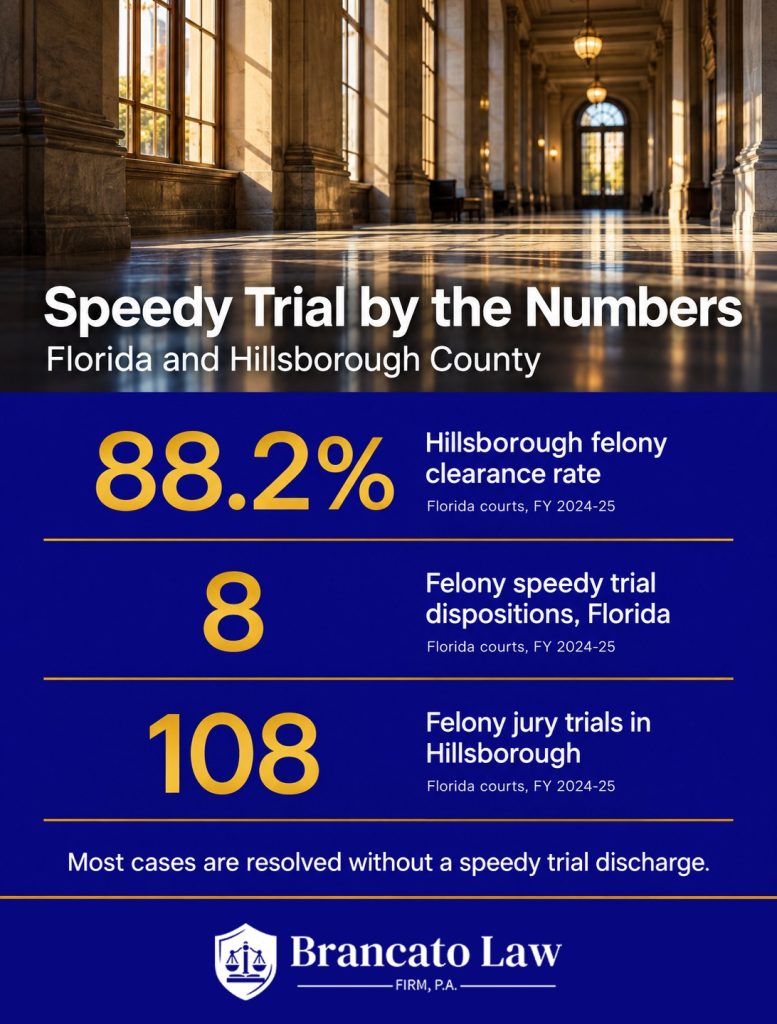
Speedy trial discharges are rare. Of 155,206 felony dispositions statewide in FY 2024-25, the same report counts 8 as speedy trial dispositions. Jury trials are uncommon too: the 13th Circuit held 108 felony jury trials that year, about 1.0% of its dispositions. Florida’s court rules set a presumptively reasonable time standard of 180 days from arrest to final disposition for a felony and 90 days for a misdemeanor in Rule 2.250 of the Florida Rules of General Practice and Judicial Administration.
Scholars saw the recapture debate coming. In Florida’s New Speedy Trial Rule: The “Window of Recapture”, 13 Fla. St. U. L. Rev. 9 (1985), Professor John Yetter explained the 1984 creation of the recapture window and argued it must stay short to keep the State’s incentive to meet deadlines. The 2025 rule tripled it.
When should you demand a speedy trial?
Only when you are ready for trial. A Demand for Speedy Trial tells the court the defense is prepared, and once filed, the trial must be set within 60 days. If the State is not ready, the demand can force a dismissal, a better offer, or a trial on a thin case. If the defense is not ready, the demand can backfire.
Holding the State to its deadlines still changes outcomes. In a September 2025 case, a gang beating and kidnapping prosecution ended in a misdemeanor battery plea and probation after our firm declined to waive speedy trial. In February 2025, our attorneys had a felony warrant that had been pending for more than four years quashed and the case dismissed. Past results do not guarantee future outcomes. More results are on our case results page.
What should you do if your case is dragging on?
Take three steps:
- Find the formal charge date. The information or indictment date now starts the rule’s clock.
- Check every continuance. Know which ones the defense requested, because those usually waive the rule.
- Assert the constitutional right in writing. A written assertion is the record a court looks for under Barker.
Our Hillsborough County criminal defense attorney team reviews the docket, the continuance history, and the prejudice to the defense before deciding whether to file a demand, a notice of expiration, or a constitutional motion to dismiss. Our guide on whether criminal charges can be dropped or dismissed in Florida covers the other ways a case can end before trial.
Frequently asked questions about speedy trial in Florida
Can speedy trial get my charges dropped in Florida?
Sometimes. Under the current rule, a missed deadline usually leads to a dismissal without prejudice that the State can refile, while a proven constitutional violation can end the case for good. The Brancato Law Firm evaluates both before deciding which motion to file.
Does the speedy trial clock start at arrest in Florida?
Not anymore. Since July 1, 2025, the 90-day and 175-day periods start when you are formally charged by information, indictment, or a misdemeanor charging document. Our attorneys at The Brancato Law Firm track that date and the separate Rule 3.134 filing deadlines from the first week.
What happens if I waive speedy trial?
You give up the rule’s time periods, usually in exchange for time to investigate or for a diversion program that requires a waiver. The Brancato Law Firm weighs that trade case by case, and you can learn about diversion options on our Hillsborough County criminal defense page.
How long is too long for a criminal case in Florida?
There is no fixed number under the Constitution. Courts first ask whether the delay is long enough to be presumptively prejudicial for that kind of case, and then the reason for the delay, your assertion of the right, and the harm to your defense decide the claim. Our attorneys at The Brancato Law Firm document that harm as the case goes, not at the end.
What is the recapture period in Florida?
It is the mandatory 30 days the State gets to bring a case to trial after the court holds the hearing on a Notice of Expiration of Speedy Trial Time. The Brancato Law Firm files the notice and holds the State to the 30 days, as explained in the Florida Bar’s summary of the 2025 amendments.
Does speedy trial apply if I am out on bond?
Yes. Rule 3.191 applies whether you are in custody or on pretrial release, and the constitutional right protects everyone who has been charged. Our attorneys at The Brancato Law Firm use it for clients on bond whose cases have stalled.
Talk to our Tampa criminal defense attorneys about a delayed case
If your case has been pending for months, the next decision about speedy trial may be the most important one in it. The Brancato Law Firm, P.A., founded by Tampa Criminal Defense Attorney Rocky Brancato, will review your docket, the continuance record, and the harm the delay has caused, then tell you whether to demand trial, file a notice, or move to dismiss. Call (813) 727-7159 for a free, confidential consultation. You can call us at any hour. Our firm has Spanish-speaking staff, and attorney Jean-Luc Adrien speaks Spanish, Haitian Creole, and French. Read about our Spanish and Haitian Creole criminal defense services.
For more about our defense strategies, visit our Hillsborough County Criminal Defense page.
The Brancato Law Firm, P.A.
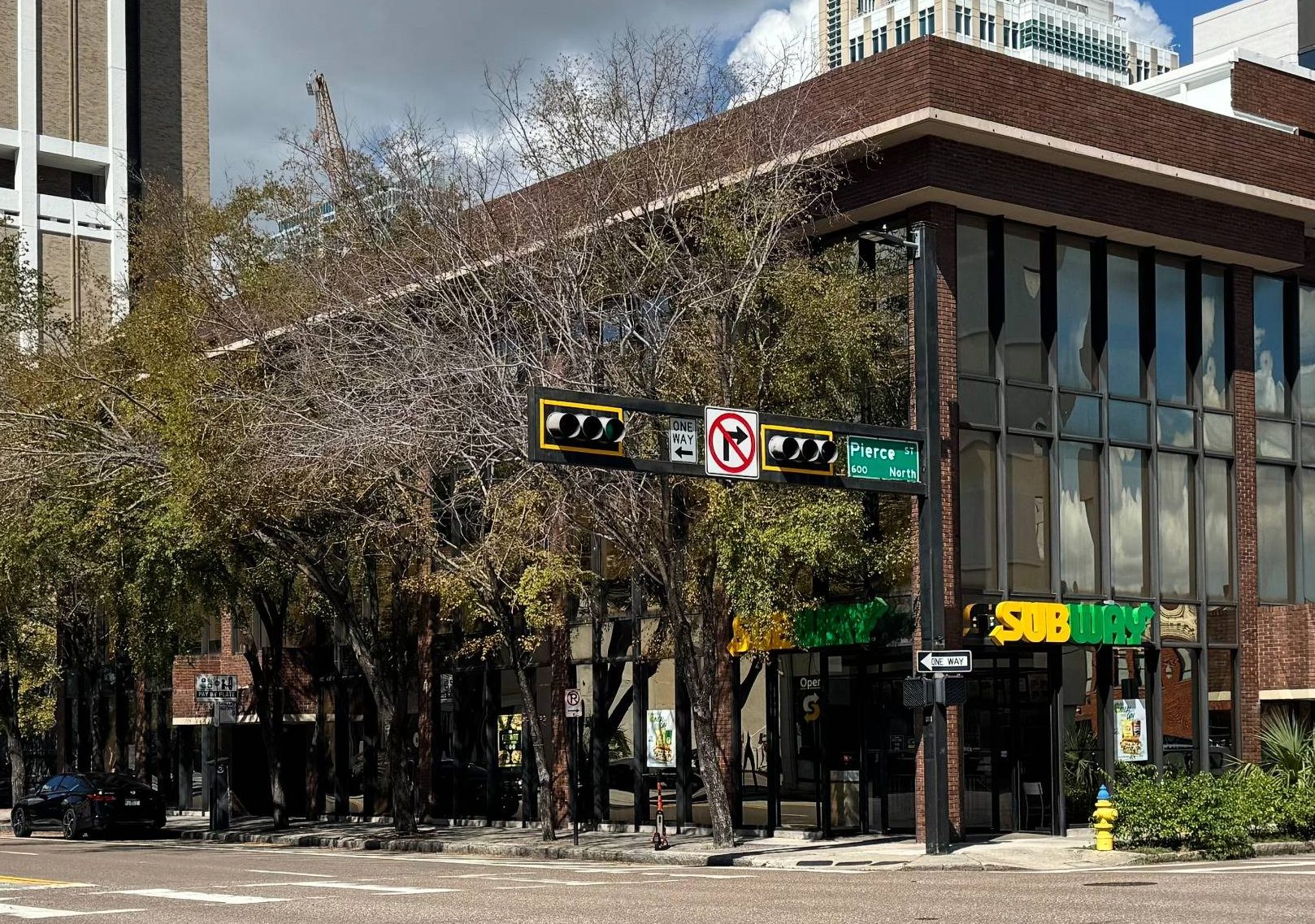
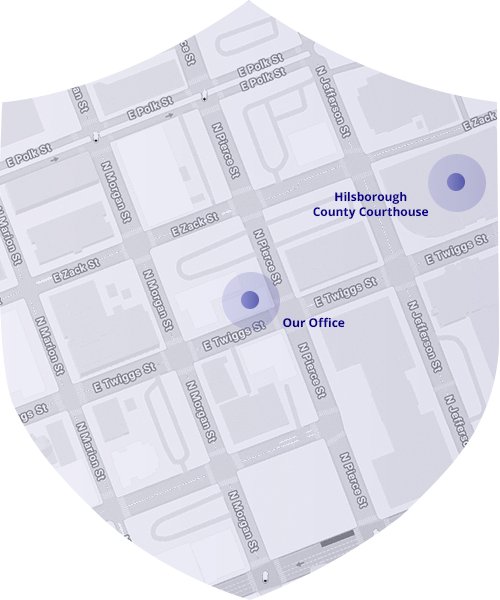
620 E. Twiggs Street, Suite 205, Tampa, FL 33602
(813) 727-7159
Serving Hillsborough, Pinellas, and Pasco Counties
The Brancato Law Firm, P.A. is a Tampa-based criminal defense practice. We are not affiliated with any other Brancato-named law firms.
Visit Us
Tampa, FL 33602
Contact Us Now
Free Legal Consultation (813) 727-7159