- Free Consultation 24/7: (813) 727-7159 Tap Here To Call Us


From First DUI to Death Penalty



How to Fight Aggravated Child Abuse in Florida (2026)


Fully rewritten and updated November 14, 2026. Previously updated November 8, 2026. Originally published February 2025.
To fight an aggravated child abuse charge in Florida, attack the specific theory the State charged under section 827.03: aggravated battery on a child, willful torture or malicious punishment, or knowing abuse that caused great bodily harm, permanent disability, or permanent disfigurement. Aggravated child abuse is a first-degree felony punishable by up to 30 years in prison, and it ranks at Level 9 on the Criminal Punishment Code scoresheet. Most defenses turn on the medical evidence: whether the injury was really inflicted, when it happened, who had the child, and whether it meets the legal definition of great bodily harm.
In an aggravated child abuse case, the judge and the prosecutor are looking for one thing first: a medical opinion that the injury could not have happened the way the family says. I learned how those opinions are built, and how they fall apart, in the Major Crimes Unit, where I handled homicide, sex crime, and child abuse cases. I’m Rocky Brancato, founder of The Brancato Law Firm, P.A., a Tampa criminal defense firm, and a former Chief Operations Officer of the Hillsborough County Public Defender’s Office, where I oversaw a staff of over 100 attorneys. Our attorneys defend aggravated child abuse cases by collecting the child’s complete medical history and putting it in front of independent experts before the State’s theory hardens.
This guide covers what the State must prove, the penalties and scoresheet, the defenses that work, how medical evidence is challenged, and what to do if you are under investigation.
What is aggravated child abuse in Florida?
Aggravated child abuse is the most serious child abuse charge in Florida. Under section 827.03, Florida Statutes, it occurs when a person (1) commits aggravated battery on a child, (2) willfully tortures, maliciously punishes, or willfully and unlawfully cages a child, or (3) knowingly or willfully abuses a child and in so doing causes great bodily harm, permanent disability, or permanent disfigurement. A “child” is anyone under 18. The charging document has to say which of these theories the State is using, and that choice shapes the whole defense.
| Charging theory | What the State must prove | Where the defense usually focuses |
|---|---|---|
| Aggravated battery on a child | An intentional battery that caused great bodily harm, permanent disability, or disfigurement, or involved a deadly weapon | Whether the harm meets the legal definition; whether a weapon was used |
| Willful torture, malicious punishment, or caging | Intentional conduct done with malice or to cause unnecessary suffering | Intent, the context of discipline, and how the injury actually occurred |
| Abuse causing great bodily harm | Knowing or willful abuse plus great bodily harm, permanent disability, or disfigurement | Causation, timing, and medical proof of the harm itself |
What are the penalties for aggravated child abuse in Florida?
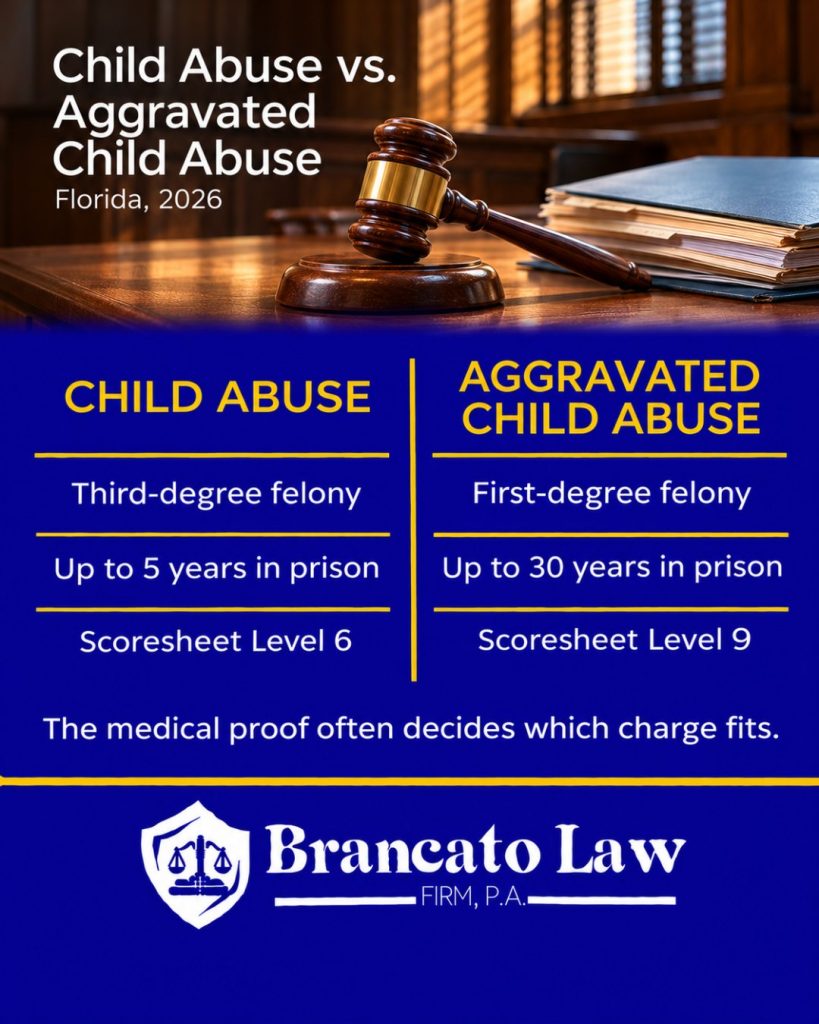
Aggravated child abuse is a first-degree felony punishable by up to 30 years in prison and a $10,000 fine under section 775.082 and section 775.083. The offense severity ranking chart in section 921.0022 places it at Level 9, which scores 92 points for the primary offense under section 921.0024. With no other points, that produces a lowest permissible sentence of 48 months in state prison, because the statute subtracts 28 points and reduces the remainder by 25 percent.
| Charge under section 827.03 | Degree | Maximum prison | Scoresheet level |
|---|---|---|---|
| Aggravated child abuse, 827.03(2)(a) | First-degree felony | 30 years | Level 9 |
| Neglect causing great bodily harm, 827.03(2)(b) | Second-degree felony | 15 years | Level 7 |
| Child abuse, no great bodily harm, 827.03(2)(c) | Third-degree felony | 5 years | Level 6 |
| Neglect, no great bodily harm, 827.03(2)(d) | Third-degree felony | 5 years | Level 6 |
The gap between the first and third rows is the reason charge reduction matters so much. A Level 6 third-degree felony scores 36 points, and under section 921.0024 a total of 44 points or fewer allows a non-prison sentence. Our attorneys build the case for that reduction from the medical record, and you can read more about how we handle these cases on our Tampa child abuse attorney page.
How often are child abuse allegations confirmed in Florida?
Most Florida child abuse investigations do not end in a finding of maltreatment. In 2024, 247,390 Florida children received a child protective investigation or alternative response, and 18,455 were found to be victims of maltreatment, according to the federal Child Maltreatment 2024 report from the U.S. Department of Health and Human Services (Tables 3-1 and 3-3). Of those Florida victims, 1,839 had a physical abuse finding (Table 3-8-2).
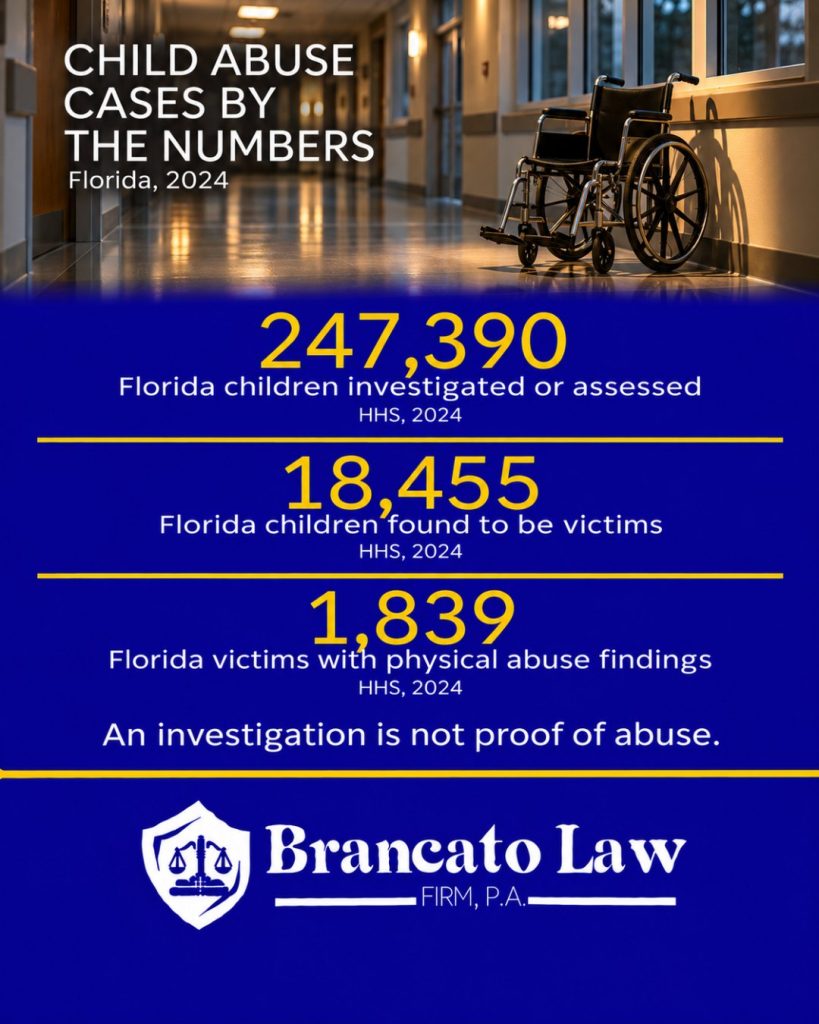
Those numbers matter in a criminal case because an investigation is not proof. A hotline report, a child protective investigator’s visit, and even a Child Protection Team referral are the start of the State’s process, not a verdict. The Brancato Law Firm treats the early civil investigation as the first chance to correct the record.
How do you fight aggravated child abuse charges in Florida?
You fight aggravated child abuse charges by testing every element the State charged against the medical evidence and the timeline. These are the defenses our attorneys use most often:
- No great bodily harm. Pain, crying, or bruising alone may not meet the legal definition. The State usually needs medical testimony.
- A medical explanation. Birth trauma, bone and bleeding disorders, metabolic disease, and infection can mimic inflicted injury.
- Wrong timing. Fracture healing and imaging can show an injury happened before the accused had the child.
- Someone else had access. Many children pass through several caregivers in a week.
- Accident. Falls, sibling play, and CPR attempts cause real injuries.
- Discipline, not malice. Reasonable corporal punishment is a defense to simple child abuse, and the context matters to whether conduct was malicious.
- Statements and searches. A statement taken without proper Miranda warnings, or evidence from an unlawful search, may be suppressed.
The first defense is often the strongest. In Wheeler v. State, 203 So. 3d 1007 (Fla. 4th DCA 2016), an 18-year-old was charged with aggravated child abuse after beating a 16-year-old at a party, and the fight was on video. The Fourth District reversed and ordered an acquittal because the State offered no medical testimony, and evidence that the boy was “moaning and crying” was at best proof of moderate harm. The lesson is that a frightening video does not prove great bodily harm. The State has to prove the injury with evidence.
Can a parent be charged for spanking or discipline in Florida?
Yes, but discipline is a defense in the right case. In Raford v. State, 828 So. 2d 1012 (Fla. 2002), a man was charged with aggravated child abuse for repeatedly striking his girlfriend’s eight-year-old child with a belt. The Florida Supreme Court held that a parent has no absolute immunity from felony child abuse, but that a parent may raise reasonable, nonexcessive corporal punishment, such as a typical spanking, as an affirmative defense to simple child abuse. The court approved the Second District’s decision in State v. McDonald, the appellate court that hears Hillsborough, Pinellas, and Pasco appeals.
In practice, the line between lawful discipline and a felony is drawn by the injury, the object used, and the reason for the punishment. Our post on whether spanking is illegal in Florida walks through that line, and our guide to fighting a child neglect charge in Florida covers the lower-level charge prosecutors often file alongside it. When the State charges malicious punishment, our attorneys at The Brancato Law Firm focus on intent and on the full picture of the household, not the single photo the case file opens with.
How is medical evidence challenged in an aggravated child abuse case?
Medical evidence is challenged by getting the complete record and having independent specialists review it. Prosecutors usually receive the records from the emergency visit that started the case. Those records rarely include the birth history, earlier illnesses, genetic testing, or lab work that could explain the findings. The American Academy of Pediatrics recognizes this risk: its clinical report Evaluating Children With Fractures for Child Physical Abuse (Pediatrics, 2014) states that incorrectly diagnosing child abuse in a child whose fractures have another cause “can be distressing for a family” and reviews the medical diseases that predispose children to fractures.
| Condition type | Examples | How it can look like abuse |
|---|---|---|
| Birth trauma | Forceps or vacuum delivery, clavicle fracture at birth | Old fractures or head findings discovered later |
| Bone disorders | Osteogenesis imperfecta, rickets, vitamin D deficiency | Fractures from minimal force |
| Bleeding and clotting disorders | Hemophilia, von Willebrand disease, vitamin K deficiency | Unexplained bruising or internal bleeding |
| Connective tissue disorders | Ehlers-Danlos syndrome | Easy bruising and skin fragility |
| Metabolic disease | Glutaric aciduria, Menkes disease | Subdural bleeding mistaken for shaking |
| Infection | Meningitis, osteomyelitis | Neurological symptoms and bone lesions |
Florida law routes many of these cases through a Child Protection Team. Under section 39.303, reports involving head injuries, burns, or fractures in a child of any age, and bruises anywhere on a child 5 or younger, must be referred to a Child Protection Team for assessment. A team opinion is often formed from a single hospital visit. Our post on Child Protection Team medical testimony explains how those opinions are tested in court, and our case study on medical conditions mistaken for child abuse shows how a full record changed the outcome. When the case also involves a child’s statement, see our guide to child forensic interviews in Tampa.
What results has our firm obtained in aggravated child abuse cases?
These are results from cases handled by Rocky Brancato. Each turned on medical evidence the State had not considered.
| Allegation | What the defense found | Result |
|---|---|---|
| A father was accused after his daughter suffered a severe abdominal injury; the Child Protection Team claimed intentional trauma. | A forensic pathologist identified a congenital choledochal cyst, a birth defect that explained the injury. | All charges dismissed |
| A grandmother was charged with murder and aggravated child abuse; experts first said blunt force trauma contributed to a child’s death. | Expert review showed the injuries came from forceful CPR attempts. | Murder and aggravated child abuse charges dropped |
| A young father was accused of injuring his infant. | Medical evidence showed the father had toxoplasmosis, a brain infection affecting impulse control. | Felony reduced to a misdemeanor |
Past results do not guarantee future outcomes. Every case depends on its own facts.
What should you do if you are being investigated for child abuse?
Do not explain the injury to investigators before you talk to a lawyer. Child abuse cases often begin with a child protective investigator or a detective asking a parent to “help us understand what happened,” and a well-meant guess about how a bruise or fracture happened can become the State’s timeline. Our attorneys provide representation before charges are filed, which means we can contact the investigator, gather the medical records, and present an expert’s view before a charging decision is made.
- Politely decline to answer questions about the injury and ask for your lawyer.
- Write down, privately for your lawyer, every person who cared for the child in the prior two weeks.
- Do not post about the case or message the other parent about it.
- Follow any safety plan or court order exactly, even if you believe it is unfair.
Frequently asked questions about aggravated child abuse charges
Can aggravated child abuse charges be dropped in Florida?
Yes. Charges can be dropped or reduced when the medical evidence does not support great bodily harm, when an independent expert finds a natural or accidental cause, or when the timeline points to someone else. The Brancato Law Firm has seen charges dismissed after a full medical history revealed a congenital condition, as described on our Tampa child abuse defense page.
What is the difference between child abuse and aggravated child abuse in Florida?
Child abuse without great bodily harm is a third-degree felony with a 5-year maximum, while aggravated child abuse is a first-degree felony with a 30-year maximum. The difference usually comes down to the severity of the injury or proof of torture or malice under section 827.03. Our attorneys at The Brancato Law Firm push for the lower charge whenever the medical record does not support the aggravating element.
Is there a minimum prison sentence for aggravated child abuse in Florida?
There is no mandatory minimum written into section 827.03, but the scoresheet sets a floor. A Level 9 offense alone produces a lowest permissible sentence of 48 months in prison, and a judge can go below it only with a legal reason for a downward departure. The Brancato Law Firm prepares mitigation and departure evidence early, because it also helps in plea negotiations.
Will I lose custody of my child if I am charged with aggravated child abuse?
A criminal charge often comes with a separate dependency case, and a judge may restrict contact while both cases are open. The two cases move on different tracks, but statements in one can be used in the other. Our attorneys at The Brancato Law Firm coordinate with dependency counsel so nothing said in the civil case undercuts the criminal defense; see our post on privileged communications in child abuse cases.
Do I need a medical expert in an aggravated child abuse case?
In most cases, yes. The State’s case usually rests on a physician’s opinion, and the jury needs a qualified expert to explain any alternative cause or timing problem. The Brancato Law Firm works with forensic pathologists, pediatric specialists, and nurse consultants; our forensic pathologist case study shows how that work looks in practice.
What happens if I talked to DCF or the police before hiring a lawyer?
Your statement is not the end of the case, but your lawyer needs to know exactly what you said. Statements can sometimes be challenged, and an early statement can often be put in context with medical evidence. The Brancato Law Firm reviews the recording or report first and then decides whether to approach the prosecutor through pre-file advocacy.
Talk to our Tampa child abuse defense attorneys
Medical records get harder to collect and experts’ calendars fill up the longer a case waits, so the first weeks matter. The Brancato Law Firm, P.A., founded by Tampa Criminal Defense Attorney Rocky Brancato, will request the child’s full medical history, consult independent experts, and speak with the investigator or prosecutor on your behalf. Call (813) 727-7159 for a free, confidential consultation; you can call us at any hour. Our office is two blocks from the courthouse. Our firm has Spanish-speaking staff, and attorney Jean-Luc Adrien speaks Spanish, Haitian Creole, and French. Read about our Spanish and Haitian Creole criminal defense services.
For more about our defense strategies, visit our Child Abuse Defense page.
The Brancato Law Firm, P.A.
620 E. Twiggs Street, Suite 205, Tampa, FL 33602
(813) 727-7159
Serving Hillsborough, Pinellas, and Pasco Counties
The Brancato Law Firm, P.A. is a Tampa-based criminal defense practice. We are not affiliated with any other Brancato-named law firms.
Visit Us

Tampa, FL 33602

Contact Us Now
Free Legal Consultation (813) 727-7159
