- Free Consultation 24/7: (813) 727-7159 Tap Here To Call Us


From First DUI to Death Penalty



Can Social Media Make You a Gang Member in Florida? (2026)


| Yes, it can now count. Since October 1, 2026, Florida’s definition of a “criminal gang member” in section 874.03(3) includes admitting gang membership online, using gang-related language on social media in furtherance of gang activity, and authoring any communication that indicates gang affiliation. A person meets the definition by satisfying any two of 13 criteria, and the statute says a single act can satisfy more than one. Gang membership is not a crime by itself, but it can support enhanced penalties, longer sentences, and a hold without bond until first appearance. |
As founder of The Brancato Law Firm, P.A., a Tampa criminal defense firm, and a former Chief Operations Officer of the Hillsborough County Public Defender’s Office, where I oversaw a staff of over 100 attorneys, I have watched gang labels follow young clients from their first arrest through sentencing. Florida’s new gang law makes that label easier to apply, and much of the new proof will come from phones and social media accounts. Our attorneys now treat a client’s online history as evidence to review on day one of any case where a gang allegation is possible.
This guide explains what HB 429 (chapter 2026-156, Laws of Florida) changed, why the Legislature split along party lines on it, what a gang label actually does to a criminal case, and how the allegation is challenged.
What Changed in Florida’s Gang Member Definition?
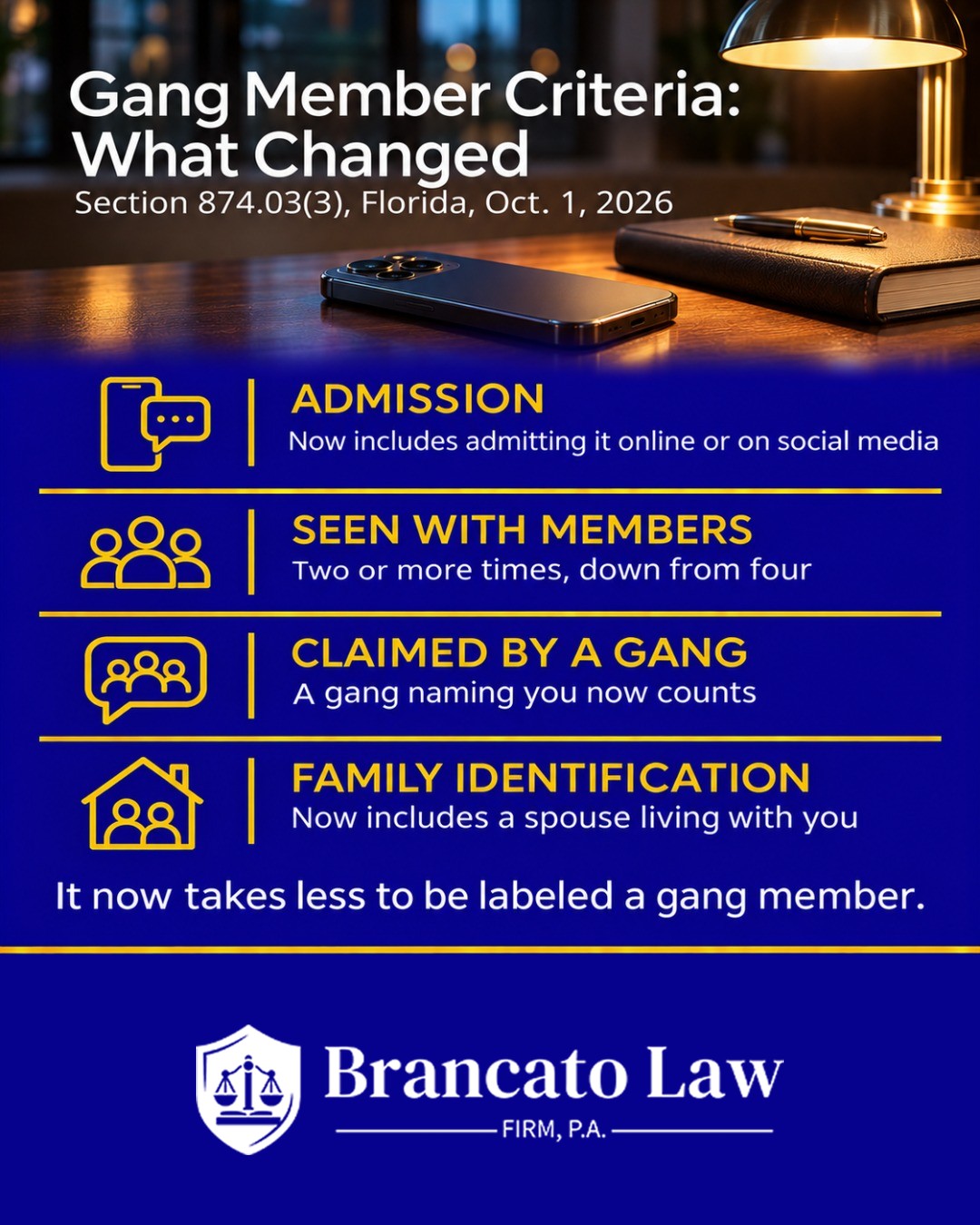
HB 429 rewrote the list of criteria in section 874.03(3), Florida Statutes. The two-criteria minimum stayed the same, but the list grew and several criteria became easier to meet.
| Criterion | Before October 1, 2026 | After October 1, 2026 |
|---|---|---|
| Admission | Admits criminal gang membership | Admits membership in person or on an online platform or social media |
| Claimed by a gang | Not a criterion | Is identified or claimed by a criminal gang as one of its members |
| Family identification | Identified by a parent or guardian | Identified by a parent, guardian, or spouse living with the person |
| Observed with known members | Four or more times | Two or more times |
| Written communications | Authored a communication accepting responsibility for a gang crime | Authored any communication indicating gang affiliation or gang activity, or accepting responsibility for a gang crime |
| Online language | Not a criterion | Uses gang-related language in furtherance of criminal gang-related activity on an online platform or social media |
The law also adds a definition of “gang-related language”: any verbal or written statement “that signals gang affiliation, supports gang activity, or uses recognized gang codes, symbols, or terminology associated with criminal organizations.” Written statements expressly include “any digital or electronic statements,” including social media posts.
The other criteria did not change. They include identification by a documented reliable informant, adopting a gang’s style of dress or hand signs, gang tattoos, associating with known gang members, identification by a corroborated untested informant, and physical evidence.
Can One Social Media Post Make Someone a Gang Member?
Possibly. Section 874.03(3) has long provided that when “a single act or factual transaction satisfies the requirements of more than one of the criteria,” each of those criteria is satisfied. Before October 1, 2026, that rule mattered mostly for tattoos and clothing. Now it applies to online speech.
In our reading of the statute, a single post in which a person claims a gang, uses its terminology, and references its activity could be argued to satisfy three criteria at once: an online admission, authoring a communication indicating gang affiliation, and using gang-related language on social media. Two criteria are enough. Whether a court accepts that argument in a particular case will depend on the post, its context, and whether the State can prove who wrote it.
The lower threshold for observation also matters. Being seen with known gang members two times, instead of four, now counts as a criterion. Observations inside a jail or prison count only if the association was “willful,” because the Legislature wanted to reach gang recruiting in custody without punishing people for who they are housed with.
Why Did Florida Pass HB 429?
Supporters said the law brings Florida’s gang statute into the social media era. The Senate sponsor, Senator Jonathan Martin of Fort Myers, told the Senate the bill “modernizes Florida’s gang statutes to reflect how gangs operate today,” according to the Florida Phoenix. He also emphasized that being in a gang is still not a crime and that two criteria must still be met.
The bill drew more opposition than most criminal justice bills this session. The House passed it 100 to 7 on February 4, 2026, but the Senate vote on March 10, 2026 was 29 to 9, largely along party lines. In Senate committees the votes were 6 to 2 in Criminal Justice, 5 to 3 in the Appropriations Committee on Criminal and Civil Justice, and 12 to 6 in Fiscal Policy. Governor DeSantis signed the bill on June 16, 2026. Vote tallies come from the official bill history and the Senate companion’s history.
Critics’ concerns track a body of research on how police read social media. In a 2017 article in the journal Social Media + Society, Columbia University researcher Desmond Patton and colleagues described social media policing as a form of “everyday racism in digital policing,” citing cases such as a New York teenager held at Rikers Island for 19 months in part because of his Facebook activity. Their point is that slang, music, and photos posted by young people are easy to misread as proof of gang activity.
How Often Are Gang Enhancements Used in Florida?
Rarely, at least on paper. According to the Senate Criminal Justice Committee’s analysis of SB 536, the Florida Department of Law Enforcement reported no arrests and no convictions for gang-related penalty enhancements under section 874.04 in fiscal year 2024-25, and the Department of Corrections reported no new prison commitments under that section. FDLE reported 15 arrests for other chapter 874 felonies that year.
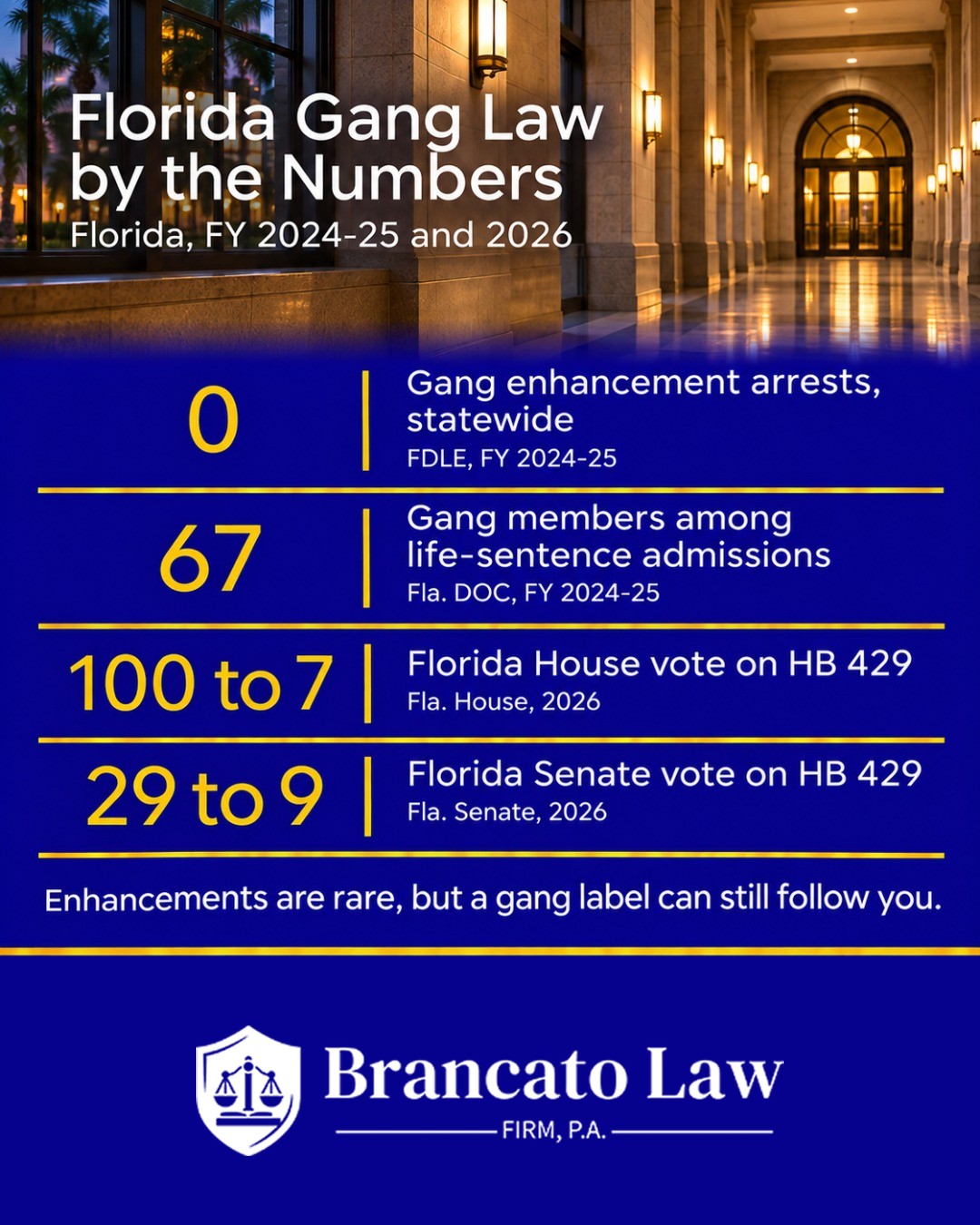
Gang labels show up more often after sentencing. The same analysis reports that of 469 people admitted to Florida prisons with life sentences in fiscal year 2024-25, the Department of Corrections listed 67 as gang members and 25 as gang associates. The Legislature’s economists projected a “positive indeterminate” prison bed impact from HB 429, meaning more prison time in an amount they could not estimate.
Those numbers suggest the new criteria may matter less as a separate charge and more as pressure: in bond arguments, in plea negotiations, and in how a defendant is classified once in custody.
What Does a Gang Label Do to a Criminal Case?
A gang allegation can raise the maximum penalty, change the scoresheet, and delay release. These are the main consequences under Florida law:
- Reclassification. Under section 874.04, if the factfinder finds beyond a reasonable doubt that the defendant committed the offense “for the purpose of benefiting, promoting, or furthering the interests of a criminal gang,” the offense can be punished one degree higher. A third-degree felony becomes punishable as a second-degree felony, and a first-degree felony as a life felony.
- Scoresheet multiplier. Florida’s sentencing code applies a gang multiplier to the primary offense points when the enhancement applies, which can raise the lowest permissible sentence.
- No bond before first appearance. Under section 903.046(2)(l), a defendant charged with a chapter 874 crime, or with a crime alleged to be subject to gang enhancement, “is not eligible for release on bail or surety bond until the first appearance.”
- Separate gang crimes. Chapter 874 also punishes recruiting gang members and directing gang activity as standalone felonies.
Our guide to how a bond hearing works in Tampa explains how judges weigh these allegations when setting release conditions.
Is Gang Membership Alone Enough for an Enhancement?
No. The Florida Supreme Court settled that in State v. O.C., 748 So. 2d 945 (Fla. 1999). O.C., an Orlando-area juvenile, was found guilty of attempted aggravated battery and battery, and the trial court bumped the felony up a degree because it found O.C. was a gang member. The Supreme Court struck down that version of section 874.04, holding that it punished “gang membership without requiring any nexus between the criminal activity and gang membership,” which violated substantive due process.
The current statute was rewritten to require that nexus. The State must prove beyond a reasonable doubt that the crime was committed to benefit, promote, or further the gang. HB 429 makes membership easier to prove, but it did not change the nexus requirement. That is where many gang enhancements can be defeated.
The First Amendment adds another limit. In Dawson v. Delaware, 503 U.S. 159 (1992), the U.S. Supreme Court set aside a ruling that upheld a death sentence, because the prosecution told the sentencing jury the defendant belonged to a white racist prison gang without connecting that membership to the crime or any issue in sentencing. The Court held the evidence was “totally without relevance,” while making clear that association evidence can be admitted when it is relevant. The rule for defense lawyers is the same as in O.C.: membership without connection to the crime is not proof of anything.
How Do You Fight a Gang Allegation Based on Social Media?
Social media evidence has to be authenticated, interpreted, and connected to the crime, and each step can be challenged. Our Tampa violent crimes lawyer team works through these questions:
- Who wrote it? Accounts are shared, hacked, and impersonated. The State must authenticate a post as the defendant’s before it can be used, which usually requires more than a profile name and photo.
- What does it mean? Song lyrics, slang, neighborhood pride, and jokes are not admissions. The criterion requires gang-related language used “in furtherance of criminal gang-related activity,” not just language that sounds like it. A defense expert can explain context that a detective may miss.
- Is there a “criminal gang” at all? The State must prove the group is an ongoing organization with three or more members whose primary activities include criminal acts. A neighborhood friend group with a name is not automatically a criminal gang.
- Is each criterion independently proved? A spouse’s identification, an informant’s tip, and a detective’s observations all have to be proved with admissible evidence. Florida’s spousal privilege in section 90.504 protects confidential communications between spouses, which can limit what a spouse may repeat.
- Where is the nexus? Even a proven member cannot receive an enhancement unless the State proves the specific crime benefited the gang.
- Should the jury hear it at all? Gang evidence is highly prejudicial. Our attorneys file motions in limine to keep gang references out of trial when they are not needed to prove an element.
Gang investigations often begin long before an arrest. If you have been contacted by a detective about a group or a social media account, representation before charges are filed lets our attorneys respond before the State decides what to charge.
What Should You Do About Your Social Media Now?
Assume detectives can see anything you post publicly, and think about how a stranger would read it. These steps reduce risk without hiding evidence:
- Do not post, like, or repost content that claims a group, uses its symbols, or references crimes, even as a joke or song lyric.
- Review your privacy settings and who can see your posts and stories.
- Do not delete content after you learn of an investigation or arrest; that can be charged as tampering with evidence. Talk to a lawyer first.
- Do not accept friend or follow requests from people you do not know.
- If you are arrested, do not discuss the case or your associations on jail phones or messaging apps.
This post is part of our guide to the new Florida criminal laws that took effect October 1, 2026, which summarizes all eight laws in one place.
Frequently Asked Questions
Is it illegal to be in a gang in Florida?
No. Florida does not make gang membership a crime by itself, but membership can lead to enhanced penalties when a crime is committed to benefit a gang, and chapter 874 punishes recruiting and directing gang activity. The Brancato Law Firm challenges gang allegations at the bond stage, in plea negotiations, and at trial.
Can rap lyrics be used as gang evidence in Florida?
They can be offered as evidence, but the State must show the lyrics are relevant to the charged crime, and a judge can exclude them when their unfair prejudice outweighs their value. Our attorneys at The Brancato Law Firm move to exclude creative expression that the State uses only to suggest bad character.
Can my spouse identify me as a gang member?
Yes. Since October 1, 2026, identification by a spouse who lives with you is one of the 13 criteria, though it counts only if a second criterion is also proved. The Brancato Law Firm examines whether a spouse’s statement rests on privileged confidential communications or on reliable personal knowledge.
Does the new gang law apply to old social media posts?
The enhanced penalties apply only to crimes committed on or after October 1, 2026, but the statute does not say whether posts made before that date can be used to prove membership. Our attorneys at The Brancato Law Firm will argue that pre-October 2026 posts cannot be used to satisfy criteria that did not exist when they were posted.
Can a juvenile be labeled a gang member in Florida?
Yes. Section 874.04 applies to delinquent acts as well as adult crimes, and the same membership criteria apply to juveniles. The Brancato Law Firm defends juveniles in Hillsborough County, where a gang allegation can affect detention decisions and the disposition of the case.
Does a gang allegation affect bond in Hillsborough County?
Yes. When the State alleges a gang enhancement, the defendant cannot bond out on a schedule and must wait for a judge at first appearance, where the allegation is weighed in setting conditions. Our attorneys at The Brancato Law Firm prepare to contest the gang allegation at that first hearing, through our violent crimes defense practice.
Talk to a Tampa Violent Crimes Lawyer Today
For more about our defense strategies, visit our Violent Crimes practice page.
A gang allegation can keep someone in jail until first appearance and double the stakes of a case. Our attorneys will review the arrest report, the social media evidence, and every criterion the State relies on, and we will be ready to argue at the first hearing. Call The Brancato Law Firm, P.A., founded by Tampa Criminal Defense Attorney Rocky Brancato, at (813) 727-7159. Call us at any hour; our office is two blocks from the courthouse. Our firm has Spanish-speaking staff, and attorney Jean-Luc Adrien speaks Spanish, Haitian Creole, and French.
The Brancato Law Firm, P.A.
620 E. Twiggs Street, Suite 205, Tampa, FL 33602
(813) 727-7159
Serving Hillsborough, Pinellas, and Pasco Counties
The Brancato Law Firm, P.A. is a Tampa-based criminal defense practice. We are not affiliated with any other Brancato-named law firms.
Visit Us

Tampa, FL 33602

Contact Us Now
Free Legal Consultation (813) 727-7159
