- Free Consultation 24/7: (813) 727-7159 Tap Here To Call Us


From First DUI to Death Penalty



Do You Have to Report a Car Accident in Florida? (2026)


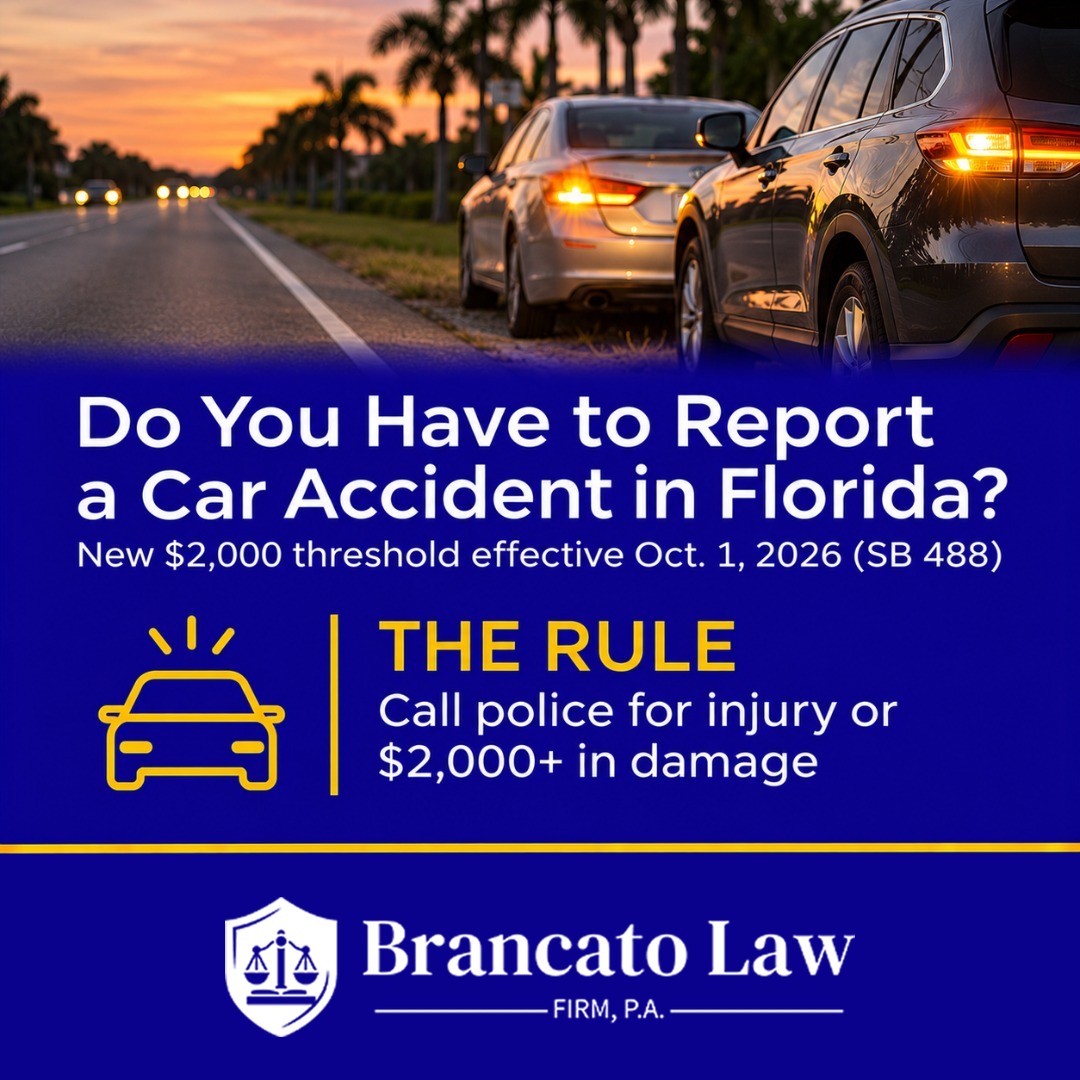
| Yes, in many cases, but the threshold changed. Since October 1, 2026, Florida drivers must immediately notify police of a crash that causes injury, death, or apparent property damage of at least $2,000, up from $500, under section 316.065. Failing to make that call is a noncriminal traffic infraction. The higher threshold does not change the duty to stop, exchange information, and render aid, and leaving the scene of any crash with an occupied vehicle or attended property is still a crime. |
If you backed into another car in a parking lot this week, the rules for whether you must call the police are different from what they were in September. As founder of The Brancato Law Firm, P.A., a Tampa criminal defense firm, a former police academy instructor, and a former Chief Operations Officer of the Hillsborough County Public Defender’s Office, where I oversaw a staff of over 100 attorneys, I have seen minor crashes turn into criminal cases because a driver left too soon or said too much. Our attorneys explain to drivers what the new threshold changes, and what it does not.
This guide explains the crash reporting change in SB 488 (chapter 2026-39, Laws of Florida), the duties that still apply after every crash, the new email notice rule for license suspensions, and the other criminal provisions in the bill.
What Changed in Florida’s Crash Reporting Law?
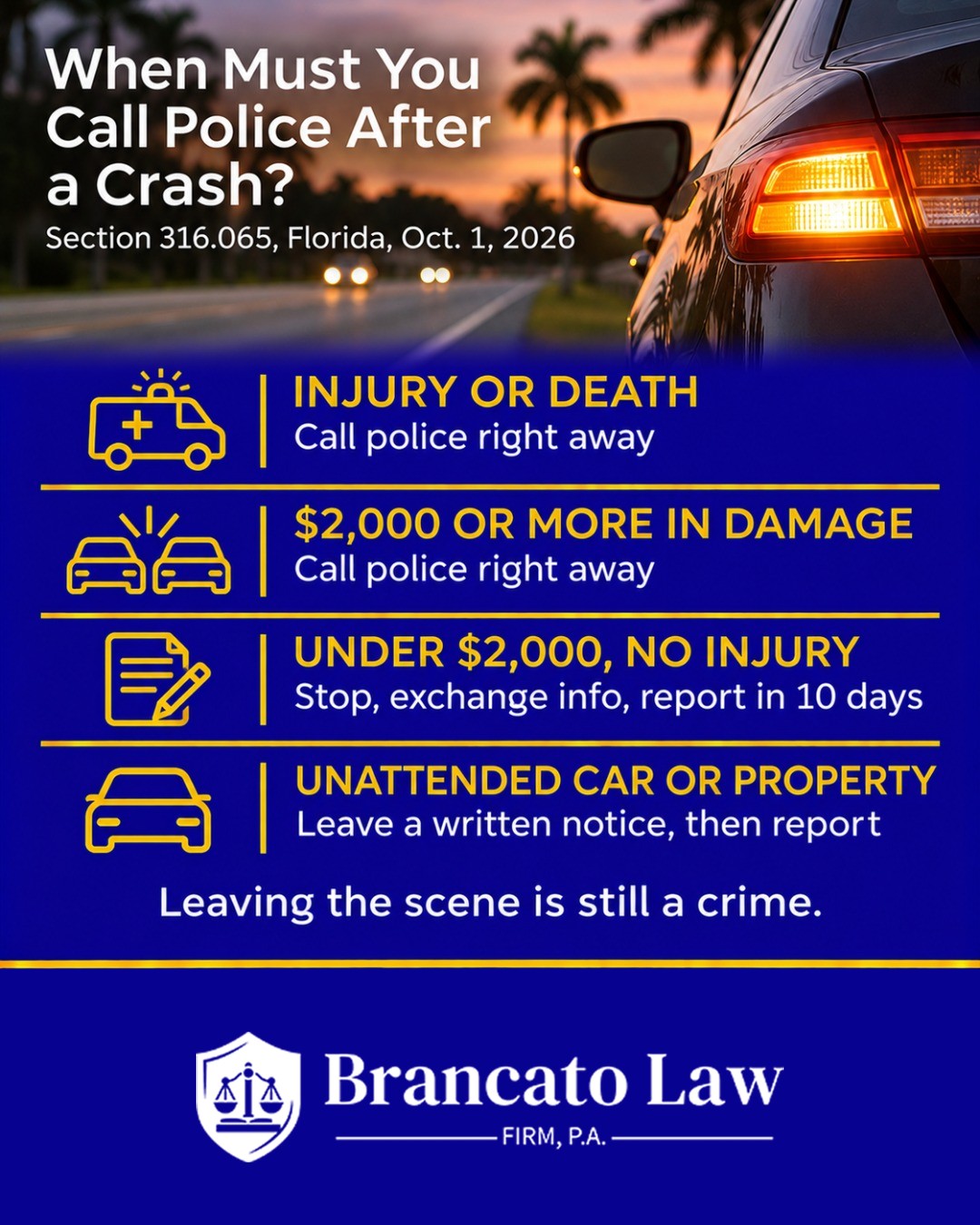
SB 488 raised the dollar amount that triggers a driver’s duty to call the police. Under section 316.065, Florida Statutes, the driver of a vehicle in a crash “resulting in injury to or death of any persons or damage to any vehicle or other property in an apparent amount of at least $2,000” must “immediately by the quickest means of communication” notify the local police department, or the sheriff or Florida Highway Patrol outside city limits.
The old threshold was $500, and it had not changed since 1989, when the Legislature raised it from $100, according to the Senate Fiscal Policy Committee’s analysis of SB 488. The same analysis cited insurance industry data showing that the most common repair cost range for crashes since 2021 was $1,000 to $1,499, and that about 60% of crashes caused more than $2,500 in damage. In other words, a $500 threshold covered nearly every fender bender, while a $2,000 threshold still covers most crashes.
Failing to report a crash that meets the threshold is a noncriminal traffic infraction, punishable as a nonmoving violation. The analysis put the base fine at $30, or up to $108 with fees and costs.
| Crash | Must you call police right away? (from Oct. 1, 2026) | Penalty for not calling |
|---|---|---|
| Anyone injured or killed | Yes | Noncriminal infraction for failing to report; leaving the scene is a crime |
| Apparent damage of $2,000 or more | Yes | Noncriminal infraction |
| Apparent damage under $2,000, no injuries | No police notice required, but you must still stop, exchange information, and file a written report within 10 days if no officer makes one | Noncriminal infraction for failing to file the written report |
| Unattended vehicle or property damaged | Yes, without unnecessary delay, after leaving a written notice or finding the owner | Second-degree misdemeanor |
Do You Still Have to Stop After a Minor Crash?
Yes. The $2,000 threshold governs only the duty to call the police. It does not change the duty to stop. Under section 316.061, a driver in a crash that damages a vehicle or property “driven or attended by any person” must stop and remain at the scene until he or she has given the information required by section 316.062. Leaving early is a second-degree misdemeanor, with no minimum dollar amount.
A crash with an unoccupied parked car or other unattended property carries its own duty under section 316.063. The driver must stop and either find the owner or leave a secure, visible written note with his or her name, address, and vehicle registration number, and then notify the police without unnecessary delay. Failing to do so is also a second-degree misdemeanor.
The stakes are highest when someone is hurt. Leaving the scene of a crash involving injury or death is a felony in Florida, as explained in our guide to leaving the scene of an accident in Florida.
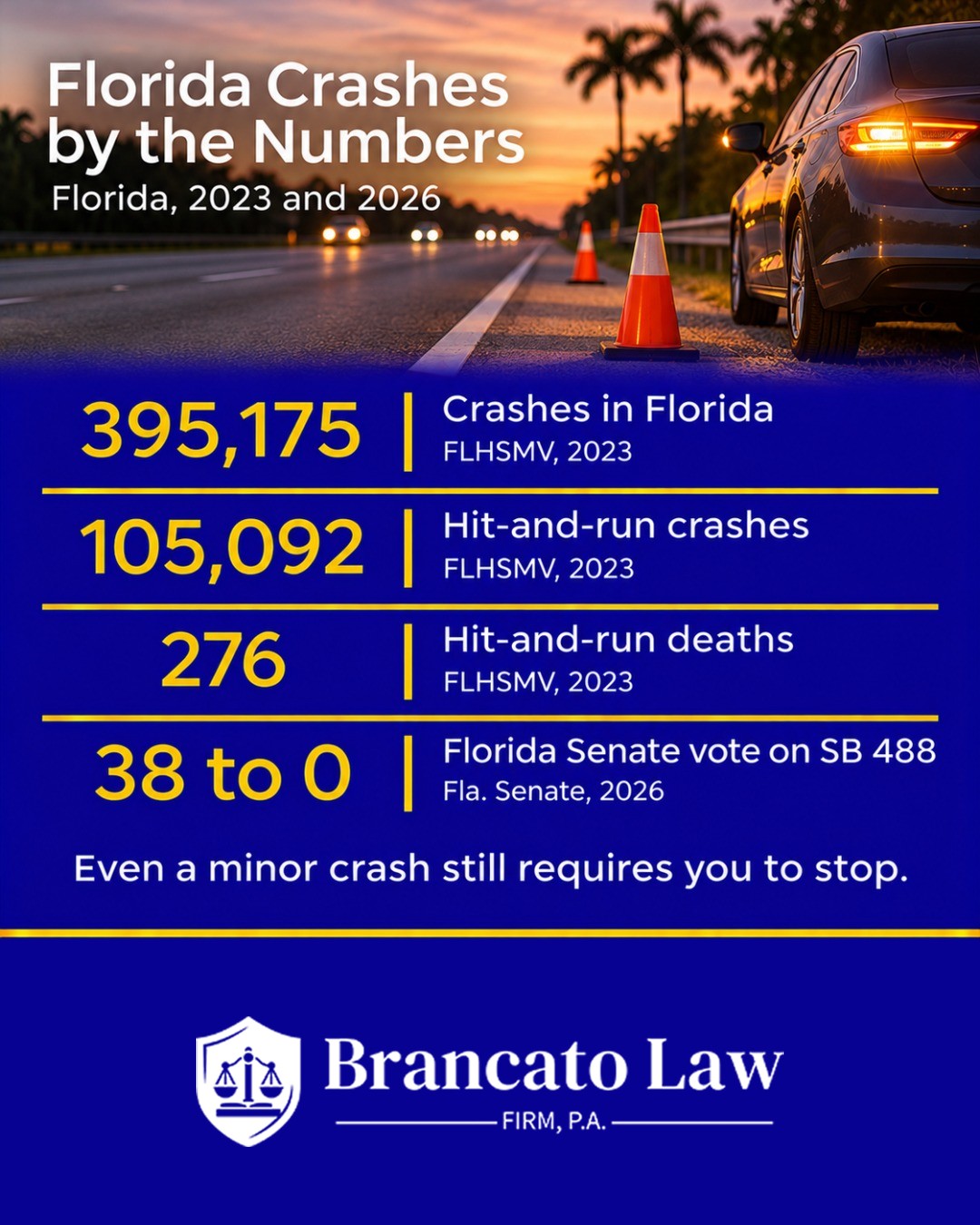
Hit-and-run crashes are common. According to the Florida Department of Highway Safety and Motor Vehicles’ Traffic Crash Facts 2023, Florida recorded 395,175 crashes in 2023, and 105,092 of them were hit-and-run crashes, which caused 276 deaths. Many of those cases start as minor collisions in which a driver did not know the rules.
Do You Have to File a Report If Police Do Not Come?
Yes, if the crash damaged a vehicle or property and no officer prepares a report. Under section 316.066, the driver of any vehicle “in any manner involved in a crash resulting in damage to a vehicle or other property which does not require a law enforcement report” must submit a written crash report to the Department of Highway Safety and Motor Vehicles within 10 days. Failing to file it is a noncriminal traffic infraction.
That means the higher threshold may shift more paperwork onto drivers. When the police no longer have to be called, the 10-day self-report becomes the official record of the crash.
Can What You Say After a Crash Be Used Against You?
Usually not, if you are speaking only to complete the crash report, but that protection ends when a criminal investigation begins. Section 316.066(4) provides that statements made by a person involved in a crash “for the purpose of completing a crash report” may not be used “as evidence in any trial, civil or criminal.” This is known as the accident report privilege.
The Florida Supreme Court explained the limits of that privilege in State v. Norstrom, 613 So. 2d 437 (Fla. 1993). Norstrom was questioned after a crash, read his Miranda rights, and chose to talk. The Court held his statements could be used because he was never told he had to answer. It added a rule that still governs roadside questioning: if an officer suggests a person must answer questions about a crash, the officer must say “this is now a criminal investigation,” followed immediately by Miranda warnings, before any later statement can be used.
As a former police academy instructor, I can tell you that officers are trained on this line, and defense lawyers look for the moment it was crossed. In DUI and leaving-the-scene cases, our attorneys review body camera video to pinpoint when the crash investigation became a criminal one, and we move to suppress statements made before that moment.
What Else Did SB 488 Change?
SB 488 is a large transportation bill, and two other parts matter to drivers and businesses facing criminal exposure.
- Email notice of license suspensions. Under section 322.251, FLHSMV may now send orders of cancellation, suspension, revocation, or disqualification “by e-mail notification if authorized by the licensee.” Notice is complete 20 days after the email is sent, and “any failure by the person to receive the order does not affect or stay the effective date.” That matters because Florida’s driving while license suspended statute presumes knowledge in many cases when a suspension order is in the department’s records. If you opted into email, check it.
- Fuel tax offenses. The bill created penalties for counterfeiting or illegally altering fuel tax licenses and related permits and for misusing motor fuel tax documents. These provisions mainly affect fuel dealers, carriers, and trucking companies.
- Motor carriers. The bill moved motor carriers from registration to licensing and added recordkeeping requirements.
SB 488 was sponsored by Senator Massullo. It passed with near-unanimous support: 38 to 0 in the Senate on February 19, 2026, 108 to 1 in the House on March 9, 2026, and 36 to 0 when the Senate accepted the House’s changes on March 11, 2026, according to the official bill history. Governor DeSantis signed it on April 21, 2026.
What Should You Do After a Car Accident in Florida?
Follow these steps after any crash, whatever the damage looks like:
- Stop as close to the scene as safely possible and stay there.
- Check for injuries and call 911 if anyone is hurt. Render reasonable assistance.
- Exchange your name, address, vehicle registration number, and, if asked, your driver license with the other driver.
- Call police if anyone is injured or damage appears to be $2,000 or more. When in doubt, call; modern bumpers and sensors often cost more than they look.
- If you hit an unattended vehicle or property, find the owner or leave a secure note, then notify police.
- If no officer makes a report, file your own written report with FLHSMV within 10 days.
- Be polite, but do not guess about speed, drinking, or fault. If the questions turn toward a crime, you may decline to answer until you speak with a lawyer.
This post is part of our guide to the new Florida criminal laws that took effect October 1, 2026, which summarizes all eight laws in one place.
Frequently Asked Questions
Is it illegal to leave the scene of a minor accident in Florida?
Yes. Leaving the scene of a crash involving an occupied vehicle or attended property, without stopping and exchanging information, is a second-degree misdemeanor regardless of the dollar amount of damage. The Brancato Law Firm defends leaving-the-scene charges through our Tampa criminal traffic lawyer practice.
Do I have to call the police for a parking lot accident in Florida?
You must call if anyone is hurt or the apparent damage is $2,000 or more, and you must notify police after striking an unattended car. Our attorneys at The Brancato Law Firm advise calling whenever the damage is unclear, because failing to report is an infraction while leaving improperly can be a crime.
What happens if I don’t report a car accident in Florida?
Failing to notify police of a reportable crash is a noncriminal traffic infraction, and failing to file a required written report within 10 days is also an infraction. The Brancato Law Firm sees the bigger risk in leaving the scene, which is a criminal charge, and in statements made after the investigation turns criminal.
Can my statements in a crash report be used against me?
Statements made only to complete a required crash report are privileged and cannot be used at trial, but statements made after an officer announces a criminal investigation and gives Miranda warnings can be. Our attorneys at The Brancato Law Firm review body camera footage to find exactly when that line was crossed.
Can Florida suspend my license by email?
Yes, if you authorized email notice. Notice is complete 20 days after the email, and failing to see it does not delay the suspension. The Brancato Law Firm defends driving while license suspended charges, including cases where the driver never knew of the suspension, through our criminal traffic defense attorneys.
Talk to a Tampa Criminal Traffic Lawyer Today
For more about our defense strategies, visit our Criminal Traffic practice page.
A minor crash can become a criminal case in the minutes after impact. If you have been cited or contacted about leaving the scene, or questioned after a crash, our attorneys will review the report, the video, and your statements and tell you where you stand. Call The Brancato Law Firm, P.A., founded by Tampa Criminal Defense Attorney Rocky Brancato, at (813) 727-7159. Call us at any hour; our office is two blocks from the courthouse. Our firm has Spanish-speaking staff, and attorney Jean-Luc Adrien speaks Spanish, Haitian Creole, and French.
The Brancato Law Firm, P.A.
620 E. Twiggs Street, Suite 205, Tampa, FL 33602
(813) 727-7159
Serving Hillsborough, Pinellas, and Pasco Counties
The Brancato Law Firm, P.A. is a Tampa-based criminal defense practice. We are not affiliated with any other Brancato-named law firms.
Visit Us

Tampa, FL 33602

Contact Us Now
Free Legal Consultation (813) 727-7159
