- Free Consultation 24/7: (813) 727-7159 Tap Here To Call Us


From First DUI to Death Penalty



Is Selling Nitrous Oxide a Felony in Florida? (2026)


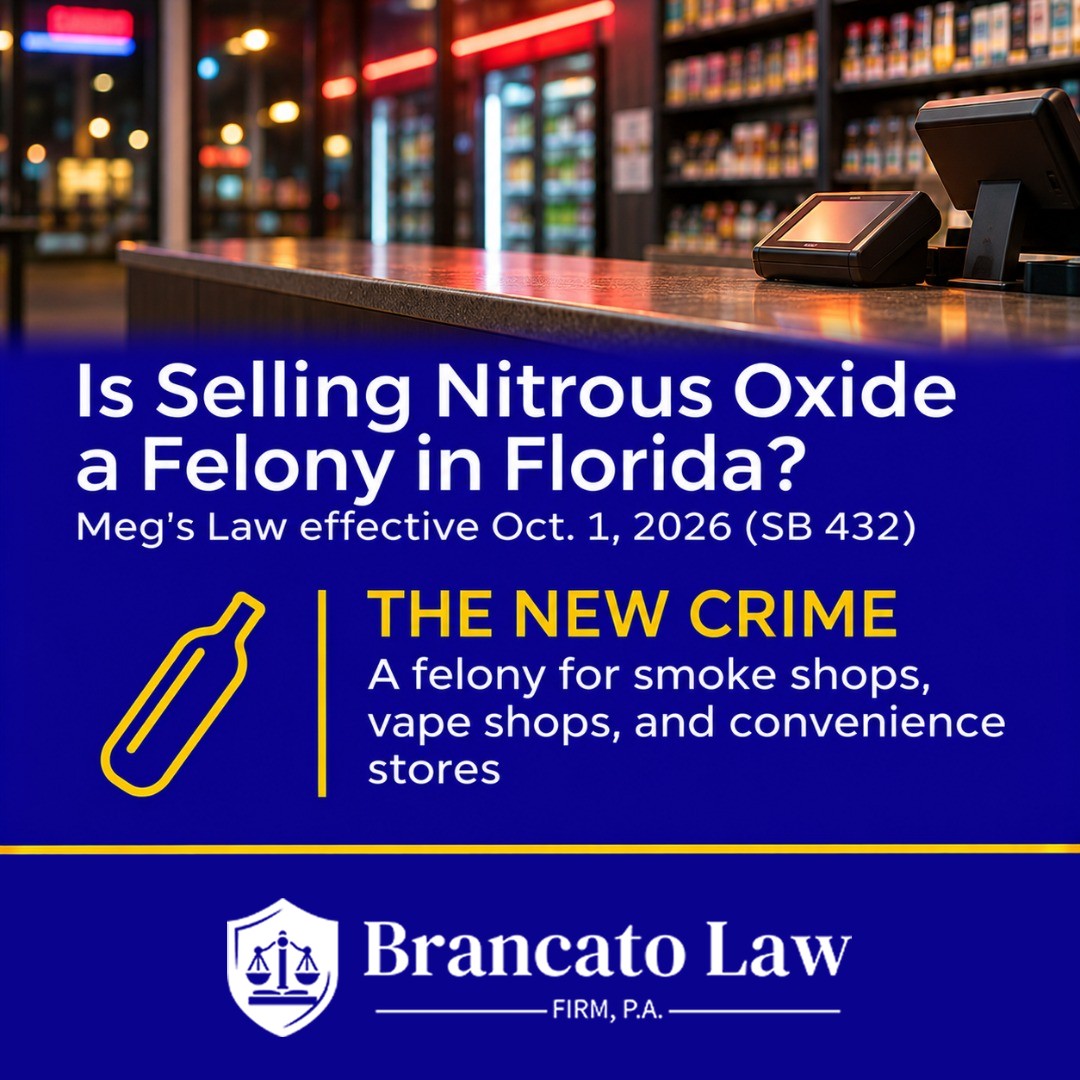
| Yes, for most retailers. Since October 1, 2026, Florida’s Meg’s Law, section 569.216, makes it a third-degree felony for a licensed tobacco or nicotine dealer, or any agent or employee of the dealer, to possess, sell, deliver, or give away nitrous oxide on or from the licensed premises. That covers smoke shops, vape shops, and convenience stores, but not licensed grocery stores or supermarkets, and it does not ban whipped cream or other finished foods that use nitrous oxide only as a propellant. The same law created a new crime of trafficking in xylazine, with mandatory prison terms starting at 3 years for 28 grams or more. |
If you own, manage, or work the counter at a smoke shop or convenience store in Florida, a product that sat legally on the shelf in September became a felony on October 1, 2026. As founder of The Brancato Law Firm, P.A., a Tampa criminal defense firm, and a former Chief Operations Officer of the Hillsborough County Public Defender’s Office, where I oversaw a staff of over 100 attorneys, I have seen how new drug laws are enforced in their first months: through undercover buys and store inspections, before most people know the law changed. Our attorneys work to resolve these cases early, often before a charge is filed.
This guide covers both halves of CS/SB 432 (chapter 2026-148, Laws of Florida): Meg’s Law on nitrous oxide and the new xylazine trafficking crime. It explains why the Legislature acted, what changed in committee, and how the charges are defended.
What Is Meg’s Law in Florida?
Meg’s Law is the nitrous oxide part of SB 432, codified at section 569.216, Florida Statutes. It provides that a dealer licensed or permitted under Florida’s tobacco and nicotine laws, or the dealer’s agent or employee, may not “possess, sell, possess with intent to sell, deliver, or give, directly or indirectly, nitrous oxide on or from the dealer’s licensed premises.” A violation is a third-degree felony, punishable by up to five years in prison and a $5,000 fine.
The law reaches three groups of people:
- Owners and licensees of businesses that hold a tobacco or nicotine dealer license or permit.
- Employees and agents, including clerks, managers, and delivery drivers. The statute names them directly, so an employee can be charged even if the owner set the store’s inventory.
- Convenience businesses as defined in section 812.171, such as gas station stores, which the statute expressly includes.
Two exceptions apply. Grocery stores and supermarkets licensed or permitted by the Florida Department of Agriculture and Consumer Services are exempt. And the law does not prohibit selling “a finished food product in which nitrous oxide is used solely as a propellant,” such as canned whipped cream. The Department of Business and Professional Regulation must also adopt rules to prevent nitrous oxide from being used to get intoxicated.
Who Was Meg, and Why Did Florida Pass This Law?
The law is named for Margaret “Meg” Caldwell, a 29-year-old Central Florida woman whose family says she was addicted to nitrous oxide. According to Spectrum News 13, she was found behind an Orlando tobacco shop in November 2024 after buying oversized canisters of the gas. Representative Rachel Plakon championed the measure in the House, and Meg’s sister Kathleen backed it publicly.
The Senate sponsor, Senator Clay Yarborough of Jacksonville, told WUSF that nitrous oxide “has legitimate culinary and medical uses” but that canisters were being marketed with bright packaging and flavoring. He said the nitrous oxide provision was added after talks with Senator Darryl Rouson of St. Petersburg.
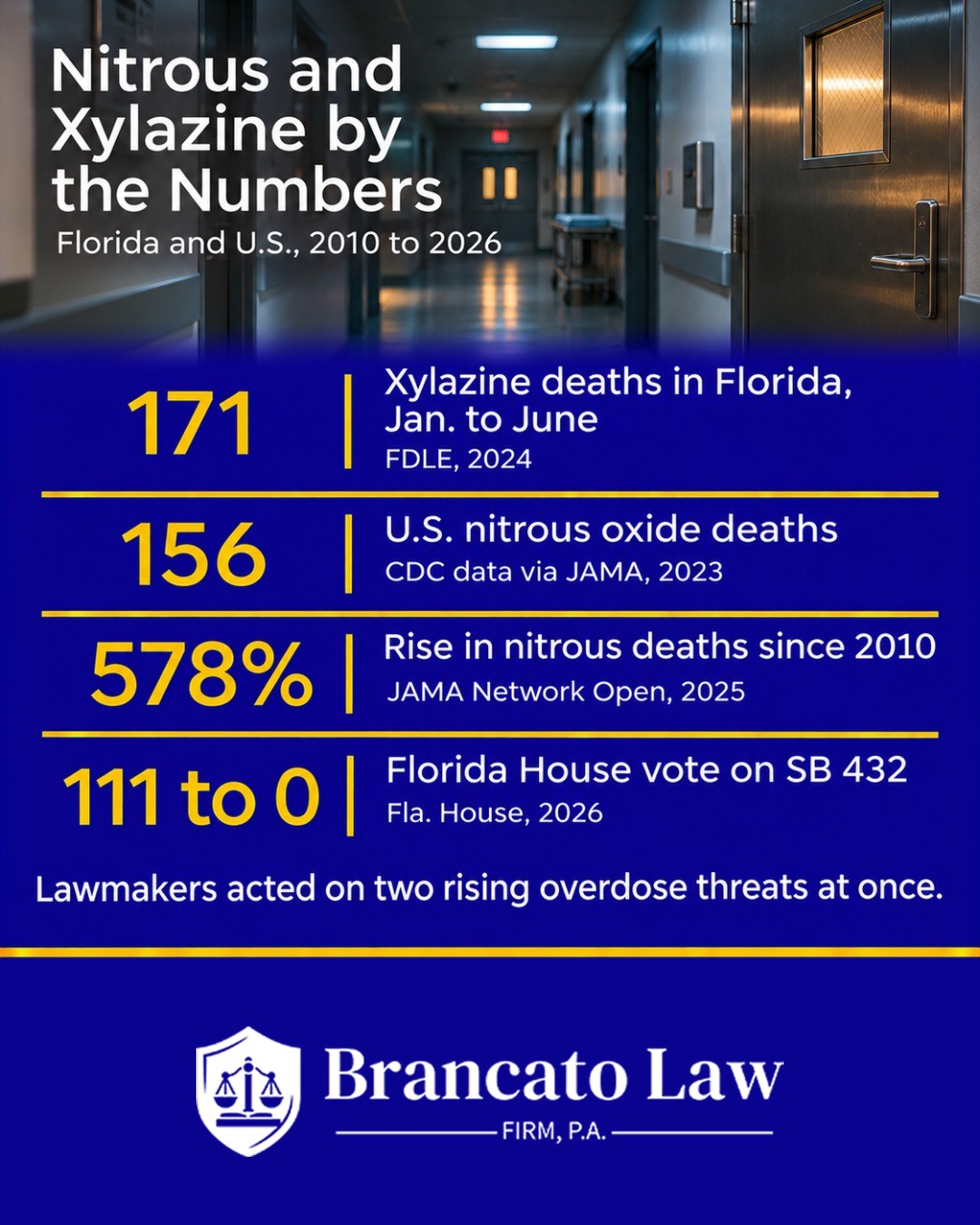
National data supports the concern. A 2025 study by Andrew Yockey and Rachel Hoopsick, published in JAMA Network Open and summarized by the University of Mississippi, used CDC mortality data to find that U.S. deaths involving nitrous oxide rose from 23 in 2010 to 156 in 2023, a 578% increase. Florida’s medical examiners do not track nitrous oxide deaths separately, so no state-level count exists.
Was Nitrous Oxide Already Illegal in Florida?
Partly, and many people do not realize it. Under section 877.111, Florida Statutes, it has long been a crime to inhale nitrous oxide to get intoxicated, and it is a third-degree felony for “any person” to knowingly distribute, sell, purchase, transfer, or possess “more than 16 grams of nitrous oxide,” unless the use falls into a listed medical, food processing, or industrial category.
A single small whipped cream charger holds about 8 grams. The large flavored tanks sold in smoke shops hold far more than 16 grams, so a customer who buys one, and not just the seller, can be charged under section 877.111. The statute also says that using nitrous oxide to inflate a balloon creates an inference that the person knew it was for an unlawful purpose.
What Meg’s Law adds is a location-based ban. Under section 569.216, the State does not need to prove an amount over 16 grams or a purpose to intoxicate. Possession on a dealer’s licensed premises is enough.
| Question | Section 877.111 (existing law) | Section 569.216 (Meg’s Law, Oct. 1, 2026) |
|---|---|---|
| Who it covers | Any person | Licensed tobacco and nicotine dealers, their agents and employees, and convenience businesses |
| What is prohibited | Inhaling for intoxication; knowing sale, purchase, transfer, or possession of more than 16 grams | Possessing, selling, delivering, or giving nitrous oxide on or from the licensed premises, in any amount |
| Penalty | Second-degree misdemeanor for inhaling; third-degree felony for more than 16 grams | Third-degree felony |
| Main exceptions | Medical, food processing, industrial, and automotive uses | Grocery stores and supermarkets; finished foods using nitrous oxide only as a propellant |
What Is Xylazine, and What Did the Law Change?
Xylazine is a veterinary sedative that is increasingly mixed into illicit fentanyl, where it is often called “tranq.” It is not approved for people, and the FDA has warned that it is not known whether naloxone reverses its effects. Florida already lists xylazine in Schedule I under section 893.03(1)(c)37. SB 432 made three changes:
- An exception for animal medicine. FDA-approved animal drug products containing xylazine are now excluded from Schedule I. Before the change, Florida’s Schedule I listing did not distinguish veterinary xylazine from street xylazine, a problem for veterinarians, horse owners, and farms.
- A new trafficking crime. Trafficking in xylazine under section 893.135(1)(c)7. is a first-degree felony with mandatory minimum prison terms and fines tied to weight.
- A candy-product offense. Xylazine was added to section 893.13(1)(i), which makes it a first-degree felony with a 3-year mandatory minimum to sell, manufacture, deliver, or possess with intent any of these drugs in a form that resembles candy, cereal, gummies, vitamins, a branded food product, or a cartoon character.
| Xylazine weight (including any mixture) | Mandatory minimum prison | Mandatory fine |
|---|---|---|
| 28 grams to under 100 grams | 3 years | $50,000 |
| 100 grams to under 200 grams | 7 years | $100,000 |
| 200 grams or more | 25 years | $500,000 |
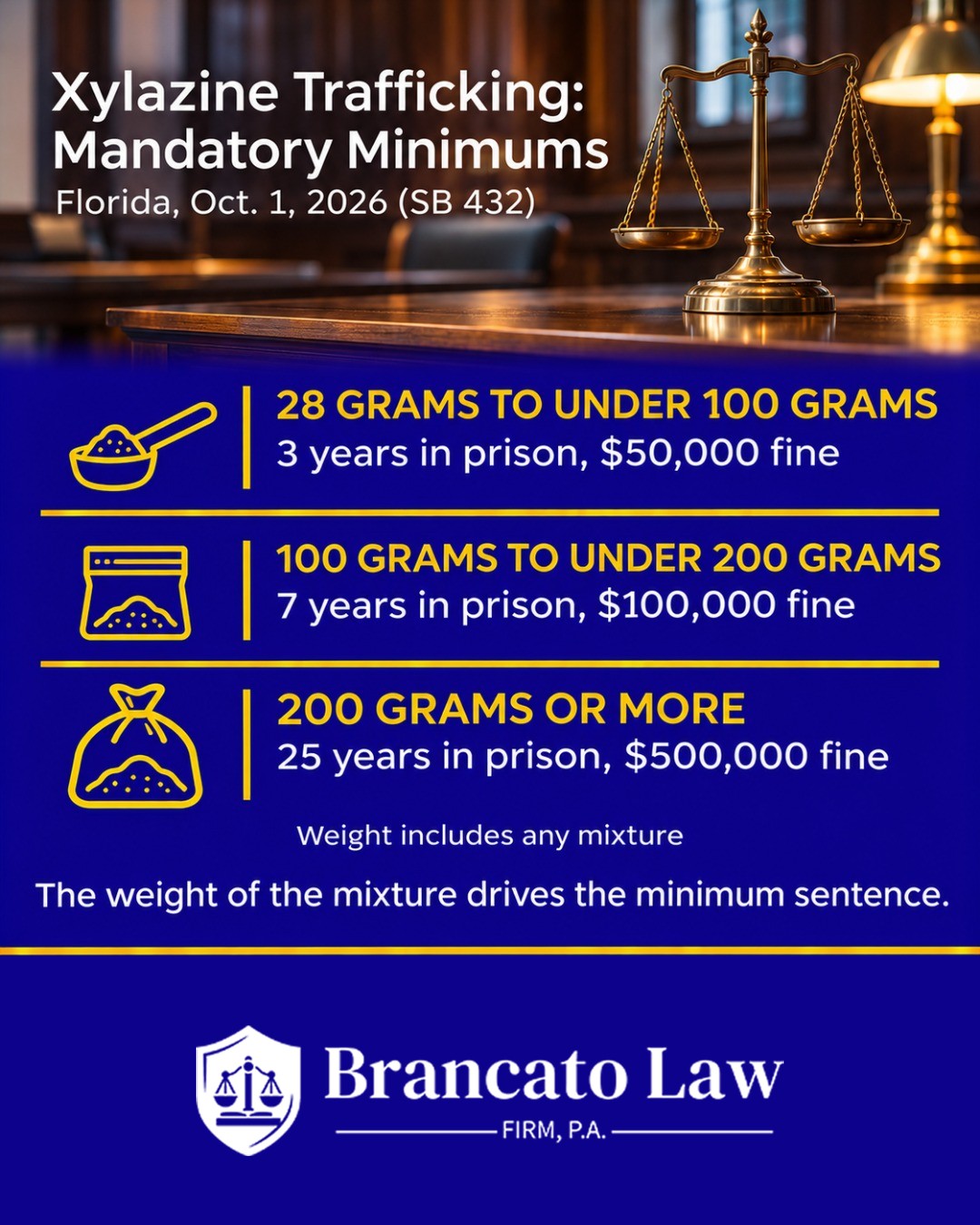
The fine amounts above come from the enacted statute. An earlier Senate staff analysis listed a $100,000 fine for the lowest tier, but the version the Legislature passed sets it at $50,000.
Xylazine is a real factor in Florida overdose deaths. The Florida Medical Examiners Commission’s 2024 Interim Drug Report, published by FDLE, found that xylazine caused 171 deaths in Florida in just the first six months of 2024, and was found in 236 deceased persons overall in that period.
How Did SB 432 Change in the Legislature?
The bill passed both chambers unanimously, but it looked different when it was filed. The original Senate bill would have placed 7-hydroxymitragynine, the concentrated kratom compound sold as “7-OH,” in Schedule I. Senator Yarborough removed that provision after negotiations with the House. Meg’s Law was added in the Senate Fiscal Policy Committee, and a floor amendment made further changes before the final Senate vote. The House companion on xylazine, HB 309, was laid on the table when SB 432 passed.
| Date (2026) | Committee or chamber | Vote |
|---|---|---|
| January 12 | Senate Criminal Justice Committee | 8 to 0 |
| January 21 | Senate Appropriations Committee on Criminal and Civil Justice | 8 to 0 |
| February 24 | Senate Fiscal Policy Committee | 19 to 0 |
| March 4 | Full Senate | 37 to 0 |
| March 9 | Full House | 111 to 0 |
Vote tallies come from the official bill history. Governor DeSantis signed the bill on June 16, 2026. The Criminal Justice Impact Conference projected a “positive indeterminate” impact on prison beds, noting that the Department of Corrections recorded 1,159 new prison commitments for drug possession, sale, manufacture, delivery, or trafficking in fiscal year 2024-25, according to the Senate Fiscal Policy Committee analysis.
How Do You Fight a Xylazine Trafficking Charge in Florida?
Xylazine trafficking cases are built on weight, knowledge, and possession, and each can be challenged. Our Tampa drug crimes attorney team looks at these issues first:
- The lab result. The State must prove the substance contains xylazine and that the mixture weighs at least 28 grams. Our attorneys review the lab’s methods, chain of custody, and whether packaging or cutting agents were weighed.
- Knowledge of the substance. Many people who buy street fentanyl have no idea it contains xylazine. Under section 893.101, lack of knowledge of the illicit nature of a controlled substance is an affirmative defense that can be raised at trial.
- Possession. Drugs found in a shared car or home require proof the person knew of the drugs and could control them. Constructive possession cases are often won on this element.
- The veterinary exception. FDA-approved animal products are no longer Schedule I. Whether a product qualifies, and whether it was being used for an animal, can decide the case.
- Overlapping charges. A fentanyl-xylazine mixture can support both fentanyl and xylazine charges. Whether the State can punish the same mixture twice is a double jeopardy question Florida’s appellate courts have not yet answered for xylazine, and our attorneys raise it.
- The search. Trafficking weights are usually found in traffic stops and home searches. A successful motion to suppress removes the drugs from evidence entirely.
Mandatory minimums do not have to be the end of the story. Under section 893.135(4), the State may ask the court to reduce or suspend a trafficking sentence for a defendant who provides substantial assistance. Our guide to drug trafficking in Florida explains the weights and mandatory sentences for other drugs.
What Should Store Owners and Employees Do Now?
Remove nitrous oxide products from any licensed tobacco or nicotine premises now, and document that you did. The law took effect October 1, 2026, and an undercover purchase is the most common way new retail laws are enforced. Our attorneys recommend these steps:
- Pull all nitrous oxide chargers, tanks, and dispensers from the sales floor, storage rooms, and vehicles tied to the store.
- Keep a dated record of the removal, including invoices showing how the product was returned or disposed of.
- Tell every employee in writing that the store does not sell nitrous oxide, because employees face felony exposure personally.
- Do not transfer the inventory to another business you control; the law reaches possession “directly or indirectly.”
- If an inspector or officer visits, be polite, do not consent to anything beyond what the law requires, and call a lawyer.
If you learn your store or an employee is under investigation, representation before charges are filed gives our attorneys the chance to show the State Attorney’s Office that the business complied once the law took effect. Our guide on fighting a drug charge before it is filed explains that process.
This post is part of our guide to the new Florida criminal laws that took effect October 1, 2026, which summarizes all eight laws in one place.
Frequently Asked Questions
Can I still buy whipped cream chargers in Florida?
Yes, from businesses that are not licensed tobacco or nicotine dealers, such as grocery stores and kitchen suppliers, though possessing more than 16 grams for intoxication or without a lawful purpose can still be charged under section 877.111. The Brancato Law Firm reviews the amount, the purpose, and where the product was bought when advising clients charged with nitrous oxide possession.
Can a smoke shop clerk be charged under Meg’s Law?
Yes. Section 569.216 applies to a dealer’s “agent or employee,” so a clerk who sells or even possesses nitrous oxide on the licensed premises can face a third-degree felony. Our attorneys at The Brancato Law Firm look closely at whether the employee knew the product was nitrous oxide and what instructions the owner gave.
Is xylazine a controlled substance in Florida?
Yes. Xylazine is a Schedule I substance under section 893.03(1)(c)37., except FDA-approved animal drug products, which SB 432 removed from Schedule I. The Brancato Law Firm defends xylazine possession and sale cases in Hillsborough, Pinellas, and Pasco Counties through our drug crimes defense practice.
What is the penalty for trafficking xylazine in Florida?
Trafficking 28 grams or more of xylazine or a mixture containing it is a first-degree felony with a mandatory minimum of 3 years and a $50,000 fine, rising to 7 years at 100 grams and 25 years at 200 grams. Our attorneys at The Brancato Law Firm challenge the weight, the lab analysis, and possession in every trafficking case.
Does Meg’s Law apply to gas stations?
Yes. The statute expressly applies to a “convenience business” as defined in section 812.171, which includes most gas station stores, even if the business is not a typical smoke shop. The Brancato Law Firm advises owners on compliance and defends employees charged after undercover purchases.
Does the law apply to sales before October 1, 2026?
No. Section 569.216 and the xylazine trafficking provision apply only to conduct on or after October 1, 2026. Our attorneys at The Brancato Law Firm check the date of every alleged sale, because earlier conduct can only be charged under the laws in effect at the time.
Talk to a Tampa Drug Crimes Lawyer Today
For more about our defense strategies, visit our Drug Crimes practice page.
The earliest days of a drug investigation are when a charge can still be shaped or stopped. Our attorneys will review the arrest or inspection report, the lab work, and the search, and we will contact the prosecutor before the filing decision when that helps. Call The Brancato Law Firm, P.A., founded by Tampa Criminal Defense Attorney Rocky Brancato, at (813) 727-7159. Call us at any hour; our office is two blocks from the courthouse. Our firm has Spanish-speaking staff, and attorney Jean-Luc Adrien speaks Spanish, Haitian Creole, and French.
The Brancato Law Firm, P.A.
620 E. Twiggs Street, Suite 205, Tampa, FL 33602
(813) 727-7159
Serving Hillsborough, Pinellas, and Pasco Counties
The Brancato Law Firm, P.A. is a Tampa-based criminal defense practice. We are not affiliated with any other Brancato-named law firms.
Visit Us

Tampa, FL 33602

Contact Us Now
Free Legal Consultation (813) 727-7159
