- Free Consultation 24/7: (813) 727-7159 Tap Here To Call Us


From First DUI to Death Penalty



How to Protect Your License After a Tampa DUI Arrest (2026)


Updated October 22, 2026
To protect your Florida driver license after a DUI arrest, act within 10 days of the notice of suspension the officer gave you. In that window you can request a formal review hearing to fight the suspension, request an informal review on the paperwork, or, if this is your first DUI, request an eligibility review that gives you a business-purposes-only license for the whole suspension in exchange for giving up the hearing. If you do nothing, the suspension runs: 6 months for a first breath result of 0.08 or higher, 1 year for a first refusal, and 18 months after a prior refusal.
If you were arrested for DUI in Tampa this week, your license is on a faster clock than your criminal case. The suspension started the day the officer handed you the citation, and the temporary permit expires at midnight on the 10th day. I’m Rocky Brancato, founder of The Brancato Law Firm, P.A., a Tampa criminal defense firm, a member of the National College for DUI Defense, and a former police academy instructor. Our attorneys handle the license case and the criminal case together for drivers in Hillsborough, Pinellas, and Pasco Counties.
This guide explains your three options, what happens at a formal review hearing, when the waiver makes sense, and what happens to your license if the criminal case ends in a conviction.
What happens to your license when you are arrested for DUI in Florida?
The officer takes your license and gives you a notice of suspension that works as a 10-day temporary permit. Under section 322.2615, Florida Statutes, the suspension begins on the date the notice is issued, and the permit “expires at midnight of the 10th day following the date of issuance of the notice of suspension.”
This is an administrative suspension by the Florida Department of Highway Safety and Motor Vehicles. It happens before any judge decides anything in the criminal case, and a not-guilty verdict months later does not automatically undo it. Our attorneys at The Brancato Law Firm treat the first 10 days as the most important deadline in a DUI case.
How long is the license suspension after a DUI arrest?
The length depends on whether you took the test and whether you have a prior suspension. Section 322.2615(1)(b) sets the periods.
| Situation at arrest | Administrative suspension | Hardship wait if the suspension is upheld |
|---|---|---|
| First breath or blood result of 0.08 or higher | 6 months | 30 days |
| Result of 0.08 or higher after a prior suspension under this section | 1 year | 30 days |
| First refusal to submit to a test | 1 year | 90 days |
| Refusal after a prior refusal suspension | 18 months | No business license after two refusal suspensions |
The hardship waits in the right column come from section 322.2615(10) and run from the end of the last temporary permit. They apply when the suspension is upheld after a review. The eligibility review described below works differently, which is why the choice you make in the first 10 days matters so much.
What are your three choices within the 10 days?
You have three choices, and you must make one within 10 days after the notice of suspension is issued. The statute lets a driver “request a formal or informal review of the suspension” or “request a review of eligibility for a restricted driving privilege under s. 322.271(7).”
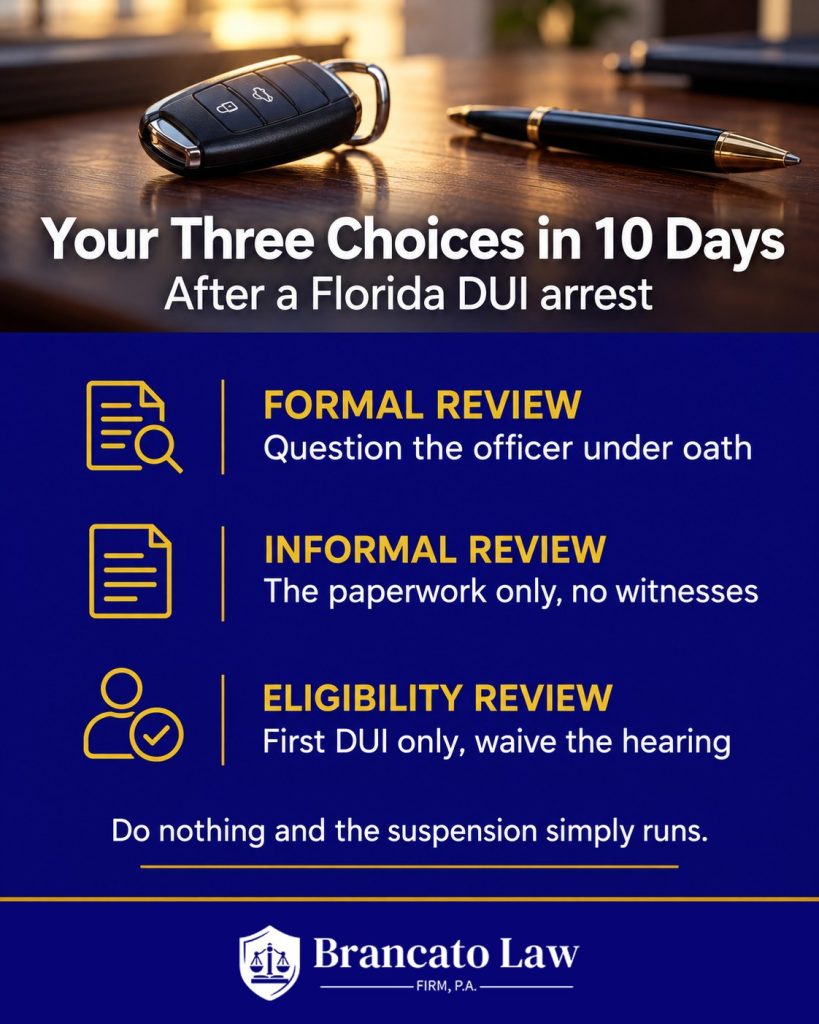
| Option | What happens | Best fit |
|---|---|---|
| Formal review hearing | A hearing officer reviews the evidence, and your lawyer can subpoena and question the arresting officer and breath technician | Drivers with a challenge to the stop, the arrest, the test, or the warnings |
| Informal review | The hearing officer reviews only the paperwork; no officer or witness appears | Rarely the best choice, because no one can be questioned |
| Eligibility review (often called the waiver) | You give up the formal and informal review and receive a business-purposes-only license for the full suspension | True first-time drivers who need to keep driving to work and have no strong hearing issue |
Our attorneys at The Brancato Law Firm make this choice with each client based on the video and the paperwork. The decision is permanent once the eligibility license is accepted.
What happens at a formal review hearing?
A formal review hearing is an administrative hearing before a Department hearing officer, not a judge. The Department must schedule it within 30 days after it receives the request, or “the department shall invalidate the suspension.” The hearing can be held by communications technology, and the hearing officer can issue subpoenas for the officers and witnesses named in the arrest paperwork.
The hearing officer decides “by a preponderance of the evidence” whether to sustain, amend, or invalidate the suspension. For a breath-result suspension, the issues are probable cause and whether the result was 0.08 or higher. For a refusal suspension, the issues are probable cause, whether you refused after a request, and whether you were warned about the suspension. The Florida Supreme Court added one more issue in Florida Department of Highway Safety & Motor Vehicles v. Hernandez, 74 So. 3d 1070 (Fla. 2011): the department cannot suspend a license for a refusal that was not incident to a lawful arrest.
Two rules make these hearings worth fighting:
- The no-show rule. Under section 322.2615(11), if the arresting officer or the breath technician fails to appear under a subpoena, the department must invalidate the suspension. In Objio v. State, Department of Highway Safety & Motor Vehicles, 179 So. 3d 494 (Fla. 5th DCA 2015), the court called that rule “absolute, mandatory, and quite clear” and ordered the suspension invalidated.
- The video rule. In Wiggins v. Florida Department of Highway Safety & Motor Vehicles, 209 So. 3d 1165 (Fla. 2017), the Florida Supreme Court held that an officer’s account that is “totally contradicted” by video evidence is not competent evidence to sustain a suspension.
The hearing also gives our attorneys something the criminal case will not offer for months: the officer’s sworn account of the stop, the driving pattern, and the warnings. That testimony often shapes the motion to suppress in the DUI case.
Should you waive the hearing for a hardship license?
Sometimes. The eligibility review under section 322.271(7), Florida Statutes is available only to a driver who has never had a suspension under section 322.2615, has never been disqualified under section 322.64, and has never been convicted of DUI. It applies “notwithstanding” the 30-day and 90-day hardship waits, so an eligible driver can keep driving for business purposes from the start.
The trade is real. Under section 322.271(7)(c), accepting the restricted license “is deemed a waiver of the right to formal and informal review.” The Department’s Request for Eligibility Review form (HSMV 72034) requires enrollment in DUI school, warns that the restricted license will be canceled if the course is not completed within 90 days, and lists a $25 fee. The license lasts the full suspension period: 6 months for a breath result, 1 year for a refusal.
When the video shows a weak stop or a defective warning, our attorneys usually fight the suspension instead of waiving it, because winning restores full driving privileges and builds the record for the criminal case. When the hearing issues are thin and the client must drive to work next week, the waiver is often the better choice. The Brancato Law Firm explains both paths before the deadline.
What if you lose the formal review hearing?
You can ask the circuit court to review the decision by a petition for writ of certiorari under section 322.2615(13). The petition does not stop the suspension, and the court does not rehear the case from scratch. In Department of Highway Safety & Motor Vehicles v. Begera, 420 So. 3d 1119 (Fla. 5th DCA 2025), the Fifth District held that the circuit court must defer to the hearing officer’s findings unless no competent evidence supports them, and reversed an order that had thrown out a suspension over a time discrepancy in the paperwork.
Certiorari still wins cases. In September 2025, after a client lost at the DHSMV hearing, our firm’s certiorari petition in circuit court reinstated both his regular license and his commercial driver license. Past results do not guarantee future outcomes.
Where are DUI license hearings held for Tampa drivers?
Hillsborough County hearings are handled by the Department’s Bureau of Administrative Reviews office at 2814 E. Hillsborough Ave., Tampa, FL 33610, according to the FLHSMV Hillsborough County locations page. That office lists hardship licenses, formal DUI reviews, and the first-DUI waiver among its services. The statute allows hearings by communications technology, and the Department says some services can be handled without a visit.
One 2026 change affects the paperwork. Chapter 2026-39, Laws of Florida, effective October 1, 2026, allows the Department to email the decision in an informal review to the email address the driver provided, so check your email as well as your mail after a review.
How many license hearings happen in Florida?
Tens of thousands each year. The Department’s Office of Inspector General reported in its December 2024 audit of the Bureau of Administrative Reviews that the bureau held 26,052 hearings and reviews statewide from July 1, 2023 through June 30, 2024, across eight offices.
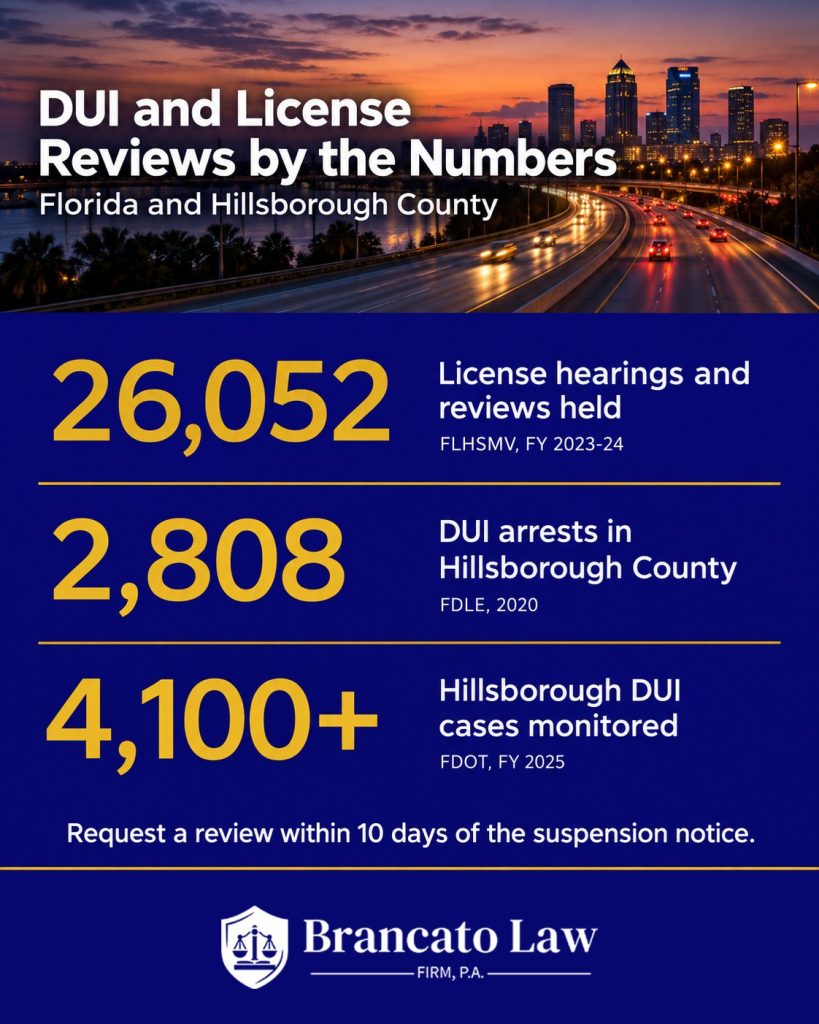
The local volume is just as heavy. FDLE’s Total Arrests by County, 2020, the most recent county-level FDLE table, counted 2,808 DUI arrests in Hillsborough County, 2,027 in Pinellas, and 661 in Pasco. The Florida Department of Transportation’s FY2025 Highway Safety Annual Report says the MADD court monitoring program tracked more than 4,100 DUI cases in Hillsborough County from October 2024 through September 2025.
What happens to your license if you are convicted of DUI?
A DUI conviction brings a separate revocation by the court under section 322.28, Florida Statutes, in addition to the administrative suspension.
| Conviction | Revocation under § 322.28 | Hardship option |
|---|---|---|
| First DUI | At least 180 days, up to 1 year | Available after completing DUI school |
| Second DUI within 5 years | At least 5 years | Petition after 12 months |
| Third DUI within 10 years | At least 10 years | Petition after 24 months |
| Fourth DUI, or DUI manslaughter | Permanent | Petition after 5 years in limited cases |
Ignition interlock periods are set by section 322.2715, Florida Statutes: at least 1 year after a second conviction and at least 6 months after a first conviction at 0.15 or higher. Research supports the requirement. A study by Kaufman and Wiebe in the American Journal of Public Health, Impact of State Ignition Interlock Laws on Alcohol-Involved Crash Deaths in the United States (2016), found lower alcohol-involved crash death rates in states with universal interlock laws. This is why the result of the criminal case matters to the license, and why our attorneys often negotiate DUI charges down to reckless driving, which carries no DUI revocation.
What should you do this week?
Five steps protect the license and the case:
- Find the date on your notice of suspension and count 10 days from it.
- Decide on the review with a lawyer before that date: formal review, informal review, or eligibility review.
- Ask for the evidence. The arrest affidavit, the breath result or refusal affidavit, and the video decide most hearings.
- Enroll in DUI school if you choose the waiver, because the restricted license is canceled if the course is not completed in time.
- Do not drive on an expired permit. Driving after the permit expires can lead to a separate charge for driving while license suspended.
Our Tampa DUI lawyer team files the review request, subpoenas the officers, and coordinates the hearing with the criminal defense. If you refused the test, our guide on whether refusing a breathalyzer is a crime in Florida explains the new refusal charge, and our post on what happens after a DUI arrest in Hillsborough County walks through the whole case timeline.
Frequently asked questions about your license after a DUI arrest
Can I drive after a DUI arrest in Florida?
Yes, for 10 days. The notice of suspension is a temporary permit that expires at midnight on the 10th day, and our attorneys at The Brancato Law Firm use that window to request the review that decides whether you keep driving.
Does the 10-day deadline count from the arrest or the notice?
The statute counts it from the date the notice of suspension is issued. That is usually the arrest date, but not always, so The Brancato Law Firm reads the date on the notice itself before calculating the deadline.
Is the DUI waiver hearing worth it for a first offense?
It depends on the evidence. The waiver gives a first-time driver a business-purposes-only license right away but gives up the chance to beat the suspension, and our attorneys at The Brancato Law Firm compare that trade against the video and the paperwork in each case. Our DUI defense attorneys in Tampa can review your case before the deadline.
What if the officer does not show up to the formal review hearing?
If the arresting officer or breath technician was subpoenaed and fails to appear, section 322.2615(11) requires the department to invalidate the suspension. The Brancato Law Firm subpoenas both witnesses so that rule is available.
Can I get a hardship license after a DUI refusal?
Often, yes. A first refusal suspension allows a business-purposes-only license after a 90-day wait if the suspension is upheld, or sooner through the eligibility review if you qualify, and our attorneys at The Brancato Law Firm explain which route fits your record. Read more in our guide to breath-test refusal in Florida.
Does winning the license hearing end the DUI case?
No. The license case and the criminal case are separate, and the result of one does not decide the other. The Brancato Law Firm uses the hearing testimony to build the criminal defense, and you can see how DUI cases have been resolved on our case results page.
Talk to a Tampa DUI attorney before your permit expires
Count the days on your notice of suspension, then call. The Brancato Law Firm, P.A., founded by Tampa Criminal Defense Attorney Rocky Brancato, will file the review request, subpoena the officer, and tell you whether the hearing or the waiver gives you the better result. Call (813) 727-7159 for a free, confidential consultation. You can call us at any hour. Our firm has Spanish-speaking staff, and attorney Jean-Luc Adrien speaks Spanish, Haitian Creole, and French. Read about our Spanish and Haitian Creole criminal defense services.
For more about our defense strategies, visit our Tampa DUI defense page.
The Brancato Law Firm, P.A.
620 E. Twiggs Street, Suite 205, Tampa, FL 33602
(813) 727-7159
Serving Hillsborough, Pinellas, and Pasco Counties
The Brancato Law Firm, P.A. is a Tampa-based criminal defense practice. We are not affiliated with any other Brancato-named law firms.
Visit Us

Tampa, FL 33602

Contact Us Now
Free Legal Consultation (813) 727-7159
