- Free Consultation 24/7: (813) 727-7159 Tap Here To Call Us


From First DUI to Death Penalty


Circumstantial Evidence in Florida


What Tampa Defendants Need to Know After Bush v. State
Updated January 18, 2026
| The Common Misconception Many defendants assume that without direct proof—such as a video or eyewitness—a case cannot move forward. This is not true. Under Florida law, circumstantial evidence is admissible and can support a conviction if the jury finds it persuasive. |
When you face criminal charges in Tampa, Hillsborough County, or anywhere in the Tampa Bay area, understanding circumstantial evidence can be critical to your defense. The distinction between direct and circumstantial evidence—and how Florida courts treat each type—may determine whether you are convicted or acquitted. I am Tampa Criminal Defense Attorney Rocky Brancato. My firm, The Brancato Law Firm, P.A., can help you navigate the circumstantial evidence Rule at trial and before.
Understanding Circumstantial Evidence
Circumstantial evidence requires inference to connect it to a fact in question. In other words, it does not directly prove the event happened but instead points toward a logical conclusion. The jury must draw a connection between the evidence and the alleged crime.
Direct vs. Circumstantial Evidence
| Direct Evidence | Circumstantial Evidence |
| Proves a fact directly without inference | Requires inference to connect to the fact |
| Eyewitness testimony (“I saw him do it”) | Fingerprints at the crime scene |
| Confession (“I committed the crime”) | Suspect running from the scene |
| Video recording of the act | Cell phone data placing person near location |
| DNA from the defendant on the victim | Financial records showing suspicious activity |
How Bush v. State Changed Florida Law
The Florida Supreme Court’s ruling in Bush v. State, 295 So. 3d 179 (Fla. 2020), fundamentally reshaped how courts view circumstantial evidence in criminal cases.
Before Bush v. State
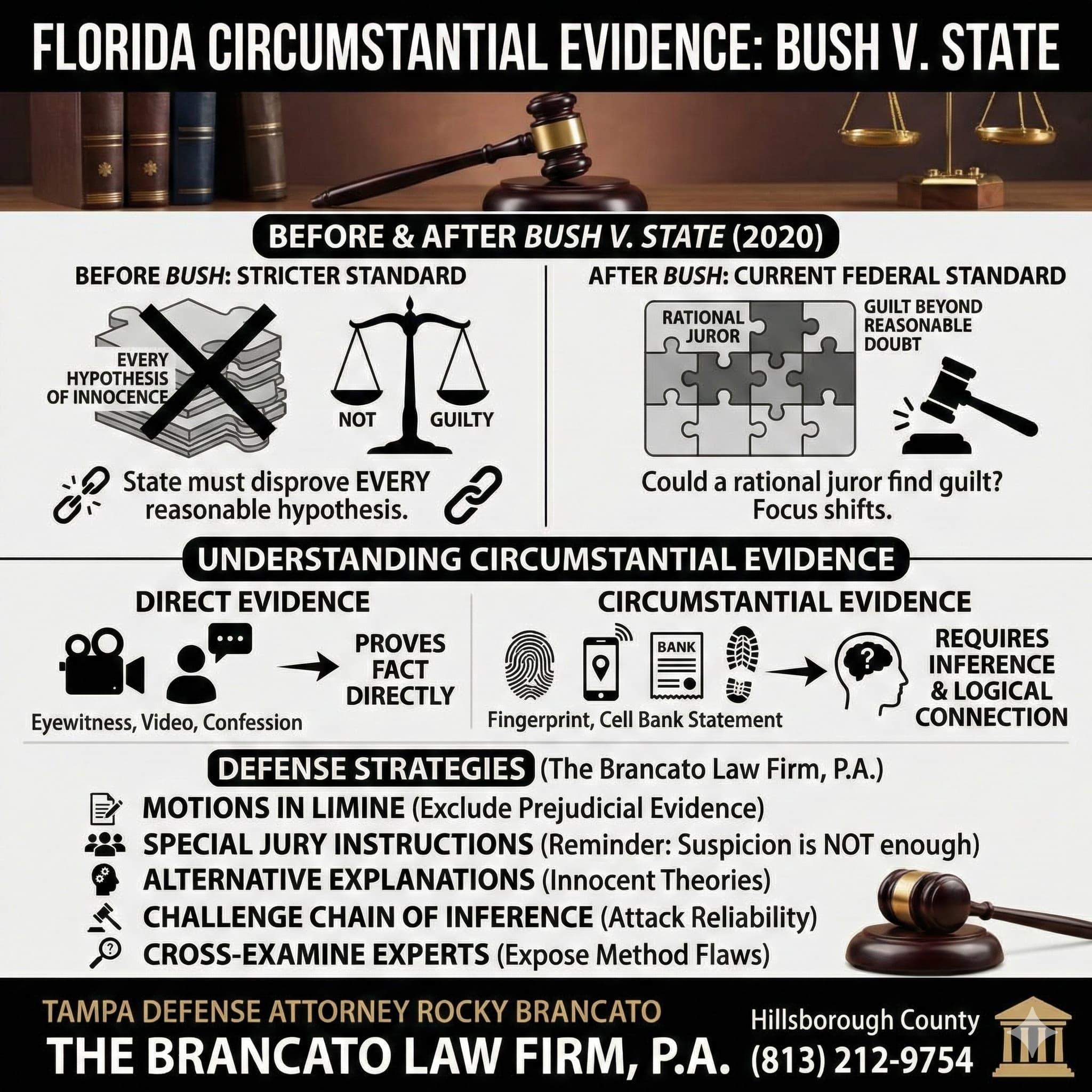
Before Bush, when a case relied only on circumstantial evidence, the State had to disprove every reasonable hypothesis of innocence. This meant that if the defense could present any reasonable alternative explanation for the evidence, the jury was supposed to acquit.
This standard provided significant protection for defendants in cases built entirely on circumstantial proof.
After Bush v. State
The Court adopted a federal standard. Now, appellate courts must review the evidence in the light most favorable to the prosecution and decide whether a rational juror could have found guilt beyond a reasonable doubt.
Consequently, the defense can no longer win on appeal simply by showing an alternative hypothesis of innocence. Instead, the focus shifts to whether any rational juror could have convicted based on the evidence presented.
| Before Bush v. State State must disprove every reasonable hypothesis of innocence | After Bush v. State Could a rational juror find guilt beyond a reasonable doubt? |
Common Examples of Circumstantial Evidence
Prosecutors frequently build cases on circumstantial evidence. Understanding these common types can help you recognize the strengths and weaknesses of the State’s case against you:
| Evidence Type | What Prosecutors Argue |
| Fingerprints | Defendant was present at the crime scene |
| Flight from Scene | Consciousness of guilt—defendant ran because they knew they were guilty |
| Cell Phone Data | Defendant’s phone was near the crime location at the time of the offense |
| Financial Records | Transactions show activity linked to the offense (fraud, theft, drug sales) |
| Computer Records | Search history, downloads, or communications show intent or planning |
| Motive Evidence | Defendant had a reason to commit the crime (jealousy, financial gain, revenge) |
| Prior Bad Acts | Similar conduct in the past shows pattern or intent (if admissible) |
Defense Strategies Against Circumstantial Evidence
Even under the Bush standard, skilled defense lawyers can weaken or exclude circumstantial proof. The following strategies are essential to defending cases built on inference:
1. Motions in Limine
Filed before trial, motions in limine seek to exclude evidence when its prejudicial impact outweighs its probative value. Under § 90.403, Florida Statutes, even relevant evidence can be excluded if it would unfairly prejudice the jury or confuse the issues.
2. Special Jury Instructions
When all evidence is circumstantial and other explanations remain reasonable, defense attorneys can request special jury instructions. These instructions remind jurors that suspicion alone cannot justify a conviction—and that they must be convinced beyond a reasonable doubt.
3. Presenting Alternative Explanations
Circumstantial evidence often has innocent explanations. For example, proving a stolen wallet explains how another person used the defendant’s credit card near the crime scene. A skilled defense attorney presents these alternative theories to create reasonable doubt.
4. Challenging the Chain of Inference
Circumstantial cases require the jury to make logical leaps from evidence to conclusion. Defense attorneys can attack each link in that chain—demonstrating that the inferences the prosecution asks the jury to draw are unreliable, speculative, or contradicted by other evidence.
5. Cross-Examining Forensic Experts
Much circumstantial evidence—fingerprints, cell phone data, financial records—comes through expert testimony. Aggressive cross-examination can expose flaws in methodology, chain of custody problems, or alternative interpretations the expert failed to consider.
Frequently Asked Questions
What is the difference between direct and circumstantial evidence?
Direct evidence proves a fact outright—such as a video recording, confession, or eyewitness testimony. Circumstantial evidence, by contrast, requires inference. Fingerprints, phone data, or suspicious behavior must be connected to the offense through logical reasoning.
Can someone be convicted solely on circumstantial evidence?
Yes, they can. After Bush v. State, Florida courts no longer require the State to disprove every hypothesis of innocence. If a jury believes the circumstantial evidence proves guilt beyond a reasonable doubt, a conviction can stand.
How can a defense attorney challenge circumstantial evidence?
An attorney can question how the evidence was collected, whether it is reliable, or if other explanations make more sense. Pre-trial motions can exclude prejudicial evidence, and expert witnesses can discredit weak forensic conclusions. Ultimately, the goal is to show that the prosecution’s inferences are not the only reasonable explanation.
Does circumstantial evidence carry less weight than direct evidence?
Not necessarily. Florida juries receive instructions that both types of evidence can be used to reach a verdict. However, a skilled defense can argue that circumstantial proof leaves too much room for doubt—especially when alternative explanations exist.
What is Bush v. State and why does it matter?
Bush v. State, 295 So. 3d 179 (Fla. 2020), changed how Florida courts review convictions based on circumstantial evidence. Before Bush, the State had to disprove every reasonable hypothesis of innocence. Now, courts ask only whether a rational juror could have found guilt. This makes it easier for convictions to stand on appeal.
What are special jury instructions for circumstantial evidence?
When a case relies entirely on circumstantial evidence, defense attorneys can request jury instructions that remind jurors: (1) suspicion is not enough for conviction, (2) all evidence must be consistent with guilt, and (3) if a reasonable interpretation points to innocence, they must acquit.
Why Skilled Legal Representation Matters
If you or someone you love faces charges based on circumstantial evidence, you need an attorney who can expose weak links in the State’s case. Rocky Brancato has over 25 years of experience and previously served as Chief Operations Officer of the Hillsborough County Public Defender’s Office.
At The Brancato Law Firm, P.A., we focus on challenging unreliable inferences, cross-examining forensic experts, and protecting the rights of Tampa defendants. Every assumption gets tested. Every inference gets challenged.
Call (813) 727-7159 for a Confidential Consultation
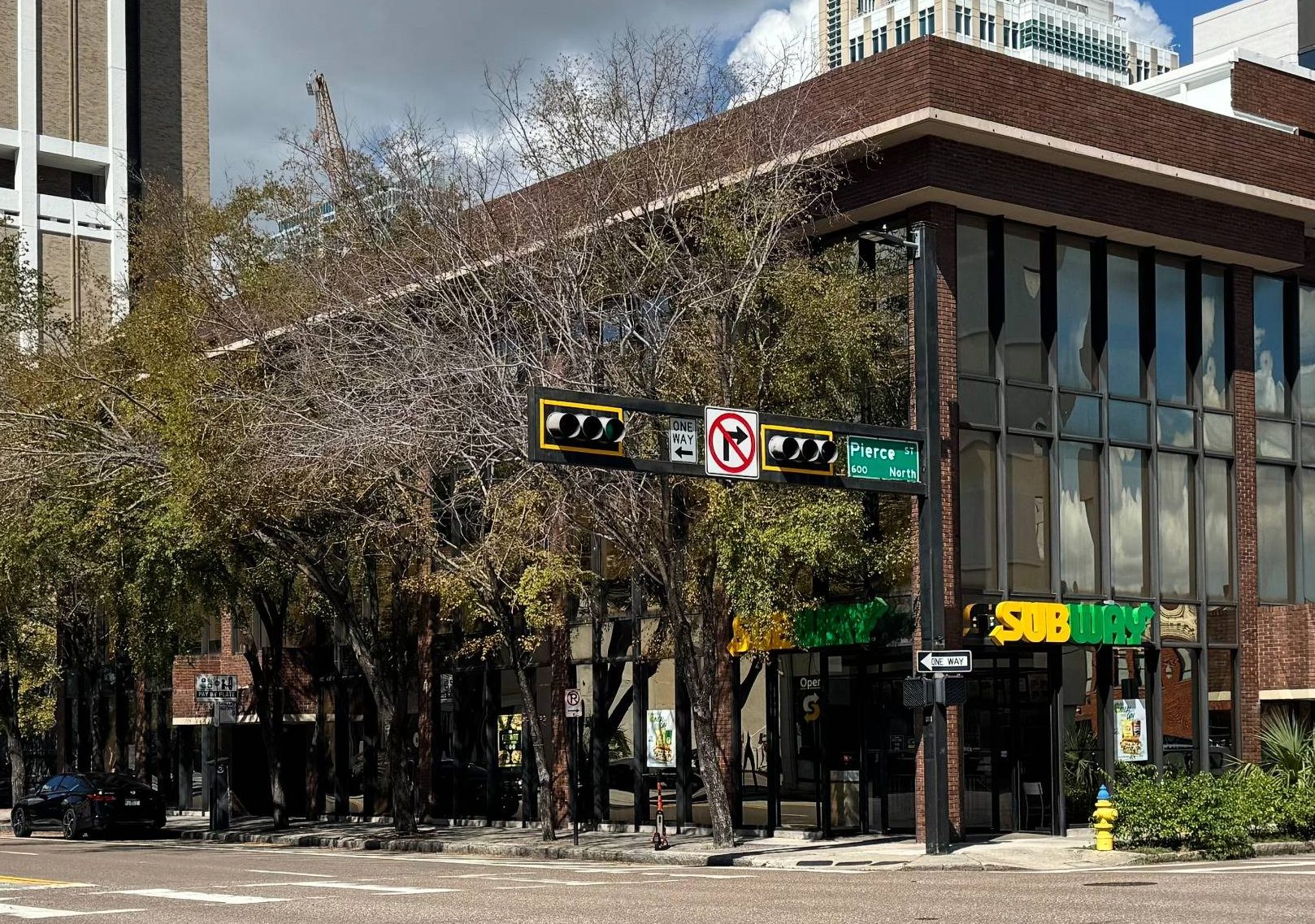
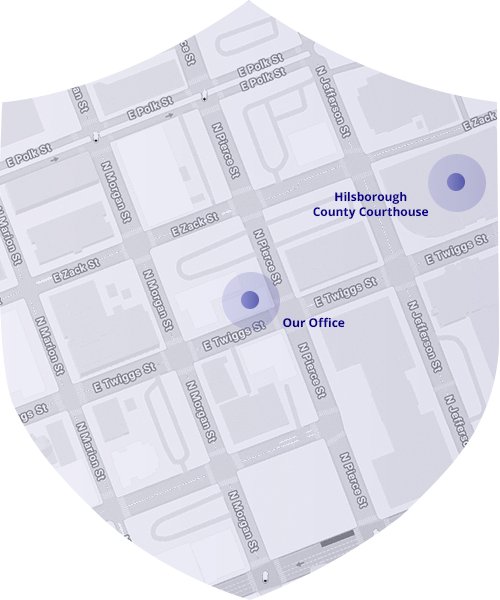
620 E Twiggs Street, Suite 205, Tampa, FL 33602
Serving Hillsborough, Pinellas, and Pasco Counties
Related: Tampa Criminal Defense Attorney | Tampa Criminal Forensic Science Attorney | Cell Phone Location Evidence
Visit Us
Tampa, FL 33602
Contact Us Now
Free Legal Consultation (813) 727-7159