- Free Consultation 24/7: (813) 727-7159 Tap Here To Call Us


From First DUI to Death Penalty



What Charges Did Captain Brock Horner Face for Boarding a Boat in Florida? (2026)


Fully rewritten and updated October 25, 2026.
Charter captain Brock Horner was arrested by the Punta Gorda Police Department in April 2025 and charged with burglary with assault or battery after a viral video showed him climbing onto a young fisherman’s boat in Charlotte County. Under Florida law a boat is a “conveyance,” so entering one to commit an offense can be burglary, and burglary with an assault or battery is a first-degree felony punishable by up to life in prison. The Florida Fish and Wildlife Conservation Commission also referred two misdemeanors and three infractions. Horner pleaded not guilty and is presumed innocent.
A prosecutor who sees a stranger step onto someone else’s boat and start a fight does not think “boating dispute.” The prosecutor thinks burglary, because Florida’s burglary statute treats a vessel the same way it treats a car or a house trailer. I have watched that charging choice drive plea negotiations for more than 25 years in Hillsborough County courtrooms. I’m Rocky Brancato, founder of The Brancato Law Firm, P.A., a Tampa criminal defense firm, and a former Chief Operations Officer of the Hillsborough County Public Defender’s Office, where I oversaw a staff of over 100 attorneys. Our attorneys defend people charged with burglary, battery, and on-the-water offenses across Hillsborough, Pinellas, and Pasco Counties.
The Brancato Law Firm is not involved in Mr. Horner’s case and does not represent anyone in it. This article explains the Florida law the case raised, using public reporting.
What Happened in the Brock Horner Boat Confrontation?
According to news reports, a video recorded on April 1, 2025, showed Horner, a Punta Gorda charter captain, pull alongside a 22-year-old fisherman’s boat, climb aboard, and confront him with threats and profanity while the young man tried to calm the situation. The video spread nationally. Punta Gorda police arrested Horner on a charge of burglary with assault or battery, and he was released from the Charlotte County Jail on a $20,000 bond. A judge later ordered him to have no contact with the fisherman.
On April 11, 2025, the Florida Fish and Wildlife Conservation Commission referred two misdemeanors and three infractions to the State Attorney’s Office for the 20th Judicial Circuit: harassment of hunters or fishers, using a recreationally registered vessel commercially, careless operation of a vessel, no saltwater charter fishing license, and improper display of registration. Horner entered a written plea of not guilty and asked for a jury trial. As of October 2026, we have not found a public report of how the case was resolved. Every person charged with a crime is presumed innocent unless the State proves guilt beyond a reasonable doubt.
Why Is Boarding Someone Else’s Boat Burglary in Florida?
Boarding another person’s boat can be burglary because Florida’s burglary law covers “conveyances,” and a conveyance includes a boat. Section 810.011(3), Florida Statutes, defines a conveyance as “any motor vehicle, ship, vessel, railroad vehicle or car, trailer, aircraft, or sleeping car.” Under section 810.02, Florida Statutes, burglary means entering a dwelling, structure, or conveyance “with the intent to commit an offense therein,” unless the defendant was licensed or invited to enter. The offense intended can be a battery or an assault; it does not have to be a theft.
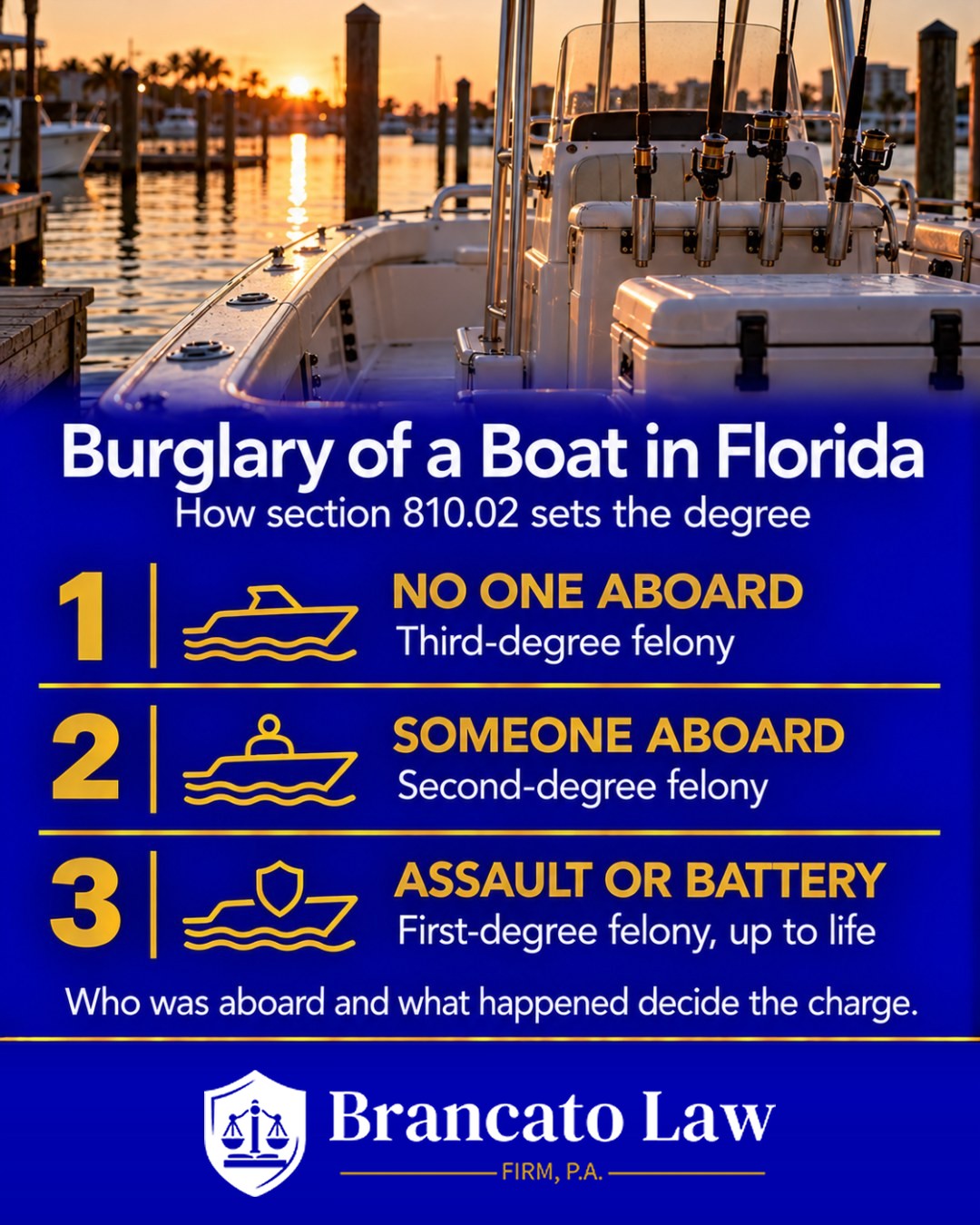
| Burglary of a boat or other conveyance | Subsection | Degree | Maximum penalty |
|---|---|---|---|
| Offender makes an assault or battery on any person | 810.02(2)(a) | First-degree felony | Life in prison |
| Another person is aboard, no assault, battery, or weapon | 810.02(3)(d) | Second-degree felony | 15 years in prison, $10,000 fine |
| No one is aboard, no assault, battery, or weapon | 810.02(4)(b) | Third-degree felony | 5 years in prison, $5,000 fine |
Maximum terms and fines for the second- and third-degree rows come from section 775.082 and section 775.083, Florida Statutes. The jump from a third-degree felony to a life felony turns on two facts: whether someone was on board and whether the State can prove an assault or battery. That is why our attorneys study every second of the video in a case like this. Our Tampa violent crime lawyer page explains how we defend battery and burglary-with-battery charges.
How Often Do Things Go Wrong on Florida Waters?
Florida has more than a million registered boats, and crowded water leads to confrontations as well as crashes. According to the Florida Fish and Wildlife Conservation Commission, Florida had 1,030,053 registered vessels in 2024, and the FWC recorded 685 reportable boating accidents and 81 boating fatalities that year, per its 2024 Boating Accident Statistical Report.
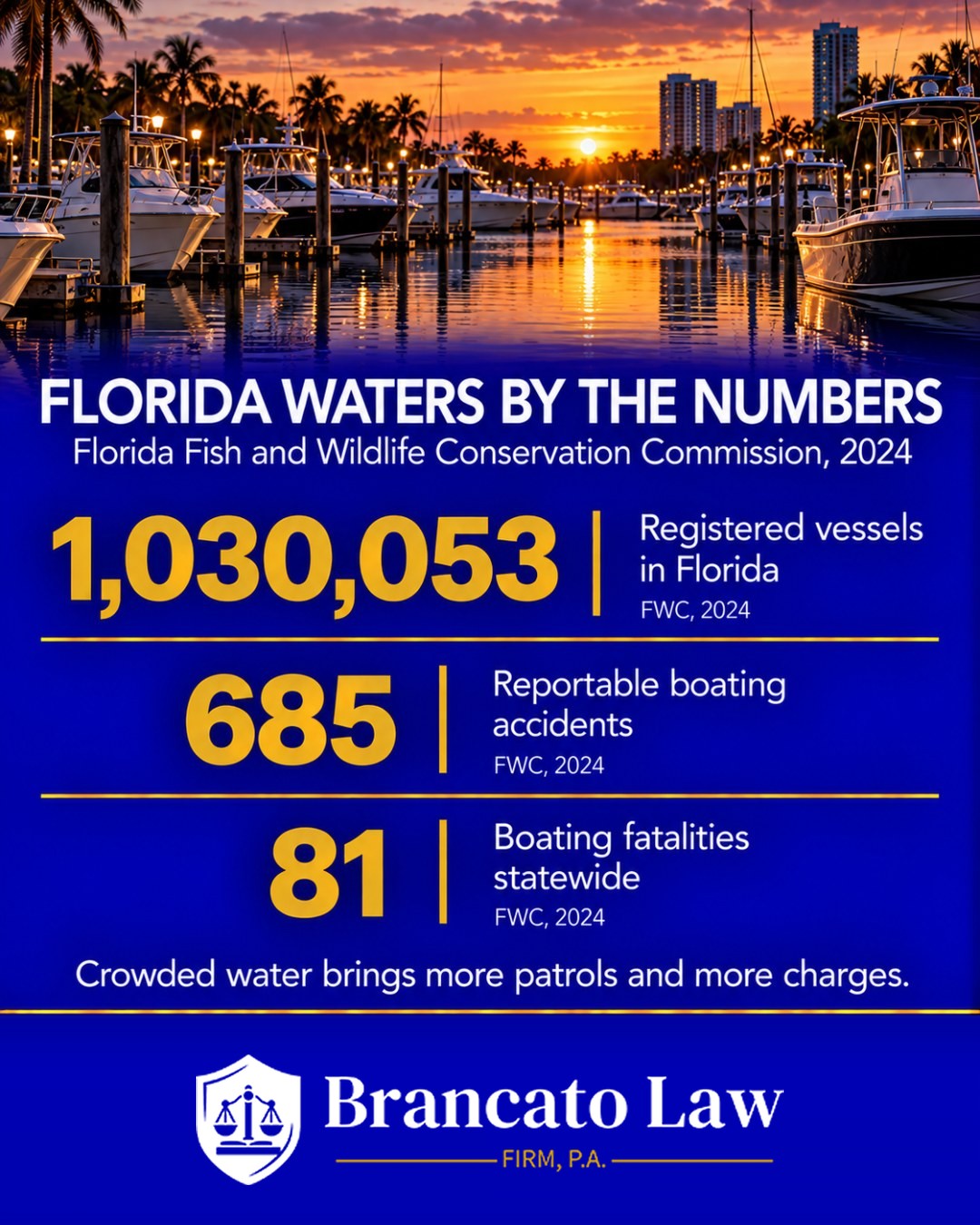
Those numbers count accidents, not fights, but they explain why FWC officers, sheriff’s marine units, and local police patrol the same water and why a dispute at a boat ramp or sandbar can bring more than one agency. In Hillsborough County, a case like this is filed by the State Attorney’s Office for the 13th Judicial Circuit; in Pinellas and Pasco, by the 6th Circuit.
Could the Fisherman Have Used Force to Defend Himself?
Possibly. Florida law allows force in self-defense when a person reasonably believes it is necessary, and the law gives extra protection to people inside an occupied vehicle. Under section 776.012(2), Florida Statutes, a person may use or threaten deadly force if he or she reasonably believes it is necessary to prevent imminent death or great bodily harm or the imminent commission of a forcible felony, and a person who is not engaged in criminal activity and is in a place where he or she has a right to be has no duty to retreat.
Section 776.013(2), Florida Statutes, adds a presumption of reasonable fear when the intruder “was in the process of unlawfully and forcefully entering, or had unlawfully and forcibly entered, a dwelling, residence, or occupied vehicle.” The statute defines “vehicle” as “a conveyance of any kind, whether or not motorized, which is designed to transport people or property,” which by its words can reach a boat. Two limits matter: the presumption requires a forcible entry, and it does not protect someone who is engaged in criminal activity. Whether a given boarding was forcible is a fact question for a judge at a Stand Your Ground hearing or for a jury.
Could the Passengers on Horner’s Boat Be Charged for Not Stopping Him?
Almost certainly not, based on what was public. Florida, like most states, has no general law making it a crime to stand by while someone else commits an assault or battery. A law review note in the Indiana Law Review (Jennifer Bagby, 33 Ind. L. Rev. 571, 2000) summarized the American rule: “American law has not imposed liability, either civil or criminal, for the failure to render assistance or rescue.” Florida’s one notable exception, section 794.027, Florida Statutes, makes it a first-degree misdemeanor to fail to report a sexual battery a person witnesses when he or she could safely do so; it does not apply to a fight.
A passenger could be charged only as a principal. Under section 777.011, Florida Statutes, a person who “aids, abets, counsels, hires, or otherwise procures” a crime is punished as if he or she committed it. In Staten v. State, 519 So. 2d 622 (Fla. 1988), a case about a getaway driver in a planned robbery, the Florida Supreme Court held that a principal “must intend that the crime be committed and do some act to assist the other person in actually committing the crime,” and agreed that mere knowledge of the crime and mere presence at the scene are not enough. Silent passengers who did nothing to help would not meet that test unless new evidence showed encouragement or planning.
Could Veterans Treatment Court Apply in a Case Like This?
Only in limited ways for a burglary-with-battery charge. Military service does not change the elements of the charge, and Florida’s felony pretrial veterans program under section 948.08(7), Florida Statutes, excludes felonies listed in section 948.06(8)(c), and that list includes “any burglary offense” that is a first- or second-degree felony under section 810.02(2) or (3). So a first-degree burglary charge would have to be reduced before a veteran could use pretrial veterans court, where successful completion leads to dismissal.
After a plea, section 948.21, Florida Statutes, lets a judge order a qualifying veteran on probation to complete treatment for a service-related mental illness, traumatic brain injury, substance abuse disorder, or psychological problem. Hillsborough County’s Veterans Treatment Court held its first session in October 2013, added felonies in February 2015, and runs misdemeanor and felony pretrial programs plus a post-adjudication program, according to the 13th Judicial Circuit. Our Tampa criminal mental health lawyer page covers how we document PTSD and other service-related conditions for the court.
How Do Our Attorneys Defend a Burglary or Battery Charge From an Incident on the Water?
We start with the entry, because the burglary charge depends on why and how the person came aboard:
- Was the person licensed or invited to come aboard? An invitation, even an implied one at a raft-up or sandbar, defeats the entry element.
- What was the intent at the moment of entry? The State must prove the person meant to commit an offense when he or she boarded, not only that a dispute happened later.
- Was there an assault or battery? Words alone are not a battery. An assault requires a threat with an apparent ability to carry it out that creates a well-founded fear.
- What does all the video show? Phone clips often start mid-argument. We look for other angles, marina cameras, and the minutes before the recording.
- Are there self-defense or defense-of-others facts? Stand Your Ground can apply to the person charged as well as to the person boarded.
- Can the charge be reduced? Trespass on a vessel, simple battery, or a reduced burglary count can open diversion or veterans court options.
If an investigation is still open, our representation before charges are filed can reach the prosecutor before a charging decision. See our Hillsborough County criminal defense attorney page, or our pages for Pinellas County and Pasco County cases.
Frequently Asked Questions About the Brock Horner Case and Boat Burglary
Is getting on someone’s boat without permission a crime in Florida?
It can be. Entering a boat to commit an offense can be burglary of a conveyance, and boarding without permission can support other charges. The Brancato Law Firm looks first at whether there was an invitation and what the person intended; our violent crime defense page has more.
What is the penalty for burglary with battery in Florida?
It is a first-degree felony punishable by up to life in prison under section 810.02(2)(a). The Brancato Law Firm often works to show that the entry or the battery element is missing, which can reduce the charge to a lower degree or a misdemeanor.
Can you stand your ground on a boat in Florida?
Yes, if you are not engaged in criminal activity, are where you have a right to be, and reasonably believe force is necessary. Our attorneys at The Brancato Law Firm litigate Stand Your Ground motions and examine whether the boarding was forcible enough to trigger the occupied-vehicle presumption; our Tampa violent crime lawyer page explains the process.
Do bystanders have to intervene in a crime in Florida?
No. Florida has no general duty to intervene, and presence at a crime is not enough to make someone a principal. The Brancato Law Firm defends people charged as principals by showing there was no intent and no act of help.
Can a veteran charged with burglary with battery go to veterans court?
Not through the felony pretrial program while the charge is a first-degree burglary, because those charges are excluded. The Brancato Law Firm can seek a reduced charge or a probation sentence with veterans treatment under section 948.21.
What happened to Captain Brock Horner’s case?
He was charged with burglary with assault or battery, and the FWC referred additional misdemeanors and infractions; he pleaded not guilty. The Brancato Law Firm is not involved in the case, and as of October 2026 we had not found a public report of its outcome.
Talk to a Tampa Defense Attorney About a Charge From an Incident on the Water
If a confrontation at a boat ramp, a sandbar, or a marina has led to an arrest or a call from an officer, call The Brancato Law Firm, P.A., founded by Tampa Criminal Defense Attorney Rocky Brancato, at (813) 727-7159. We will get the video, the FWC and police reports, and the witness list, and work to keep a dispute on the water from becoming a life felony. You can call us at any hour; our office is two blocks from the courthouse. Our firm has Spanish-speaking staff, and attorney Jean-Luc Adrien speaks Spanish, Haitian Creole, and French.
For more about our defense strategies, visit our Tampa Violent Crime Lawyer page.
The Brancato Law Firm, P.A.
620 E. Twiggs Street, Suite 205, Tampa, FL 33602
(813) 727-7159
Serving Hillsborough, Pinellas, and Pasco Counties
The Brancato Law Firm, P.A. is a Tampa-based criminal defense practice. We are not affiliated with any other Brancato-named law firms.
Visit Us

Tampa, FL 33602

Contact Us Now
Free Legal Consultation (813) 727-7159
