- Free Consultation 24/7: (813) 727-7159 Tap Here To Call Us


From First DUI to Death Penalty



Is Animal Cruelty Around a Child a Felony in Florida? (2026)


| Yes. Since October 1, 2026, an adult who commits aggravated animal cruelty in the presence of a child under 18, or who causes or entices a child to commit it, commits a separate third-degree felony under section 828.12(4), Florida Statutes. The same rule now applies to animal fighting or baiting and to sexual activity involving animals. The new law, HB 559, also requires juvenile courts to order a psychological evaluation for any minor who commits animal cruelty, and anyone who pleads to or is convicted of animal cruelty, even with adjudication withheld, will appear on a public FDLE website starting January 1, 2027. |
A prosecutor deciding how to charge an animal cruelty case in Florida now has to ask a new question: was a child there? As founder of The Brancato Law Firm, P.A., a Tampa criminal defense firm, and a former Chief Operations Officer of the Hillsborough County Public Defender’s Office, where I oversaw a staff of over 100 attorneys, I have seen animal cruelty charges arise from family fights, neighbor disputes, and hoarding situations where children live in the home. Under the new law, a child’s presence can turn one felony into two, and our attorneys now investigate who was in the room as carefully as what happened to the animal.
This guide covers what HB 559 (chapter 2026-78, Laws of Florida) changed, why the Legislature passed it without a single “no” vote, what the new public database means for plea decisions, and how these charges are defended. For the basics of Florida animal cruelty law, see our guide to whether animal cruelty is a felony in Florida.
What Did HB 559 Make a Crime?
HB 559 created three new third-degree felonies, each punishable by up to five years in prison and a $5,000 fine. Each applies to a person 18 or older who “causes or entices a minor to commit, or in the presence of a minor commits,” one of these offenses:
| Underlying offense | New statute | Offense severity level |
|---|---|---|
| Aggravated animal cruelty | Section 828.12(4) | Level 6 |
| Animal fighting or baiting | Section 828.122(4) | Level 6 |
| Sexual activity involving animals | Section 828.126(7) | Level 7 |
The levels come from the House Judiciary Committee’s analysis of HB 559. They matter because most third-degree felonies that are not specifically ranked score at Level 1. A Level 6 or Level 7 primary offense adds far more points to a scoresheet and makes a prison sentence much more likely. The bill also moved animal fighting or baiting itself from Level 1 to Level 5.
Only aggravated cruelty under section 828.12(2) triggers the new animal cruelty felony. Simple cruelty under section 828.12(1), a first-degree misdemeanor, does not, even if a child is present. Aggravated cruelty generally involves intentionally committing an act that results in the cruel death or excessive or repeated infliction of unnecessary pain or suffering, or knowingly and intentionally torturing or tormenting an animal.
Why Did Florida Pass HB 559?
Lawmakers framed the bill around the connection between animal abuse and violence against people, especially children. Research on that connection goes back decades. In a frequently cited 1998 study in the Journal of Emotional Abuse, psychologist Frank Ascione surveyed women at a shelter for battered partners and found that 71% of those who had pets reported that their partner had threatened, hurt, or killed a pet. Among the women with children, 32% reported that a child had hurt or killed a pet.
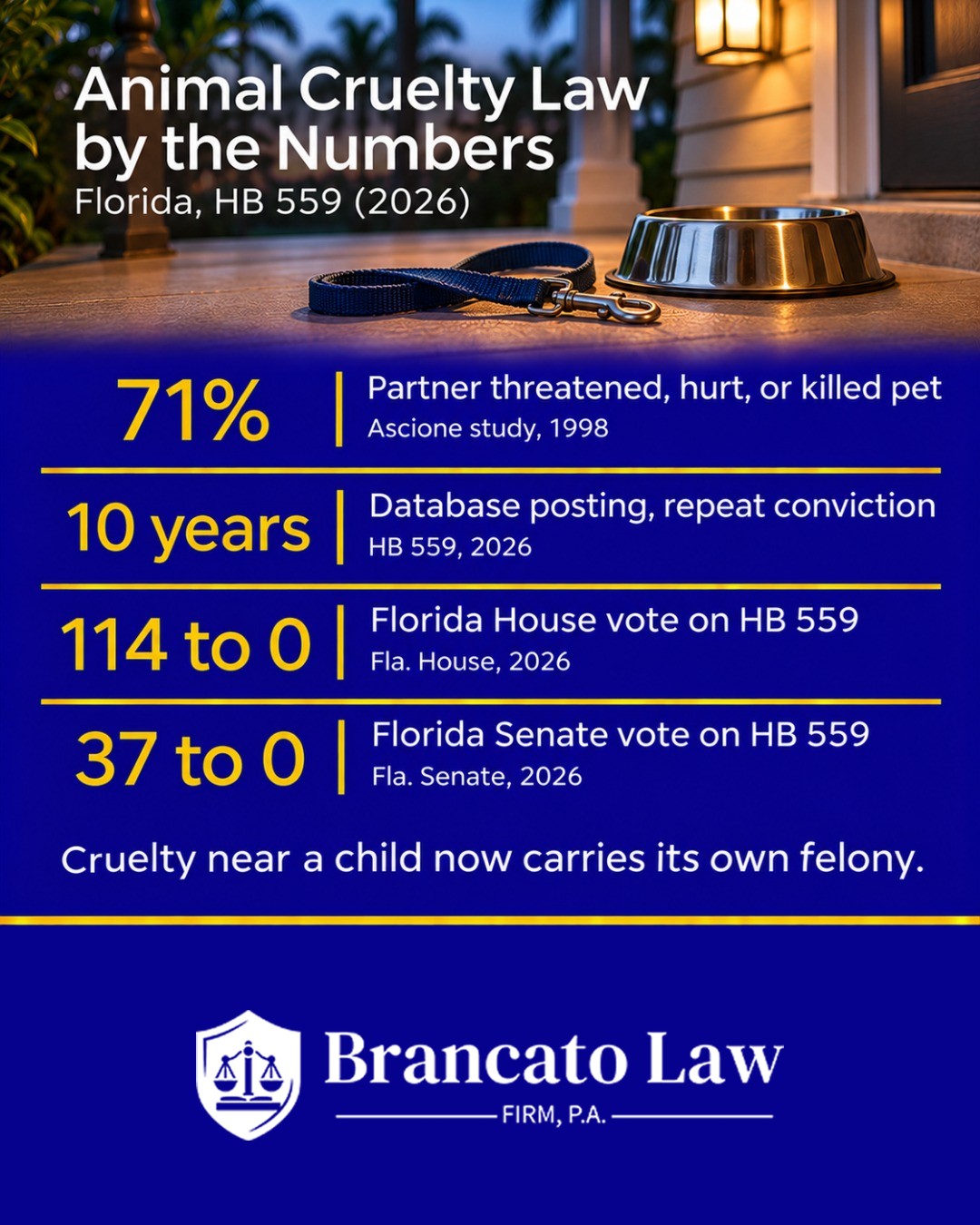
The House sponsors were Representative Linda Chaney of St. Pete Beach, in Pinellas County, and Representative Johanna López of Orlando. Senator Kristen Arrington of Kissimmee sponsored the identical Senate bill, SB 676. The bill was bipartisan from start to finish:
| Date (2026) | Committee or chamber | Vote |
|---|---|---|
| February 5 | House Criminal Justice Subcommittee | 15 to 0 |
| February 17 | House Judiciary Committee | 19 to 0 |
| February 25 | Full House | 114 to 0 |
| March 4 | Full Senate | 37 to 0 |
Governor DeSantis signed the bill on May 12, 2026, at Big Dog Ranch Rescue in Loxahatchee, saying, according to the Floridian Press, that “Florida has become a leader in protecting animals and holding accountable those who harm them.” Vote tallies come from the official bill history and the House staff analysis.
What Is Florida’s Animal Abuser Database?
Florida’s animal abuser database is a public, searchable FDLE website that must be live by January 1, 2027. It began with Dexter’s Law in 2025, explained in our post on Florida’s Dexter’s Law, and HB 559 expanded it. Under section 828.12(9), the site will show each person’s name, aliases, date of birth, race, county of conviction, charges, case numbers, dispositions, identifying marks and tattoos, and booking photograph.
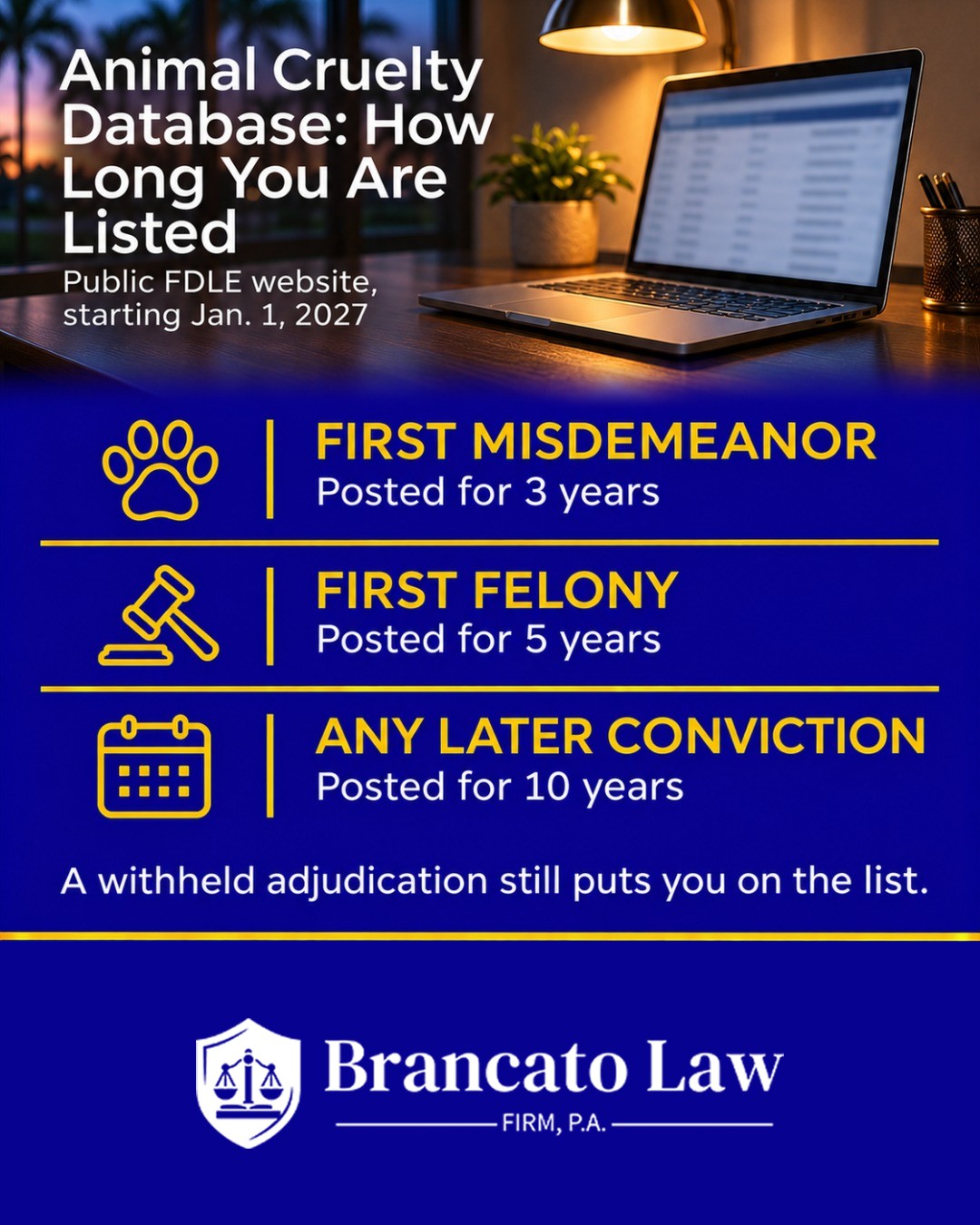
The database covers anyone “convicted of, or who has entered a plea of guilty or nolo contendere to, regardless of adjudication,” a violation of section 828.12. That last phrase is the most important part for anyone negotiating a plea. A withhold of adjudication, which normally lets a person truthfully say they were not convicted, will not keep a name off this list.
| Record | How long it is posted |
|---|---|
| First misdemeanor conviction | 3 years from the conviction date |
| First felony conviction | 5 years from the conviction date |
| Any later misdemeanor or felony conviction | 10 years from the conviction date |
HB 559 also requires clerks of court and county jails to send this information to FDLE, and it requires FDLE to remove a listing within 30 days after receiving a petition with documentation that the conviction was overturned or the record was sealed.
What Happens When a Minor Commits Animal Cruelty?
The juvenile court must order a psychological evaluation. Under section 828.12(5), if a minor commits animal cruelty under section 828.12(1) or (2), the court “must order the minor to undergo a psychological evaluation and, if recommended, receive counseling or treatment” for as long as the court prescribes. Parents or guardians pay for it, with waivers for families who cannot afford it, and a parent who willfully refuses to cooperate can be held in contempt.
For families, the evaluation is not only a requirement but also an opportunity. A thoughtful evaluation can show a judge that a child’s conduct came from trauma, a disability, or an abusive household rather than a fixed pattern. Our attorneys work with families to make sure the evaluator has the full picture.
How Do You Fight an Animal Cruelty Charge Involving a Child?
The State must prove the underlying aggravated offense and the child-related element, and both can be challenged. Our Hillsborough County criminal defense attorney team focuses on these points:
- Was it aggravated cruelty at all? The new felony requires a violation of section 828.12(2). If the conduct was simple cruelty or neglect, the child-presence felony does not apply. Veterinary records and expert testimony often decide this line.
- What does “in the presence of” mean? The statute does not define it. In other Florida statutes, the Florida Supreme Court has read “presence” to require that the child see or sense the act, as in State v. Werner, 609 So. 2d 585 (Fla. 1992), which interpreted the lewd conduct statute. Whether courts apply that reading to animal cruelty is an open question, and our attorneys will argue that it should.
- Was the person 18 or older, and was the child under 18? Both ages are elements the State must prove.
- Did the defendant cause or entice the child? For the “causes or entices” version, the State must prove the adult’s conduct led the child to act, not just that both were present.
- Who is the witness? Many of these cases depend on a child’s statement, sometimes made during a custody dispute or family conflict. Forensic interviews and motives to fabricate are fair subjects for investigation.
What Should You Consider Before Pleading to Animal Cruelty?
Consider the database before anything else. Because any plea to a section 828.12 offense puts a person on a public FDLE website, even with adjudication withheld, the charge you plead to may matter more than the sentence. Our attorneys look for resolutions that avoid a section 828.12 plea where the facts allow, such as a diversion program, a plea to a different offense, or a dismissal after restitution and an evaluation. Each case is different, and prosecutors are not required to agree.
This post is part of our guide to the new Florida criminal laws that took effect October 1, 2026, which summarizes all eight laws in one place.
Frequently Asked Questions
Is it a felony to hurt a pet in front of a child in Florida?
It is a third-degree felony if the conduct is aggravated animal cruelty and the person is 18 or older, under section 828.12(4) as of October 1, 2026. The Brancato Law Firm examines whether the conduct actually meets the aggravated standard, because simple cruelty in front of a child does not trigger the new felony.
Will a withhold of adjudication keep me off the animal abuser list?
No. The database includes anyone who pleads guilty or no contest to a section 828.12 violation “regardless of adjudication.” Our attorneys at The Brancato Law Firm review alternatives to a section 828.12 plea before any client decides how to resolve the case.
When will Florida’s animal abuser database go online?
FDLE must post the searchable database by January 1, 2027. The Brancato Law Firm advises clients with pending cases now, because a plea entered today can lead to a public listing as soon as the site launches.
Can a juvenile be put on the animal abuser database?
The database covers people convicted of or pleading to section 828.12 violations, and the statute does not separately address juvenile adjudications, so families should get advice before any juvenile plea. Our attorneys at The Brancato Law Firm defend juveniles in Hillsborough County and explain how the mandatory evaluation affects the case.
How can I get removed from the animal abuser database?
Listings come off automatically after 3, 5, or 10 years depending on the record, and FDLE must remove a listing within 30 days of a petition showing the conviction was overturned or the record was sealed. The Brancato Law Firm helps eligible clients pursue the postconviction relief or sealing that supports removal.
What are the local fines for animal control violations now?
HB 559 raised the maximum civil fines counties and cities may impose for animal control violations from $500 to $2,500 for a first violation, $5,000 for a second, and $7,500 for a third or later violation. Our attorneys at The Brancato Law Firm handle the criminal side of animal cases, and a large civil fine can be a sign that a criminal charge may follow.
Talk to a Tampa Criminal Defense Lawyer Today
For more about our defense strategies, visit our Hillsborough County criminal defense page.
The plea you choose in an animal cruelty case can put your name and photograph on a public website for years. Before you accept any offer, our attorneys will review the veterinary evidence, the witnesses, and every alternative to a section 828.12 plea. Call The Brancato Law Firm, P.A., founded by Tampa Criminal Defense Attorney Rocky Brancato, at (813) 727-7159. Call us at any hour; our office is two blocks from the courthouse. Our firm has Spanish-speaking staff, and attorney Jean-Luc Adrien speaks Spanish, Haitian Creole, and French.
The Brancato Law Firm, P.A.
620 E. Twiggs Street, Suite 205, Tampa, FL 33602
(813) 727-7159
Serving Hillsborough, Pinellas, and Pasco Counties
The Brancato Law Firm, P.A. is a Tampa-based criminal defense practice. We are not affiliated with any other Brancato-named law firms.
Visit Us

Tampa, FL 33602

Contact Us Now
Free Legal Consultation (813) 727-7159
