Strategic Defense,
From First DUI to Death Penalty
From First DUI to Death Penalty






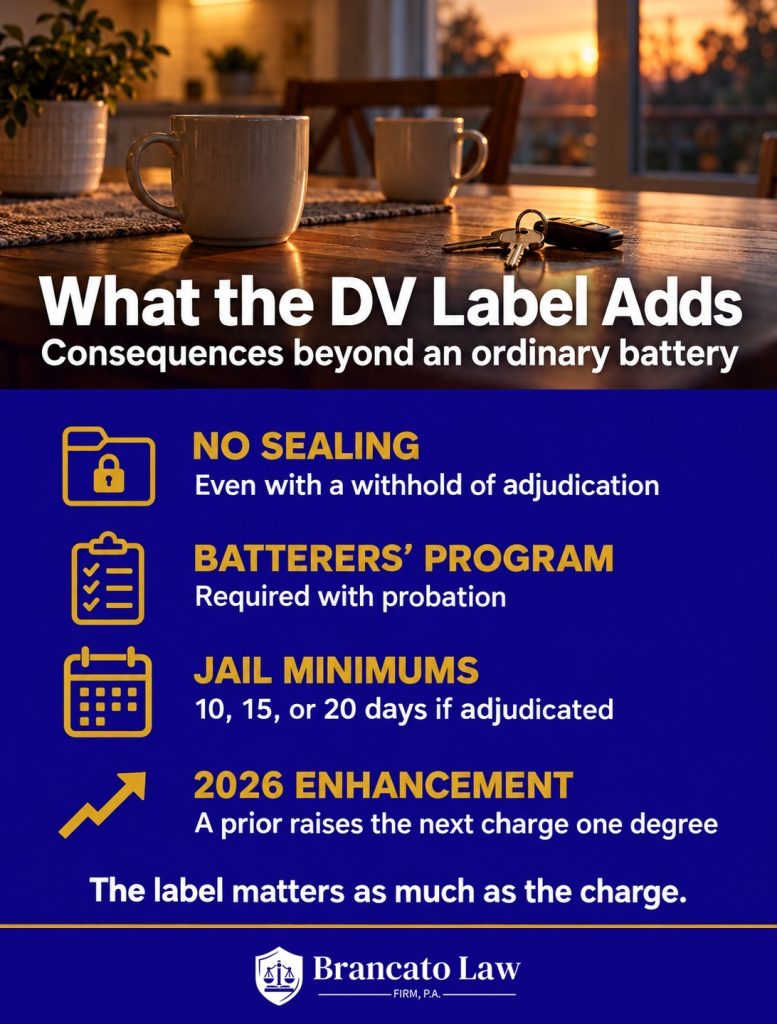
| Short answer: A Tampa domestic violence attorney defends battery, assault, strangulation, stalking, and injunction violation charges involving a spouse, former spouse, relative, co-parent, or someone the accused lives or lived with. In Florida, “domestic violence battery” is ordinary battery with a domestic violence designation, but that label brings consequences ordinary battery does not: a mandatory batterers’ intervention program, a ban on sealing the record even with a withhold of adjudication, jail minimums if adjudicated, and, since July 1, 2026, a one-degree enhancement for any later domestic violence charge. The Brancato Law Firm, P.A. moves early, often before charges are filed, to show prosecutors the evidence they did not get from the arrest report. |
Many domestic violence arrests follow one 911 call during an argument, and the person who called often does not want a prosecution. Rocky Brancato, founder of The Brancato Law Firm, P.A., has tried more than 150 jury trials to verdict and previously served as Chief Operations Officer of the Hillsborough County Public Defender’s Office, overseeing a staff of over 100 attorneys. Our attorneys at this Tampa criminal defense firm have ended many domestic violence cases within days of the arrest by getting the right evidence and the alleged victim’s sworn statement to the prosecutor before the filing decision.
Under § 741.28, domestic violence is any assault, aggravated assault, battery, aggravated battery, sexual assault, sexual battery, stalking, aggravated stalking, kidnapping, false imprisonment, or other crime causing injury or death, committed by one family or household member against another. A “family or household member” is a spouse, former spouse, relative by blood or marriage, a person who lives or has lived with the accused as a family, or a person who has a child in common with the accused. Dating partners who never lived together and have no child together are not family or household members under this definition, so a battery between them does not carry the domestic violence designation. Strangulation is the exception: § 784.041(2) expressly covers dating relationships.
| Charge | Florida law | Level |
|---|---|---|
| Battery (domestic violence designation) | § 784.03(1) | First-degree misdemeanor |
| Battery with one prior battery-type conviction | § 784.03(2) | Third-degree felony |
| Domestic battery by strangulation | § 784.041(2) | Third-degree felony |
| Aggravated assault | § 784.021 | Third-degree felony |
| Aggravated battery (great bodily harm, deadly weapon, or known pregnancy) | § 784.045 | Second-degree felony |
| Stalking / aggravated stalking | § 784.048 | First-degree misdemeanor / third-degree felony |
| Violation of a domestic violence injunction | § 741.31(4)(a) | First-degree misdemeanor; third-degree felony with one prior conviction against the same victim |
| Possessing a firearm under a final injunction | § 790.233 | First-degree misdemeanor |
The domestic violence label adds penalties that do not appear in the table:
A person arrested for domestic violence in Florida stays in custody until first appearance. Under § 741.2901(3), the judge must consider the safety of the alleged victim before setting release conditions, and under § 903.047, release usually comes with a no-contact order that bars any contact with the alleged victim and coming within 500 feet of the person’s home, car, or workplace. Officers must also complete a lethality assessment in intimate partner cases under § 741.29, and the State Attorney can see it.
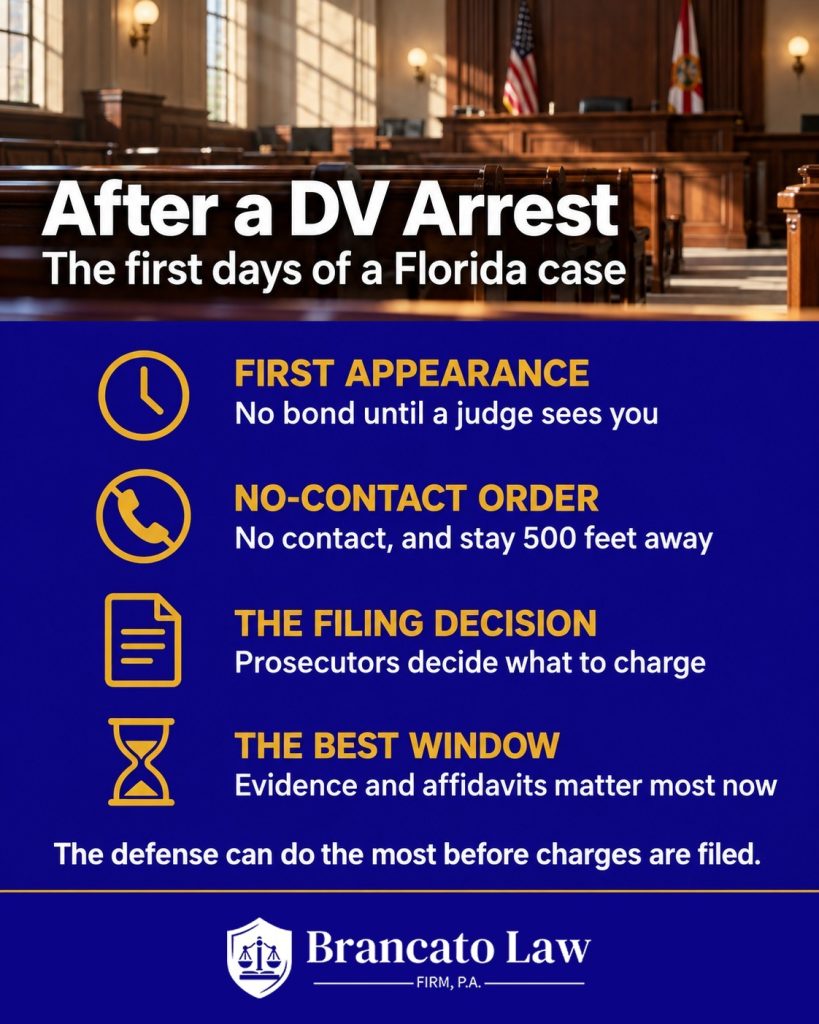
In our experience, the filing decision is where most domestic violence cases are won. Hillsborough County’s State Attorney offers a Domestic Violence Intervention Program for some cases, and eastern Hillsborough misdemeanor cases are heard at the Plant City Courthouse. Our guides to bond in Hillsborough County and the Florida lethality assessment explain these steps in more detail.
No. In Florida, the State decides whether to prosecute. Under § 741.2901(2), prosecutors are directed to proceed over the alleged victim’s objection when necessary. The alleged victim’s wishes still matter a great deal, and a properly prepared sworn affidavit often leads the State to decline charges. Many of the results below came from exactly that. An alleged victim should never be asked to lie, and the accused must not contact the alleged victim while a no-contact order is in place, because jail calls are recorded and contact is a new violation. Read our guide for alleged victims who want charges dropped.
Our attorneys build the defense around the evidence police did not collect. The most common defenses are:
Mandatory arrest policies also lead to arrests of the wrong person. A National Institute of Justice study found that laws pushing officers to arrest raised the odds of dual arrests, where both partners are arrested, and that those cases were more likely to end without a conviction (Hirschel, Buzawa, and colleagues, 2007). Our article on how to fight a domestic violence battery charge in Florida goes deeper.
Domestic violence is one of the most common arrests in our area. In 2020, the Florida Department of Law Enforcement recorded 4,952 domestic violence arrests in Hillsborough County, 3,776 in Pinellas County, and 2,597 in Pasco County (FDLE domestic violence arrests by jurisdiction), and 7,083 domestic violence offenses reported in Hillsborough County (FDLE domestic violence offenses).
These are results our firm has obtained. Every case is different, and past results do not guarantee future outcomes.
See more on our case results page.
Yes. The alleged victim cannot drop the charges alone, but prosecutors often decline or dismiss domestic violence cases when the alleged victim does not want to proceed, the evidence shows self-defense, or the relationship does not qualify. The Brancato Law Firm has ended many domestic violence cases before filing; see our case results.
Only if the person is adjudicated guilty and intentionally caused bodily harm. In that case Florida law requires at least 10 days for a first offense, 15 for a second, and 20 for a third, and our attorneys at The Brancato Law Firm work to avoid adjudication and the bodily harm finding.
No. A domestic violence battery or assault cannot be sealed or expunged in Florida, even with a withhold of adjudication, which is why The Brancato Law Firm focuses on getting cases declined, dismissed, or resolved as a non-domestic offense.
Only if the two people lived together or have a child in common. Battery between dating partners who never lived together is not domestic violence under § 741.28, except for strangulation, and The Brancato Law Firm checks this relationship element in every case.
Contact with the alleged victim while a no-contact order is in place can lead to bond revocation and a new criminal charge, even if the alleged victim started the contact. The Brancato Law Firm can ask the judge to modify the order when both people want contact.
Effective July 1, 2026, a prior domestic violence conviction, including a withhold, raises any new domestic violence offense one degree, and violating an injunction becomes a felony after just one prior conviction against the same person. The Brancato Law Firm advises clients on how a plea today could affect any future case.
The days between a domestic violence arrest and the State’s filing decision are when the defense can do the most. Our attorneys at The Brancato Law Firm, P.A., founded by Tampa Criminal Defense Attorney Rocky Brancato, can appear at first appearance and begin working with the State Attorney right away. Call (813) 727-7159 for a confidential consultation. We also defend violent crimes and child abuse allegations across Hillsborough, Pinellas, and Pasco Counties.
The Brancato Law Firm, P.A.
620 E. Twiggs Street, Suite 205, Tampa, FL 33602
(813) 727-7159
Serving Hillsborough, Pinellas, and Pasco Counties

The Brancato Law Firm, P.A. is a Tampa-based criminal defense practice. We are not affiliated with any other Brancato-named law firms.
This page is for informational purposes only and does not constitute legal advice. Each case is unique, and outcomes depend on the individual facts and circumstances involved. Past results do not guarantee future outcomes.

Tampa, FL 33602

Free Legal Consultation (813) 727-7159
