Strategic Defense,
From First DUI to Death Penalty
From First DUI to Death Penalty





| Short answer: A Tampa criminal mental health lawyer defends people whose mental illness, intellectual disability, autism, brain injury, or PTSD affects their criminal case. Florida law offers several paths: a competency proceeding when a person cannot understand the case or help the lawyer, an insanity defense, mental health court and mental health pretrial intervention that can end in dismissal, and a downward departure at sentencing for a treatable mental disorder. The Brancato Law Firm, P.A. works with families and mental health professionals to move the case toward treatment and the best legal result. |
Families usually call us after a loved one stopped taking medication, ended up in a crisis, and was arrested instead of treated. Rocky Brancato, founder of The Brancato Law Firm, P.A., previously served as Chief Operations Officer of the Hillsborough County Public Defender’s Office, overseeing a staff of over 100 attorneys who handled cases involving mental illness every day. Our attorneys at this Tampa criminal defense firm know the local mental health court, the evaluators, and the treatment providers, and we build the defense around both the law and the person.
A person is incompetent to proceed if he or she lacks a sufficient present ability to consult with a lawyer with a reasonable degree of rational understanding, or lacks a rational and factual understanding of the proceedings. That is the test from Dusky v. United States, 362 U.S. 402 (1960), and Florida writes it into § 916.12. A case cannot go forward while the person is incompetent.
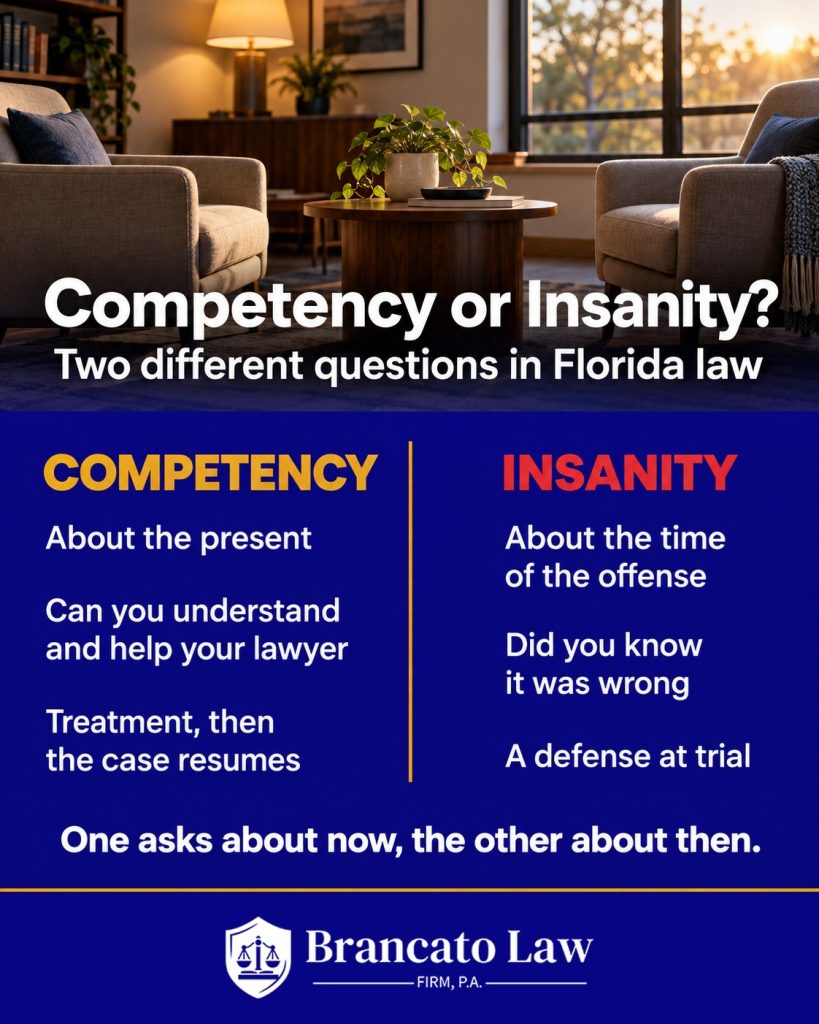
Florida’s insanity defense in § 775.027 asks whether, at the time of the offense, a mental infirmity, disease, or defect kept the person from knowing what he or she was doing or its consequences, or from knowing it was wrong. The defense must prove insanity by clear and convincing evidence, and written notice must be given within 15 days after arraignment under Rule 3.216. A person found not guilty by reason of insanity may be committed for treatment under § 916.15 if found to be dangerous because of mental illness. Insanity is rarely the best path; diversion and mitigation resolve far more cases.
People with intellectual disability or autism are evaluated for competency by specialists under § 916.3012, and restoration takes the form of training rather than treatment. Charges must be dismissed within a reasonable time, no more than 2 years, if the person is not restored. In death penalty cases, intellectual disability bars execution under § 921.137. The U.S. Supreme Court held in Hall v. Florida, 572 U.S. 701 (2014) that Florida could not use a rigid IQ score of 70 as a cutoff, though the Florida Supreme Court held in Phillips v. State, 299 So. 3d 1013 (Fla. 2020) that Hall does not apply retroactively. Read our articles on autism and downward departure and intellectual disability in death penalty cases.
Diversion programs offer treatment instead of a conventional prosecution, and many end in dismissal. Admission is voluntary and depends on the charge, the person’s history, and the prosecutor’s approval.
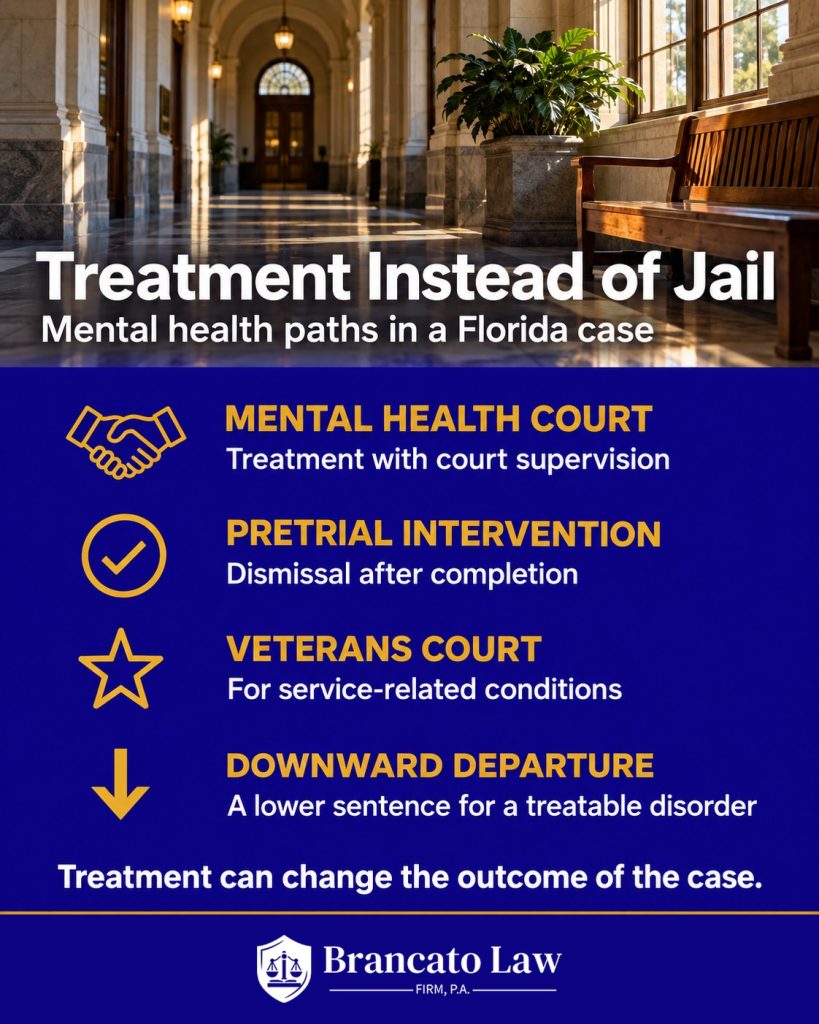
See all of the Thirteenth Circuit problem-solving courts and our article on veterans treatment court.
Mental illness can support a sentence below the guidelines. Under § 921.0026(2)(d), a judge may depart downward when the person needs specialized treatment for a mental disorder unrelated to substance abuse and is amenable to treatment, and § 921.0026(2)(c) allows a departure when the person’s capacity to appreciate the conduct or conform to the law was substantially impaired. In State v. Chubbuck, 141 So. 3d 1163 (Fla. 2014), the Florida Supreme Court held that the defense does not have to prove the Department of Corrections cannot provide the treatment. Our attorneys support these motions with expert evaluations and a comprehensive mitigation report. See our article on downward departures in Florida.
Yes, but only for a limited purpose. In Oquendo v. State, 420 So. 3d 466 (Fla. 2025), the Florida Supreme Court held that PTSD evidence may be relevant to whether the defendant actually believed force was necessary, but it cannot be used to show that a reasonable person would have believed so, and it cannot be used as a diminished capacity defense. Veterans and trauma survivors need a defense built around that distinction. Read about PTSD and self-defense.
A Baker Act is an involuntary examination of up to 72 hours under § 394.463 for a person who appears to have a mental illness and poses a danger or cannot care for himself or herself. A person charged with a crime goes back to police custody after the examination. A Baker Act examination by itself does not take away firearm rights. Under § 790.065(2)(a), the firearm disability applies after a court-ordered involuntary placement, or after a voluntary admission that follows specific findings and a judge’s review, and a person can petition the court for relief. See our article on competency to proceed.
These are results our firm has obtained. Every case is different, and past results do not guarantee future outcomes.
See more on our case results page.
Sometimes. Charges can be dismissed after successful completion of mental health court or mental health pretrial intervention, and after long periods of incompetence under § 916.145. The Brancato Law Firm evaluates every diversion path and presents the person’s treatment history to the prosecutor; see our case results.
Competency is about the present: whether the person can understand the case and help the lawyer now. Insanity is about the time of the offense: whether the person knew what he or she was doing or that it was wrong. The Brancato Law Firm works with forensic evaluators on both questions.
Yes. The Thirteenth Judicial Circuit runs an Adult Mental Health Court for felony cases that requires State Attorney approval and a clinical screening, and pretrial cases can be dismissed on completion. The Brancato Law Firm helps clients apply and advocates for admission.
Not by itself. Firearm rights are affected after a court-ordered involuntary placement or a voluntary admission that follows specific findings and a judge’s order, and relief can be sought by petition. The Brancato Law Firm can review the records and advise on restoration.
Often yes. Hillsborough County’s Veterans Treatment Court has misdemeanor, felony pretrial, and post-adjudication tracks for veterans and service members with service-related conditions, though participation is not a right. The Brancato Law Firm helps veterans gather the records needed for admission.
Gather medication lists, treatment records, and the names of providers, and call a lawyer before first appearance so the judge hears about treatment options. The Brancato Law Firm works directly with families from the first day.
When mental illness and a criminal charge collide, the right plan can mean treatment instead of jail. Our attorneys at The Brancato Law Firm, P.A., founded by Tampa Criminal Defense Attorney Rocky Brancato, can talk with your family today about competency, diversion, and treatment. Call (813) 727-7159 for a confidential consultation. We serve families across Hillsborough, Pinellas, and Pasco Counties.
The Brancato Law Firm, P.A.
620 E. Twiggs Street, Suite 205, Tampa, FL 33602
(813) 727-7159
Serving Hillsborough, Pinellas, and Pasco Counties
The Brancato Law Firm, P.A. is a Tampa-based criminal defense practice. We are not affiliated with any other Brancato-named law firms.
This page is for informational purposes only and does not constitute legal advice. Each case is unique, and outcomes depend on the individual facts and circumstances involved. Past results do not guarantee future outcomes.

Tampa, FL 33602

Free Legal Consultation (813) 727-7159
