Strategic Defense,
From First DUI to Death Penalty
From First DUI to Death Penalty





| Short answer: A Tampa child abuse attorney defends parents and caregivers charged under Florida Statute § 827.03, where aggravated child abuse is a first-degree felony punishable by up to 30 years in prison and child abuse or child neglect without great bodily harm is a third-degree felony punishable by up to 5 years. Most of these cases turn on two kinds of evidence: medical opinions and what the child said. The Brancato Law Firm, P.A. retains independent medical experts, challenges child hearsay before trial, and keeps the parallel DCF case from damaging the criminal defense. |
Most child abuse cases start in an emergency room, not a police station. A child is hurt, a doctor writes “suspected abuse” in the chart, and within days a parent is answering questions from a detective and a DCF investigator at the same time. Rocky Brancato, founder of The Brancato Law Firm, P.A., handled child abuse, sex crime, and homicide cases in the Major Crimes Unit of the Hillsborough County Public Defender’s Office and later served as its Chief Operations Officer, overseeing a staff of over 100 attorneys. Our attorneys bring that experience to every case at our Tampa criminal defense firm: we test the medical opinion, the child’s statements, and the investigation that produced them.
Florida charges physical child abuse under § 827.03, and the level of the charge depends mostly on whether the State claims great bodily harm. A “child” is anyone under 18, and a “caregiver” includes a parent, an adult household member, or anyone responsible for the child’s welfare under § 827.01. The table shows each charge and its maximum penalty under § 775.082 and § 775.083.
| Charge | Florida law | Level | Maximum penalty |
|---|---|---|---|
| Aggravated child abuse | § 827.03(2)(a) | First-degree felony | 30 years in prison and a $10,000 fine |
| Child neglect causing great bodily harm, permanent disability, or permanent disfigurement | § 827.03(2)(b) | Second-degree felony | 15 years in prison and a $10,000 fine |
| Child abuse without great bodily harm | § 827.03(2)(c) | Third-degree felony | 5 years in prison and a $5,000 fine |
| Child neglect without great bodily harm | § 827.03(2)(d) | Third-degree felony | 5 years in prison and a $5,000 fine |
| Contributing to the delinquency or dependency of a child | § 827.04(1) | First-degree misdemeanor | 1 year in jail and a $1,000 fine |
Aggravated child abuse covers three situations: an aggravated battery on a child; willful torture, malicious punishment, or unlawful caging of a child; or knowingly abusing a child in a way that causes great bodily harm, permanent disability, or permanent disfigurement. Child abuse is the intentional infliction of physical or mental injury, or an intentional act that could reasonably be expected to cause it. Neglect is a caregiver’s failure to provide the care, supervision, food, shelter, or medical treatment that a prudent person would consider essential.
Section 827.03 contains no mandatory minimum sentence. Aggravated child abuse is a Level 9 offense under Florida’s Criminal Punishment Code, so even with no prior record the scoresheet usually calls for a prison sentence of about four years or more unless the judge grants a downward departure. Separate enhancements can add mandatory prison: a prison releasee reoffender designation under § 775.082(9), or actual possession of a firearm under Florida’s 10-20-Life law.
The State has to prove both the act and the mental state the statute requires, and the mental state is where many cases are won. Child abuse requires an intentional act. Neglect requires a willful failure or culpable negligence. Aggravated child abuse based on “malicious punishment” requires proof that the caregiver acted wrongfully and without legal justification, with the primary purpose of causing unjustifiable pain or injury.
Florida appellate courts hold the State to those words. In Cox v. State, 1 So. 3d 1220 (Fla. 2d DCA 2009), a father rubbed the blunt edge of a pocketknife on his son’s leg during an argument with his ex-wife, and the child was not physically hurt. The Second District Court of Appeal, which covers Hillsborough, Pinellas, and Pasco Counties, reversed the aggravated child abuse conviction and said the charge is reserved for truly aggravated circumstances. In Wheeler v. State, 203 So. 3d 1007 (Fla. 4th DCA 2016), the court held that “great bodily harm” means harm that is great, not slight, minor, or moderate, and that testimony that the child was moaning and crying, with no medical evidence, did not prove it.
Spanking is not child abuse in Florida by itself, but discipline that causes real injury can be charged. Florida’s child welfare law, § 39.01, says corporal discipline by a parent for disciplinary purposes “does not in itself constitute abuse when it does not result in harm to the child,” and it lists injuries such as fractures, burns, cuts, and significant bruises or welts as signs that discipline was excessive.
In Raford v. State, 828 So. 2d 1012 (Fla. 2002), a man struck his girlfriend’s 8-year-old child repeatedly with a belt. The Florida Supreme Court held that parents have no privilege that bars prosecution for felony child abuse, but that reasonable, nonexcessive corporal punishment, such as a typical spanking, remains an affirmative defense to a simple child abuse charge. Our attorneys build that defense with the facts that matter to a jury: the child’s age, the reason for the discipline, the type of injury, and whether a doctor ever treated it. Our article on parental discipline and the limits of spanking in Florida explains the line in more detail.
Medical opinions decide many child abuse cases because the State often has no witness to the injury and relies on a doctor to say the injury could only have come from abuse. In Hillsborough County, that opinion usually comes from a Child Protection Team physician who examines the child at the request of DCF or law enforcement. Our article on Child Protection Team medical opinions in Tampa child abuse cases explains how that examination is done and where it can go wrong.
Florida limits who can give that testimony. Under § 827.03(3), a physician may testify as a medical expert in a criminal child abuse case only if licensed in Florida under chapter 458 or 459 or certified as an expert witness under the statutes for out-of-state physicians, and testimony about mental injury requires psychiatric training or a licensed psychologist. Our attorneys check those qualifications in every case.
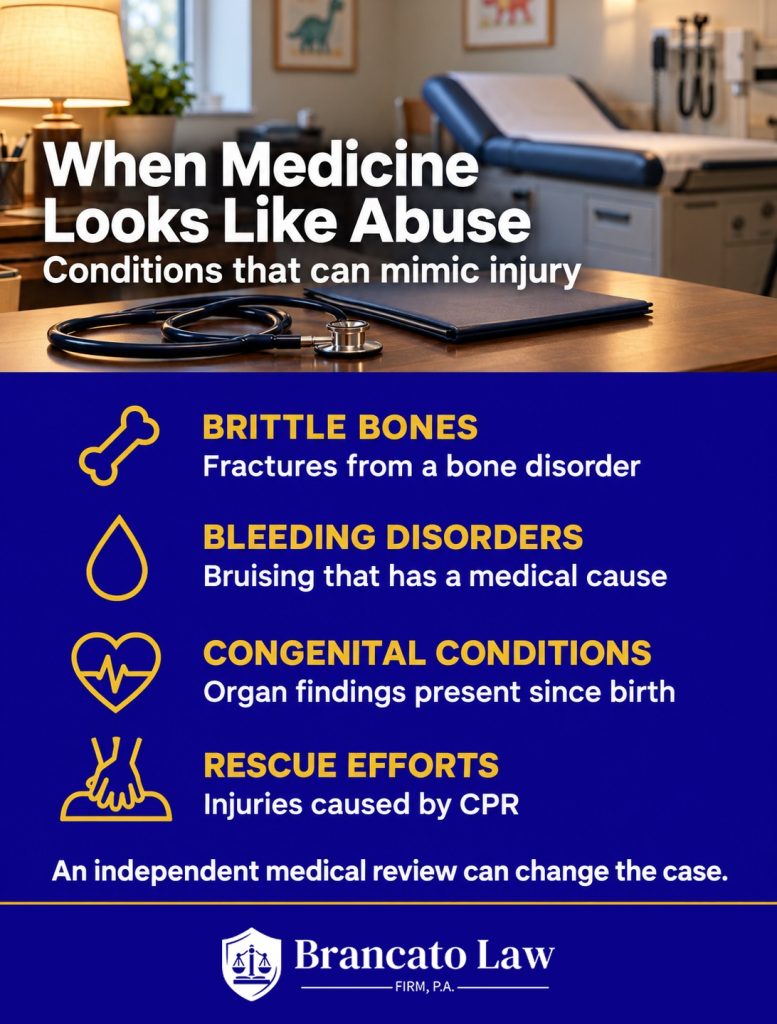
Many medical conditions can look like abuse to an emergency room doctor who does not know the child’s history:
The science behind some abuse diagnoses is also contested. A 2012 article in the Houston Journal of Health Law & Policy by Keith Findley, Patrick Barnes, David Moran, and Waney Squier, Shaken Baby Syndrome, Abusive Head Trauma, and Actual Innocence: Getting It Right, argues that the classic “triad” of internal findings cannot reliably prove abuse or pinpoint when an injury happened. Major pediatric organizations still accept abusive head trauma as a diagnosis, so the question is case-specific. That is why our firm retains independent forensic pathologists and pediatric specialists to review the records, the imaging, and the timeline before we decide how to defend the case. Our forensic science defense page describes how we work with experts.
A child’s out-of-court statement about abuse can be admitted at trial only after the judge holds a hearing and finds it reliable. Florida’s child hearsay rule, § 90.803(23), requires the court to find that the time, content, and circumstances of the statement provide sufficient safeguards of reliability, to make specific findings on the record, and to give the defense notice at least 10 days before trial. If the child does not testify, the State also needs other corroborating evidence.
In State v. Townsend, 635 So. 2d 949 (Fla. 1994), the Florida Supreme Court said a boilerplate reliability finding is reversible error and listed the factors a judge must weigh, including whether adults prompted the statement, the child’s motive to fabricate, and improper influence during a family dispute. Research supports that caution: a widely cited review by Stephen Ceci and Maggie Bruck in Psychological Bulletin, Suggestibility of the Child Witness: A Historical Review and Synthesis (1993), found that young children can be led by repeated or suggestive questioning. Our attorneys obtain the recorded forensic interview, study how the questions were asked, and challenge unreliable statements before a jury hears them. See our articles on forensic interviews in Tampa child abuse cases and child hearsay in Tampa cases.
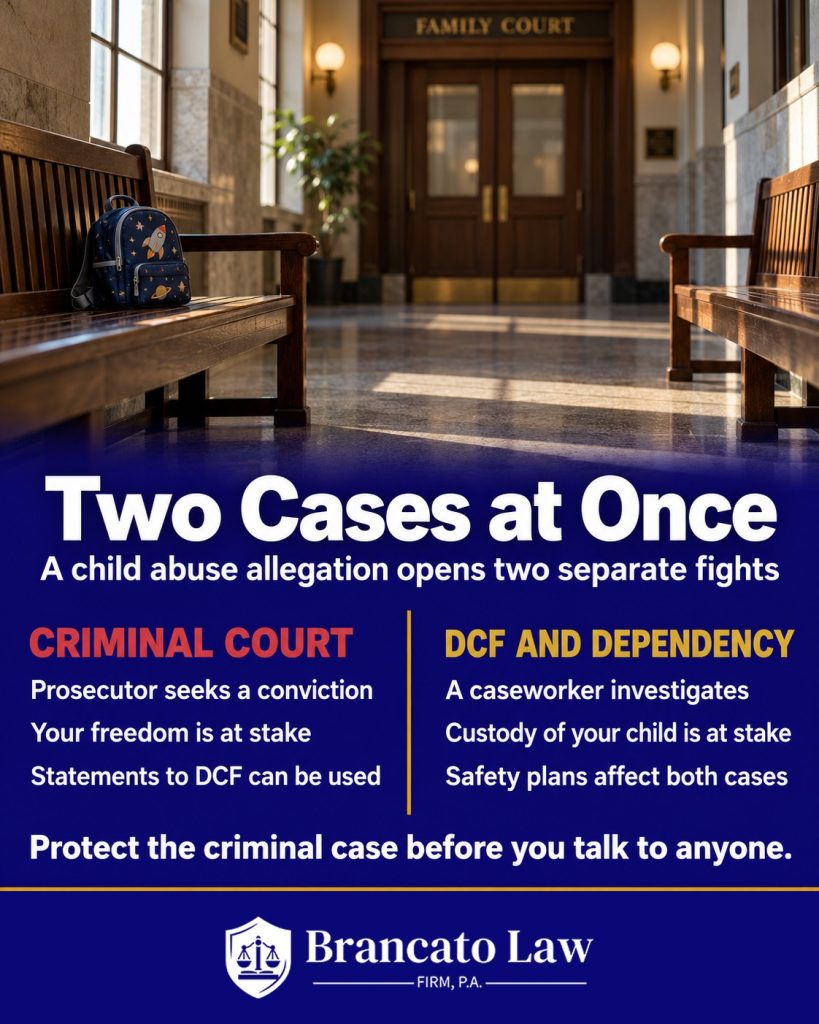
A child abuse allegation in Florida usually starts two cases at once: a criminal case and a DCF child protective investigation that can lead to dependency court. In Hillsborough County, DCF has run child protective investigations directly since July 14, 2023, when the Hillsborough County Sheriff’s Office transferred that work to the Department of Children and Families. The DCF investigator, the Child Protection Team, and the detective share information.
Many reports do not hold up. In its report to the Legislature for fiscal year 2019-2020, DCF closed 9,663 of 19,282 child abuse reports in the Thirteenth Circuit (Hillsborough County) with “no indicators,” meaning it found no credible evidence for any allegation, according to the DCF Annual Report on False Reporting. A closed DCF case does not end a criminal case, but the same facts often matter in both.
Privileges are also different in these cases. Under § 39.204, the spousal privilege and the privilege between a professional and a patient or client, such as a doctor or therapist, do not apply to communications involving the alleged perpetrator in a child abuse case. The attorney-client privilege and the clergy privilege still apply. Our firm handles the criminal case and coordinates with your dependency lawyer so that a DCF safety plan, interview, or court filing does not create evidence for the prosecution. Read more about which conversations stay privileged in Florida child abuse cases.
Yes, sometimes. Many child abuse cases are investigated for weeks before the State Attorney’s Office decides whether to file charges, and that window is the best time to act. Through pre-file advocacy, our attorneys contact the detective, keep the client out of a police interview, gather medical records and witness information, and present the defense side to the prosecutor before a charging decision is made. If you think you are being investigated, our guide to signs you are being investigated for a crime in Florida explains what to watch for.
The plea offer matters because a child abuse plea can never be sealed or expunged in Florida. Under § 943.0584(2)(y), child abuse and aggravated child abuse are listed offenses that make a record ineligible for sealing or expungement, and a guilty or no contest plea counts even when the judge withholds adjudication. That is why our attorneys look closely at which offense a plea is to, not only at the sentence. Our guide on how to decide whether to accept a plea bargain in Florida walks through the rest of that decision.
These are results our firm has obtained in child abuse cases. Every case is different, and past results do not guarantee future outcomes.
See more on our case results page.
Act before you talk to anyone about the allegation. The first days usually decide what evidence exists and what you have already said.
Yes. Prosecutors drop or reduce child abuse charges when the medical evidence has another explanation, the child’s statements are unreliable, or the facts do not meet the statute’s intent requirement. The Brancato Law Firm has had aggravated child abuse charges dismissed after an independent forensic pathologist found a medical cause for the injury; see our case results.
No. Section 827.03 has no mandatory minimum, but aggravated child abuse is a Level 9 offense, so the scoresheet usually calls for prison of about four years or more unless the judge grants a downward departure. Our attorneys at The Brancato Law Firm build departure and mitigation arguments with records and expert reports, not just a request for mercy.
You can decline to discuss the allegation without a lawyer, but how you respond to DCF can affect custody, so get advice before you decide. The Brancato Law Firm advises clients on the criminal risk of every DCF interview and safety plan and coordinates with their dependency lawyer.
No. Under § 943.0584(2)(y), a guilty or no contest plea to child abuse or aggravated child abuse makes the record permanently ineligible for sealing or expungement, even with a withhold of adjudication. That is why The Brancato Law Firm weighs which offense a plea is to as carefully as the sentence.
Yes. The defense can question the doctor’s qualifications under § 827.03(3), the completeness of the medical history, and whether another condition explains the findings. The Brancato Law Firm retains independent pediatric and forensic experts to review the imaging and records; our article on Child Protection Team testimony explains how.
Child abuse is an intentional act that injures a child or could reasonably be expected to, while neglect is a caregiver’s failure to provide essential care or supervision. The Brancato Law Firm often argues that an accident or a lapse in supervision does not meet either definition.
Yes. Many child abuse cases are investigated for weeks before charges are filed, and an arrest can come by warrant later. Our attorneys at The Brancato Law Firm offer representation before charges are filed so the prosecutor hears the defense side before deciding.
The medical records, the forensic interview, and the DCF file are being created right now, and the sooner our attorneys see them, the more we can do. Call The Brancato Law Firm, P.A., founded by Tampa Criminal Defense Attorney Rocky Brancato, at (813) 727-7159 for a confidential consultation before you speak with investigators. Our attorneys also defend related sex crime and domestic violence charges, and our Hillsborough County criminal defense page explains how cases move through the Thirteenth Judicial Circuit.
The Brancato Law Firm, P.A.
620 E. Twiggs Street, Suite 205, Tampa, FL 33602
(813) 727-7159
Serving Hillsborough, Pinellas, and Pasco Counties

The Brancato Law Firm, P.A. is a Tampa-based criminal defense practice. We are not affiliated with any other Brancato-named law firms.
This page is for informational purposes only and does not constitute legal advice. Each case is unique, and outcomes depend on the individual facts and circumstances involved. Past results do not guarantee future outcomes.

Tampa, FL 33602

Free Legal Consultation (813) 727-7159
